The opioid-related epidemic continues to present major public health and clinical challenges in the United States. From 2022 to 2023, opioid overdose deaths declined by 4%, from 25 deaths per 100,000 people to 24 deaths per 100,000 people. While this decline suggests progress, overdose risk is not evenly distributed across the country. Significant disparities exist across race, geographic location, age, socioeconomic status, education level, treatment availability, and housing stability. These disparities make it difficult for public health professionals, researchers, and policymakers to fully understand where and why overdose risk is highest and what interventions are most effective.
Public Health dashboards are valuable tools that use web-based interactive data visualizations of community-specific health metrics. They help communicate the scale of public health problems, contextualize trends at both national and local levels, guide interventions, and support research and policy decisions. Existing national overdose dashboards are often limited, because they often focus primarily on statewide data, emphasize overdose outcomes without context, or rely on a single data source. This creates a clear need for a more comprehensive and user-friendly platform that integrates multiple datasets and provides deeper insight into overdose disparities and treatment access.
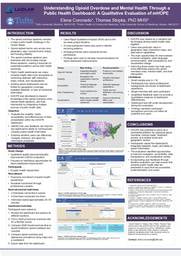
Through Dr. Thomas Stopka’s research, I will contribute to the development and evaluation of an opioid overdose dashboard designed to integrate multiple datasets and highlight geographic disparities in overdose rates at the national, state, and local levels. The dashboard will be hosted as a WordPress-Based website featuring interactive statistics, trend analyses, geographic information systems mapping, and spatial data visualization tools.
My primary role in this project will involve collecting and analyzing qualitative data from beta testing of the dashboard. I will work with potential users to gather feedback on usability, clarity, accessibility, and effectiveness of data presentation. The central research question guiding my work is: how can user-centered qualitative feedback improve the presentation, accessibility, and usefulness of data visualizations and spatial analytics in opioid overdose surveillance tools?
By the end of the six-week research period, I will produce several concrete deliverables. First, I will develop a qualitative feedback report summarizing findings from dashboard beta testing. This report will include thematic analysis of user experiences, identification of usability strengths and gaps, and recommendations for improving data visualization and accessibility.
Second, I will compile and organize qualitative datasets collected through surveys, ensuring proper documentation and ethical data handling.
Third, I will create a set of actionable dashboard improvement recommendations that can guide ongoing development of the platform. These recommendations may include suggested visualization changes, accessibility enhancements, and integration of additional contextual data sources.
Finally, I will present my findings to research team members through a written summary designed to translate research findings into practical public health applications. These deliverables aim to strengthen the effectiveness, usability, and public health impact of the opioid overdose dashboard.
Through my academic training, I have developed skills in analyzing public health literature, synthesizing research findings, and interpreting population health data, which I believe makes me qualified for this project. During this project, I hope to strengthen my research skills, particularly in qualitative data collection and public health data visualization. I am also interested in learning more about how research tools can be designed to better inform real-world public health decision making and community interventions. Additionally, I hope to gain experience and mentorship from working within interdisciplinary research teams that combine epidemiology, community health, and data science.
The broader impact of this project is to improve access to clear, actionable overdose surveillance data for public health professionals, policymakers, and community organizations. By helping refine a dashboard that better communicates overdose trends and disparities, this project aims to support more equitable and evidence-based interventions. Ultimately, I hope this work contributes to improved prevention strategies, expanded treatment access, and reduced overdose mortality in communities disproportionately affected by the opioid crisis.

Hello! I am a junior, Biochemistry student at Tufts University. I am interested in the health sciences, public health, and civic biology.
In my free time, I enjoy learning how to play different instruments, listening to music, reading, coloring, and spending time with friends and family.
I'm very blessed to be on this journey with you all and can't wait to get to know you better!