Project Outline: Colonial Hong Kong's Migrant Workers in its Newspapers

Introduction
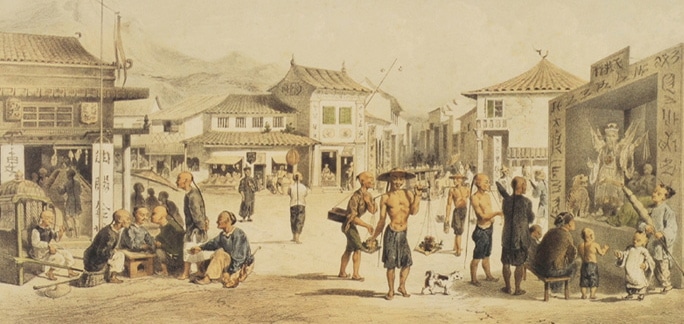
The history of Hong Kong is a history of its migrant workers. From coolies and amahs to construction workers and domestic helpers, migrant workers have driven the development of this global city. The overwhelming majority of Hong Kong’s population is either migrants or descendants of migrants, yet this group has experienced persistent discrimination throughout the city's history. While British colonials expressed their prejudices through racialised discourses, they were later joined by elite members of the Chinese community who discriminated against newer ethnic-Chinese migrants based on class. The intersectional dynamics of intolerance were shifting and relational. Thus, this project asks: how was discriminatory rhetoric against migrant workers constructed? How do changes in this rhetoric over time illuminate Hong Kong’s shifting social demographics and political landscapes, and what can its continuities tell us about the universal dangers of othering?
Research
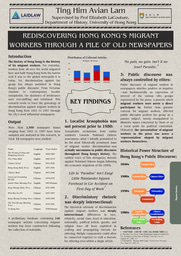
My research investigates the representation of migrant workers in colonial Hong Kong newspapers in three critical historical moments: the first major influx of Chinese migrants in the 1850-60s, the Refugee Wave of the 1950-60s, and the economic migration of the 1980-90s. I will track popular responses to the major migration waves in Hong Kong History through the city’s English and Chinese-language newspapers, notably China Mail (1860s-1960s), South China Morning Post (1900s-Present), Chinese Mail (1870s-1940s), and Wah Kiu Yat Po (1920s-1990s). Thus, my research posits that there were three periods of local power consolidation that overlapped with migratory waves: colonial antagonism (1840s-1900s); alignment of local elites and colonials (1900s-1960s); and local middle-class exclusionism (1960s-).
Goals
This research addresses a critical gap in historiography, as the socio-rhetorical construction of the “migrant worker" as a problematic “other” in Hong Kong remains a vastly understudied topic. Supervised by a gender historian, I will employ an intersectional and interdisciplinary lens to examine how class, race, and gender intersected within colonial power structures to create power while marginalising others. Ultimately, by tracing the genealogy of this rhetoric through influential popular media, I aim to illuminate the deep-rooted issue of anti-migrant discrimination in Hong Kong.
Output
The intended outcomes of my project are a research paper, a preliminary database of historical newspaper articles concerning anti-migrant discrimination, and a public presentation. The findings will be disseminated to local organisations addressing anti-migrant discrimination and migrant welfare.
Hi! This is Avian, a second-year student of History at the University of Hong Kong. My research centres around identity and sense of belonging in urban colonial societies, specifically the arbitrary distinction between the “Colonials” and the “Governed,” and those that laid somewhere in between. Outside of the archive, I am a diligent in-class Tetris gamer, amateur banjolele player, and most importantly, a lifelong book hoarder. Please feel the most welcome to reach out anytime!