Personal reflections: Uneasy lies the head that wears the crown?
In our culture, especially within Cambridge, “ambition” is often understood to be the ability to create something big. Our ideal ambitious leader is fearless and individual. While these traits alone are not harmful, our unquestioning valorisation of such attributes has led to an idea that ambitious people should trade their peace of mind to achieve success. I believe that this is a myth, and using examples from my own leadership journey with the Laidlaw Foundation will dispel the idea that ambition is realised only through suffering: highlighting the ways in which working with the community and colleagues to achieve something together can be a journey of self-fulfillment, rather than a due we must pay because we are “ambitious”.
The quotation that inspired the title of this essay, “uneasy lies the head that wears the crown” is a line from Shakespeare’s Henry IV that I have come back to during my leadership journey. The phrase is uttered during a period of insomnia as Henry struggles to adjust to his new position at the top of the food chain, following his defeat of Richard III. The quotation hints at the isolation and paranoia that is central to the life of a medieval king: his experience of high-level leadership is punctuated by a constant theme of fear. This quotation is an addition to the pantheon of warnings against “vaulting ambition”: joining the ranks of Icarus, MacBeth and Frankenstein. However, I believe that ambition itself is not the issue, but that the wrong motivation for ambition is damaging. When we pursue ambition for ambition’s sake, like becoming King of England for the sake of power or flying too close to the sun to show off, we become miserable, not purposeful.
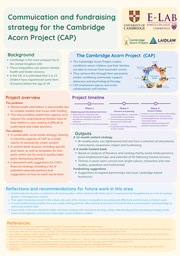
The desire to do the “most ambitious” project is one that plagued me early in the programme and prevented me from seeing the value I have generated within the Cambridge Acorn Project. I chose to work with CAP precisely because that it was a small, highly specialised charity, serving an underserved demographic in Cambridgeshire. However, as I began to hear the stories of other scholars working in more “technical” placements working with biotechnology and finance, I began to feel the familiar sting of inadequacy permeating the way I talked about my project. I felt within myself a sense of panic, and fear that I was not truly “making the most of” the Laidlaw programme.
I chose to apply to Laidlaw when I was reflecting on my place in society as a student at an elite university, and so returned to my own values and purpose, to discern what really making the most of the Laidlaw programme meant to me. Revisiting old journals I saw themes of community, practicality and extending my worldview had prompted me to apply; my ambition was to extend my knowledge while serving my community.
I also considered how my discipline – psychology – pathologises the disenfranchised. Combining my values of social innovation and ethical approaches to research and leadership, I was inspired to apply to the Laidlaw programme, to become a leader who ensures psychology now helps disenfranchised people. Reviewing my project in the
context of these goals: building soft skills and a relationship to the broader Cambridge community outside of the “Cambridge bubble”, I was reminded of why I chose to work with CAP in the first place- my values. Following this breakthrough, I returned to my leadership in action work with a renewed vigour, more clearly understanding that my purpose in this placement was to create an accessible, open and communicative brand for the Cambridge Acorn Project.
Choosing a small charity like CAP turned out to be more mutually beneficial than working in a larger organisation might be. The small, specialised scale meant that my growth and understanding throughout the project was focused on a niche subject area. This afforded me a depth of understanding and appreciation for the work CAP does working children and families that I will bring into further work in the fields of psychology and mental health. Additionally, the impact I made was much greater for the Cambridge Acorn Project, as the smaller team meant that my work as an individual was more powerful in accelerating the goals of a project than it might have been in a larger, slower-moving organisation.
Returning to the ambitious characters considered in my introduction, I see a common theme of alienation caused by self-serving ambition. King Henry lay alone and afraid; Dr Frankenstein abandoned his creation, alienated from his curiosity and fearful of that which is “different”; and Icarus abandoned his father, soaring away from him, rather than prioritising the future they could both have pursued. If I had pursused this sort of ambition, warping my goals at the CAP to look more “impressive”, I could have entered down a similar path (although not quite on the level of Shakespearean dramatics). By choosing to define ambition on my own terms, with values as the guiding factor, I ended up with a much more meaningful project.
The other key guiding principle lost by those in which ambition has “gone wrong” is isolation from others. Building community is often neglected when considering ambition, but learning to build community has been one of the most fulfilling elements of my Laidlaw journey. Without the opportunity to spend time with my fellow Laidlaw scholars, the Leadership in Action journey could have been isolating, and certainly less fulfilling, and I am so proud of the tight knit community that I have helped to build in my cohort.
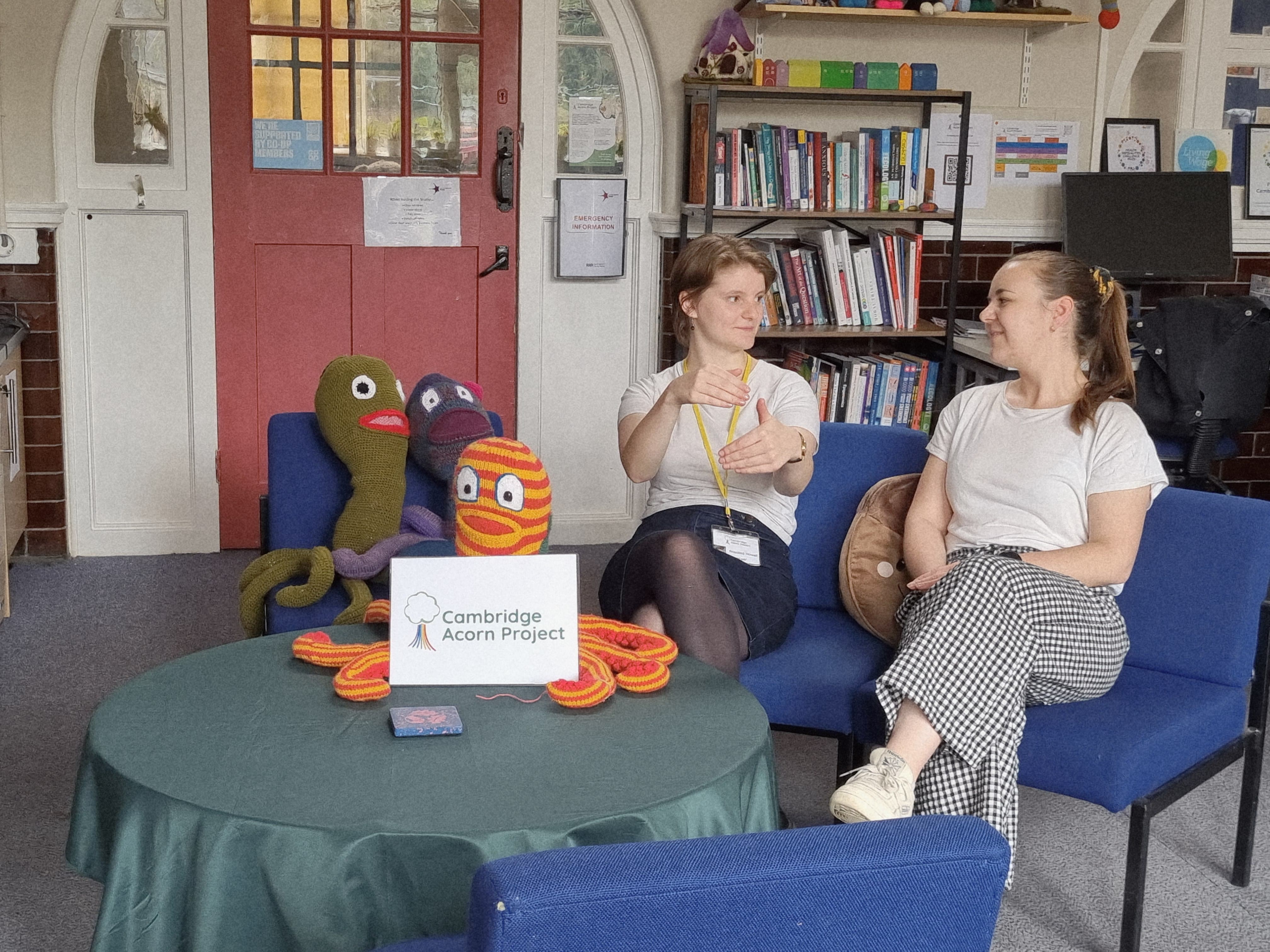
Furthermore, community is not just a “nice to have” to inspire leaders and keep us going, but also necessary to creating the outcomes we want to see in the world. By far the most profound experience I had with CAP was attending a community drop-in session while shadowing one of the therapists. Sitting cross-legged on a plastic chair in a small community library, I felt as though I had made it, I finally felt like I could be an impactful psychologist one day. Sitting with real people, surrounded by young adult fiction novels and cookbooks, I finally saw the impact my communication role was
having. By meeting the community, I could now accurately orient my output on the CAP social media towards the Cambridgeshire residents I was speaking to.
I will never subscribe to the myth that ambition necessitates suffering. It does demand dedication, but the resulting hard work need not lead to isolation and alienation from other people, or the values that inspired the leader’s ambition in the first place. Good leaders can inspire good results; however, a great leader works with their community achieving excellent results for all. Working in this way ensures that ambition leads people in the correct direction, towards an ambition which works for their good, leading them away from isolation and ego-centric celebration of value-less achievement. By reminding myself why I undertook my project, and why my work is important to the Cambridge community, I learned what good ambition can achieve. The Laidlaw Foundation has enabled me to be ambitious for what I expect from myself and the outcomes I can expect in this project, specifically effecting change in the mental health field.

My name is Rosalind and I'm a first year student in psychology at the University of Cambridge. I am particularly interested in the interection between physical and mental health and how psychological and neurological processes can impact somatic functions. Another major interest of mine is the maintenance of mental health recovery, and how post-acute care in communities and systems can support the longevity of recovery and prevent relapse.