Oxford Research Summer Week 5

Reflecting on the fifth week of my research summer at the SDG Impact Lab at the University of Oxford.
Like

Share this post

Choose a social network to share with, or copy the URL to share elsewhere

This is a representation of how your post may appear on social media. The actual post will vary between social networks

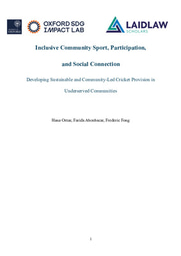
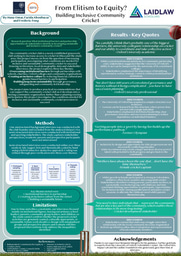
This week, we began to analyse our findings to draft a report. It was satisfying to draw links between different interviews, illustrating common threads that are pervasive throughout community sport in Oxfordshire. It was interesting to note the varying career and life experiences of our interview subjects, with different perspectives about issues in access to community sport, yet they still came to similar conclusions about solutions to those issues. This has taught me that it is not necessarily the past experiences in a leader's life that shape their leadership, but instead how they reflect on the past to build into the future. Moreover, it was powerful to note the importance of building a network to fix injustices - showing that whilst we may not have the keys to injustice ourselves, bringing people together will help create an equitable cricket club. 

As we move into the final week of this Laidlaw summer, it will be important to maintain a supportive, collaborative group dynamic whilst under pressure. This draws on the OCP session earlier in the summer, where we saw rather spectacular bursts of outrage depicted in a video clip of a successful CEO. From this, I learnt that although he was corporately successful, the way he alienated a particular member of his own team means that the ends did not necessarily justify the means. I thank our supervisor for helping us maintain this constructive dialogue and collaborative no-blame culture as we approach this deadline.

Please sign in

If you are a registered user on Laidlaw Scholars Network, please sign in

Go to the profile of Benjamin Margetts
20 days ago

Frederic, this is a concise but insightful reflection. It is encouraging that the interviews are beginning to speak to one another through recurring themes, while still retaining the different career and life experiences of each participant. Identifying both convergence and variation is an important part of qualitative analysis.

I would slightly qualify your conclusion about past experience and leadership. Our histories do shape the resources, assumptions and sensitivities we bring to leadership, but they do not necessarily determine how we will lead. As you suggest, reflection provides an important mediating process: people with different experiences may reach similar conclusions, while people who undergo similar events may interpret them very differently. The leadership significance lies partly in how experience is examined, reconstructed and translated into future action.

As you analyse the apparent agreement among participants, also look carefully for differences, qualifications and negative cases. Convergence may indicate a genuinely shared understanding of the structural problems facing community sport, but it could also reflect similarities within the people interviewed or the networks through which participants were recruited. Asking what remains contested, and whose perspective may be absent, will strengthen the report.

Your point about networks and justice is also important. Leaders rarely possess the authority or resources to dismantle every barrier themselves; bringing together people with complementary knowledge, influence and experience can expand what becomes possible. However, networks are not automatically equitable. Their value will depend upon who is invited, who has influence within them and whether people most affected by exclusion have a meaningful role in shaping the cricket club.

Finally, your attention to the team’s culture during the final week is well judged. Pressure can make blame, frustration and unilateral decision-making more likely. Maintaining constructive dialogue does not mean avoiding accountability or disagreement; it means addressing problems without diminishing the people involved.

An excellent reflection. The final week offers an opportunity to practise precisely the form of leadership your findings describe: learning from experience, connecting people and sustaining collaboration while working towards a shared purpose.