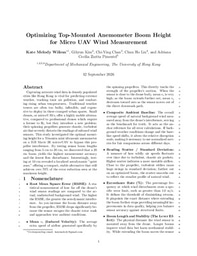
Optimizing an Under-Mounted ("Down-Heavy") Wind Sensor on a Consumer Drone
I am excited to share my first update as a Laidlaw Undergraduate Research Scholar. My research focuses on optimizing autonomous meteorological data collection by solving a key engineering and aerodynamic challenge: integrating precision wind sensors directly onto consumer-grade multirotor platforms.
🚀 Research Topic & Core Problem
My project involves evaluating the physical and aerodynamic integration of a TriSonica Mini 3D ultrasonic wind sensor onto a DJI Mavic 3E quadcopter.
Traditional designs frequently mount these wind sensors above the drone body, which unfortunately makes the aircraft top-heavy, reduces flight stability, and subjects the sensor to significant rotor-induced airflow distortion. To resolve this, my project flips the paradigm entirely by engineering an under-mounted ("down-heavy") configuration.
🎯 Project Objectives
The main objective is to design, manufacture, and experimentally validate a lightweight, custom physical mount and aerodynamic enclosure that balances structural safety with data accuracy. Key milestones include:
-
CAD Engineering & Safety Analysis: Utilizing 3D software to evaluate structural weight distributions, calculate shifts in the Center of Gravity (COG), and ensure the design leaves the drone’s critical bottom obstacle-avoidance sensors completely unblocked.
-
Aerodynamic & Enclosure Design: Fabricating a rigid, downward extension pole using lightweight carbon fiber rods and redesigning the protective housing box for our custom in-house ESP-32 datalogger to make it sleek, low-drag, and aerodynamically optimized.
-
Optimizing Extension Length: Finding the exact "sweet spot" length for the extension pole. The goal is to minimize propeller wash disturbance ($\epsilon$) by targeting the low-velocity "quiet zone" beneath the central fuselage , while avoiding the chaotic vortex further down where individual propeller streams violently collide.
📊 Anticipated Outcomes
Through rigorous ground testing and a systematic height evaluation protocol , I aim to mathematically map out how rotor disturbance behaves as a function of the sensor's distance from the drone belly. Ultimately, this design will allow us to bypass complex, non-linear software correction algorithms in favor of a reliable, structurally isolated measurement system—maximizing data precision without sacrificing the drone's short 15-minute operational battery window.
In the later stages of our project, we plan to validate our collected drone data against stationary LiDAR reference systems using comprehensive Taylor diagram cross-validations.
💬 I would love to hear your insights! If any scholars on the network have experience working with UAV-based atmospheric sensing, micro-datalogger enclosures, or multirotor downwash dynamics, please drop your thoughts, advice, or questions in the comments below!
#LaidlawScholars #UAV #Aerodynamics #DroneTechnology #UndergraduateResearch #AtmosphericScience

Hi! I love making new friends and creating things! My favourite things to create are stories -- through composing my own music, drawing or writing -- and organizations! Currently making a women in STEM society in my university and it's been a lot of fun :D Hit me up if we have any hobbies in common :) Still trying to figure out what I want to do in life