Mirror Mirror on the Wall - Week 4 Reflection
Mirror Mirror on the Wall - Week 4 Reflection
Supervised by: Kareem Khubchandani
Department of Theatre, Dance, and Performance Studies and Studies in Race, Colonialism, and Diaspora, Tufts University
Studies of Women, Gender, and Sexuality, Harvard University
"The drag queen looks in the mirror of the audience and sees his female image reflected back approvingly. It is through the process of group support and approval that the drag queen creates himself. The transformation culminates in the female impersonator's first job, …" — Ester Newton, Mother Camp: Female Impersonators in America, p.37
Esther Newton, in her ethnography Mother Camp: Female Impersonators in America, writes about the mirror. She describes the audience as the source of validation for a drag queen's transformation. This week, however, I found myself thinking about a different mirror: the one backstage.
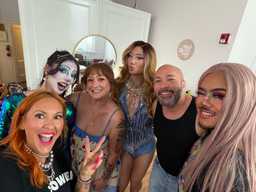
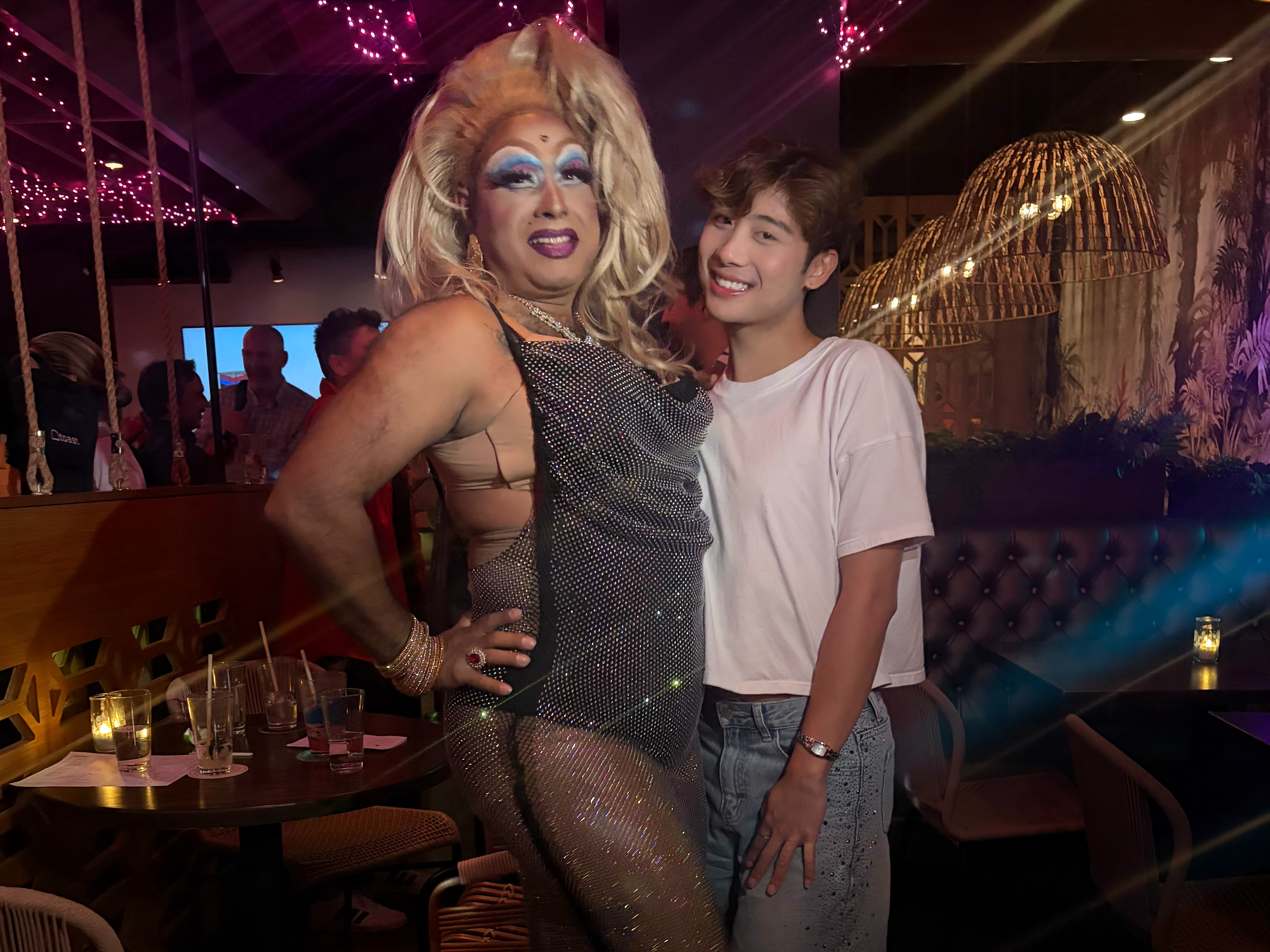
Before LaWhore Vagistan (Kareem Khubchandani) performed at Shore Leave Boston's DESI Pride event, I helped her get ready. I fastened rhinestone necklaces, zipped impossibly tight gowns, carried costumes between performances, and lifted her heavy wig so I could secure jewelry underneath. Throughout the process, we were both looking into the mirror.
It struck me that transformation begins long before a performer reaches the stage. The audience only witnesses the finished product—and even then, performance remains fluid and ever-changing. They do not see the frantic costume changes, the bags scattered across the floor, the uncertainty of whether a zipper will cooperate, or the backstage teamwork that makes drag possible. At one point, I hesitated while zipping one of LaWhore's gowns because I was afraid I would break it. She laughed and told me that hesitation was the problem. You have to trust the zipper.
Later that evening, she asked me to stand just behind her during one of her reveals. As she performed, I waited out of sight until it was time to unzip her gown and reveal the next costume beneath it. For a brief moment, I became part of the illusion. The audience never noticed me, or they weren’t supposed to. My role was invisible, but it was essential.
That interaction stayed with me throughout the rest of the week. Drag is rarely created alone. It is stitched together through community, trust, labor, and countless acts of care (under pressure) that audiences rarely witness. Looking into the mirror while helping LaWhore prepare, I also caught my own reflection. I felt an unexpected excitement, realizing that the worlds I had spent weeks reading about and studying were no longer abstract. They were tangible. I could feel the weight of the wig in my hands, hear the zipper sliding into place, and witness the nervous anticipation that exists in the moments before someone steps into the spotlight.
For weeks, I have written and observed how drag is about community, performance, and political practice. This week, I experienced it through participation. Standing behind LaWhore in the mirror, I caught a glimpse of something I had not anticipated: not only her transformation, but my own. I am learning that ethnography is not simply about observing another world or participating in the "other." It requires allowing yourself to become responsible, no matter how modest,, for helping that world come into being.
Participation, I realized, requires trust. Trust that people will welcome you into these spaces. Trust that you belong backstage as much as you belong in the audience. Trust that research can move beyond detached observation and become relational.
Apart from LaWhore's fabulously adorned apartment, the backstage area at the bar was surprisingly not the most accommodating. Rather than a glamorous dressing room, performers changed in a cramped office space cluttered with supplies and drinks, without even a proper mirror. When I asked whether this was unusual, LaWhore explained that many venues—particularly those that are not explicitly queer spaces—often provide inadequate facilities for drag artists. Audiences see polished performances, but rarely the labor or material conditions that make those performances possible. The work of drag extends far beyond the stage; it includes preparation, coordination, adaptation, and care.
Questions of visibility surfaced again throughout the evening. Burhan, from Intersectional Innovation, spoke about the nonprofit industrial complex and challenged organizations that advocate for marginalized communities while excluding those same communities from positions of leadership. He encouraged us to practice activism that is led by, rather than merely performed for, marginalized communities. His remarks immediately reminded me of Verna Felton. One of the organization's greatest strengths is that drag performers themselves shape its programming, leadership, and mission. The people making decisions are often the very people the organization seeks to support.
LaWhore's performances embodied a similar philosophy. Through medleys that combined Pakistani music classics with songs like Katy Perry's "Firework," she refused the idea that cultural identities must remain separate. Instead, she performed both identities simultaneously, demonstrating how drag can become a space where multiple cultures coexist rather than compete.
After the show, I spoke with a South Asian lesbian couple and one of their sisters, who told me this was their first drag performance. They had attended specifically because the event centered on South Asian performers. For them, seeing drag through a South Asian lens transformed what drag could mean. Representation was an invitation into a community they had not previously experienced.
The following evening, at Spotlight: The Electric Chapel, I found myself asking a different question: Who is watching drag?
The performers represented remarkable diversity. Ladda Nurv, a Thai and Lao drag queen, Buckthorne, a transgender drag king, Sativa, a Black performer, and Sapphire Bills, a Puerto Rican drag artist, all shared the stage. Interestingly, Ladda's introduction referenced Candace Persuasian, suggesting that Asian drag performers throughout the Boston area maintain close relationships. It made me wonder whether the relatively small number of Asian drag artists in New England has fostered particularly strong networks of mutual support.
Yet when I looked into the audience, I also noticed something peculiar. I realized I was the only Asian person I could identify in the crowd.
That observation immediately reminded me of Geisha of a Different Kind and its discussion of the stigma surrounding drag within many Asian communities. If Asian performers are becoming increasingly visible on stage, why do I encounter comparatively fewer Asian audience members? Is it a matter of access, cultural expectations, lingering stigma, or something else entirely? Like much of ethnographic research, each answer seems to generate another question.
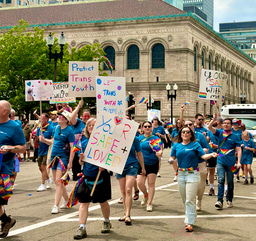
Attending New York City Pride two days later further complicated my understanding of queer visibility. The streets overflowed with people expressing themselves through clothing, flags, and celebration, yet the parade itself felt dominated by corporate sponsors. Compared with Boston Pride, New York appeared significantly larger and more commercialized. Boston felt somewhat more grounded in local organizations and interpersonal community, while New York emphasized scale, spectacle, and brand visibility.
Neither experience was inherently better than the other. Instead, they demonstrated that Pride functions differently depending on place. Community, commerce, activism, and celebration exist in different capacities across cities. Visibility itself is not a singular experience.
Reflecting on this week, I keep returning to the “mirror”. Initially, I understood it as the audience reflecting a drag queen's identity back to them. Now, I think the mirror is much larger than that. It includes the friends helping backstage, the organizations creating opportunities for marginalized communities to lead, the first-time audience members seeing themselves represented on stage, and researchers who slowly move from observing to participating. As my literature review continues to deepen, I am beginning to see that ethnography is not only about documenting communities, it is also about understanding the relationships, care, and reciprocity that sustain them.
When I caught my own reflection while helping LaWhore prepare, I felt something unexpected. Standing in front of that mirror, holding a wig in one hand and fastening a necklace with the other, I realized our queer communities are built through countless acts of care, trust, and collaboration. My research has slowly shifted from documenting performances to witnessing, participating in, and understanding the labor that makes those performances possible.
This week taught me that mirrors do more than reflect who we are. They reveal the people whose care makes transformation possible.