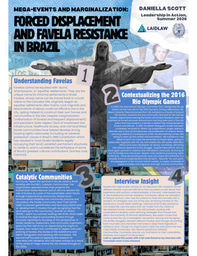
Mega-Events and Marginalization: Forced Displacement and Favela Resistance in Brazil (June 8-12)
Olá from Rio de Janeiro, Brazil!
This summer, I have received the amazing opportunity to work in one of the world’s most beautiful cities, Rio de Janeiro! I will spend the next 8 weeks with an organization called Catalytic Communities (CatComm), a non-profit founded by Dr. Theresa Williamson in 2000 aiming to change the popular stigma around favelas (and informal settlements, more broadly), support favela organizing, and support policy solutions for urban planning policies. Catalytic Communities has three main projects: the Sustainable Favela Network (which aims to solidify the role of favelas as a part of the sustainable urban future through implementing community-based socio-environmental initiatives into community practice and city policy), the Favela Community Land Trust (which seeks to prevent gentrification and land speculation and re-development in favelas through recognizing that the land belongs to the community), and Rio on Watch (often abbreviated to ROW). I will be primarily working with ROW, which was created during construction leading up to the 2016 Rio Olympics. As the city and state government advocated for the removal of favelas (in particular, Vila Autódromo) to make way for new infrastructure for the Games (parking lots, the Olympic Village, new housing, etc.), they completely disregarded both the demands of the community and pre-existing housing/tenant laws to demolish these favelas, reflecting long-standing systemic and structural desires to further segregate Rio’s lower class from Rio’s elite. ROW was a key vessel for favela voices, presenting an alternative narrative that challenged popular local and international ideas that favelas were simply stubborn communities preventing the city from successfully hosting the Olympic Games.
Now 10 years have passed since the Olympics, and ideas about the favelas have not changed much. Even in my History of Rio de Janeiro class at Georgetown, many people still associated favelas with police raids, drug trafficking, and other unsavory connotations (excluding the credit given for funk music and “fun parties”). The mischaracterization of favelas as “slums” or “shanty towns” or "Brazilian projects”, the stamp of disapproval they have been given by my own Brazilian relatives (“Stay in the South Zone and do not walk up any steep hills!”), and my own adoration for the city of Rio have all filled me with intense intrigue when it comes to favelas. Are they really all the world describes them to be?
Despite my aforementioned class on the history of the city already having answered the question for me (no), I was excited to investigate this with CatComm. My Rio professor was friends with Theresa, having met around the same time as the Rio Olympics. After some audio exchanges on WhatsApp with Theresa, I learned about how dedicated CatComm has been over the last quarter of a century in fighting these prejudices and supporting the community. She noted that as it has been ten years since the Games, a series of interview-based articles with favela residents who had been evicted would be a perfect project for me to undertake during my time with ROW this summer, and I enthusiastically agreed. I had long been fascinated by the corruption and power that existed in major international organizations like FIFA and the International Olympic Committee (IOC), but was still working on discovering the extent. I knew much more about FIFA than the IOC, with Declan Mckenna’s song “Brazil” acting as the basis to my knowledge about what Rio’s favelas experienced leading up to the Olympics (“I’m gonna burn your house down to spread peace and love”). I was eager to expand my understanding beyond this catchy and extremely metaphoric music and discover the true role and impact that mega-events have on communities like favelas, who have long been victims of political neglect and discrimination.
I arrived in Brazil last Sunday and the next day attended my first meeting with CatComm at Theresa’s house where me and two other new interns (also Laidlaw scholars!) were warmly received. The day began with ice breakers, continued with presentations from staff about various conferences they went to focused on sustainable development in informal settlements, and ended with team breakouts. I was assigned to sift through ROW articles from the last 15 years to find potential people to talk to based on previous interviews. Theresa sent me a few articles herself and highlighted the favela called Metrô-Mangueira (sometimes referred to as “Favela Metrô), which had been largely demolished between 2010 and 2015 for the World Cup and Olympics, but now is abandoned. She explained that the organization has not maintained close connections with Favela Metrô’s residents, and wants to try and identify some individuals to produce an update.
Unlike Favela Metrô, ROW maintains strong connections with former residents of Vila Autódromo, which went from 700 families to 20 families in the 2010s to make way for the Olympic Park. At the end of this week, I worked on creating a timeline for Vila Autódromo’s history, which perfectly encapsulates how greed and prejudice towards favelas is consistently favored over public investment, political consideration, and support into these settlements. Vila Autódromo was a quiet, peaceful community and considered a relatively small favela. As the Mayor declared that the favela would be removed for the Olympics (despite this not being incorporated into the plans sent to the IOC during the bidding process), residents began resistance efforts. They refused to leave, protested, collaborated with public defenders to assert their claim as legal dwellers of the land, worked with university partners to create a plan for negotiations (the “Popular Plan”), and pushed for all negotiations to occur between the community and the city, not just the city and individuals. In response, the state governor temporarily dismantled the public defenders office that was assisting them in their legal battle, consistently disregarded the Popular Plan, and took advantage of rifts between long-time residents and newcomers to prove that community members were in favor of the mayor’s plan for new housing developments. He used intimidation in his individual negotiations, leading many to flee to prevent homelessness or take advantage of the economic opportunity he was offering (multiple apartments and millions of dollars in some cases). Eventually, one way or another, residents were evicted or opted to leave Vila Autónomo, with demolition trucks rushing to destroy their houses thereafter. This also occurred with the support of newly issued decrees, which allowed for the removal of houses. The decrees expired with 20 houses left, which remain today. The remaining residents and the mayor reached the first collective relocation agreement in favela history allowing the parts of the community besides the 20 houses to be paved over, turning into parking lots or utterly useless parts of land.
That was a very condensed version of the history of Vila Autódromo, with a more detailed version linked here: https://rioonwatch.org/?p=45633. Within my first week, I am already understanding how the narratives surrounding favelas are supported by locals, the government, and the international community serve to advance social stratification (both racial and in class, which I unfortunately did not have time to get to today!). Next week as I begin deeper research into Favela Metrô, I hope to share more details about community resistance and the root causes of the prejudice towards favelas and informal settlements I alluded to before. Até a semana que vem, tchau!