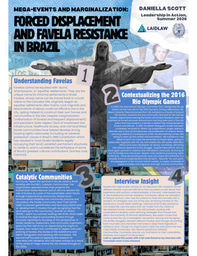
Mega-Events and Marginalization: Forced Displacement and Favela Resistance in Brazil (June 29-July 3)
Boa tarde, gente!
I have just completed my fourth week with Catalytic Communities and in Rio and can say with confidence that this truly is the Marvelous City. Evidence of this: the sounds from Copacabana beach causing the floor to reverberate four blocks to my apartment after Brazil scored the winning goal against Japan, the Botanical Gardens, rich history (as we have learned together), friendly people, and 80 degree weather during their winter. Absolute perfection.
We still have yet to find individuals to interview (fear not! I still have four more weeks), so this week was relatively slow in terms of my work load. I generally tried to just listen to podcasts, watch news clips, and read articles that focus on the overall impacts of the Olympic games, but discovered that such coverage is scarce. Anyways, the general theme is that a lot of the building or promised infrastructure projects fell flat or were not completed at all, largely serving the wealthier areas of the city and worsening living conditions for lower-income areas (not that surprising given the information in the previous three posts). With all this being said, this post will differ from previous posts sharing my week’s research and instead serve as a mid-LIA summer reflection.
First, in terms of leadership I will say that this first month has been almost entirely independent. CatComm does not have an office and with so many moving parts, almost everyone is busy. So, it was up to me to decide how to spend my time. I have always been good at creating schedules for myself and executing them, but that never prepared me for being in such an amazing city with the smell of the ocean hitting my nose the second I step out of my apartment; I can confidently say this is the most disciplined I have ever had to be in my life! Each week, I broke down this complex subject into digestible parts, allowing me to better grasp these issues and create more informed questions for my upcoming interviews. I also made sure to not limit my research to articles, but spent a lot of time learning from my co-workers, specifically one. Born and raised in Rio, she is obviously incredibly knowledgeable about the area and its history. She’s introduced me to so many of her perspectives of the city: climate ableism, the Brazilian conflation of class and race, Brazil’s education struggles, and an enduring adoration for the city that persists despite such struggles. Talking with her and her openness to share with me has made me incredibly excited for engaging in my future interviews, also preparing me with developing the conversational skills and having the background knowledge to make the interviews feel more like a conversation rather than a Q&A. While I have not necessarily led any large leadership projects, I have become much more confident in asking questions, engaging with my curiosities, and staying disciplined with my research, all of which are skills that I think are critical for leaders.
Personally, I have felt very fulfilled since being here. As I (may have) said earlier, a large part of why I chose to come to Rio specifically was to connect with my culture, improve my Portuguese, and become better educated about another country that I literally vote in. I wanted to challenge my own ideas of Brazil’s perfection and Brazil’s weaknesses, developing a complete picture of what this nation is, learning more about myself along the way. So far, I feel like I have done exactly this. I know that in Brazil, democracy tends to exist for the formerly slave-holding society, while marginalized groups must continue to fight to obtain the same rights. Favelas, for example, are a microcosm of this. Built for primarily economic purposes, they have been subject to derogatory rhetoric since their inception that has served to create long-standing narratives that have long dehumanized these communities (again, usually made up of already marginalized groups), justifying government neglect. They have built much of their own infrastructure, suffered from a lack of public investment into necessities (sanitation, clean water, protection from natural disasters). They have suffered extreme surveillance, law enforcement brutality, and extrajudicial killings. They have been ignored by local and national governments. As someone who has worked at a DC non-profit for the last year, constantly navigating solutions to make sure our democracy works the way it is supposed to for all, I have found myself at a complete loss of words when it comes to the case of the favelas. This is exactly why I am so happy to be working with CatComm; It brings me relief, pride, and joy to know that so many others are actively working with these communities to fight back. This is why I am so grateful to have learned about Marielle. Every story I have read these last four weeks has been a story of resilience, a relentless push for a more inclusive, brighter future for those who have made this country what it is today.
Next week, I hope to have some positive updates on our interview search! Até breve!