My final week at the museum was, like the others, eventful.
As we discuss issues of historical revisionism and global conflicts, it is inevitable that we encounter those who deny the truths in the exhibits; even if they are backed by international research organizations, human rights watchdogs, and the United Nations. I had only heard stories about those incidents previously, but this was my first week actually encountering such an individual.
On the day of the monthly all-staff meeting, I stayed back to man the information desk. The museum was barely staffed, as everyone was in meetings and it was during what is usually a fairly dead time. A visitor walked in, who loudly announced that they were from a country that they felt was being “discriminated against” by the symbols on the mural outside, also seeming surprised that I spoke fluent English. I was confused, as they were also attempting to buy a ticket. They asked me if the entire museum was “Pro-Palestine,” to which I replied: “As this is a museum built for the resolution of military sexual violence, we address related international issues, using internationally recognized research and human rights reports. No instance of military violence can be addressed in isolation” The visitor left angrily, declaring that they were “Pro-Women’s Rights” but not “whatever this museum was.” Shortly after, they left a one-star google review (now deleted). Shaken after that incident, I reported it to my coworkers and the director, who told me this was not the first such incident they had witnessed.
Coming face to face with such objective denial of history and ongoing conflicts and genocides in my last week at the museum, I realized how much more work still has to be done. Because I had worked along the most passionate, hardworking activists in Seoul and greeted countless visitors (foreign and domestic) who were so genuinely interested in the resolution of the comfort women issue and the larger issue of sexual violence worldwide, I had almost pushed to the back of my mind the very present opposition forces. It had become almost too easy to pretend that justice was just about awareness and solidarity, and not a very tangible, difficult conversation that had to repeat itself a thousandfold.
I was energized in this last week by how many familiar faces showed up to the museum, as the semester universities drew to a close. My old coworker from the office shed tears upstairs. A friend who visited with his Malaysian aunt connected over stories from her childhood that he had never heard before, unlocked by her viewing the exhibits in the museum. My closest friend dropped in with me on my day off to see a retelling of the history that connected our two countries. A Georgetown classmate studying abroad toured the museum. Even the sight of university students from George Mason University, George Washington University, and Spelman College seemed like a familiar sight, and I was glad to help get them set up on their tour.
As I conclude my time at the museum, I feel incredibly grateful for my coworkers, who taught me how fulfilling dedicating one’s life to historical accountability can be. I am grateful for the Laidlaw Foundation for making this experience possible. I would also like to thank Colleen Dougherty at Georgetown University for working through my special circumstances as a Spring LiA and always supporting me through the last two years as a Laidlaw scholar!
Above all, I would like to acknowledge and express sincere gratitude for all of the bravery of the victim-survivors of the Japanese military sexual slavery issue: those who came forward with their stories, those who provided evidence in anonymity, and those who could not come forward but continued to live on in defiance of the atrocities committed to them by the initial perpetrators and the deniers in the decades following.
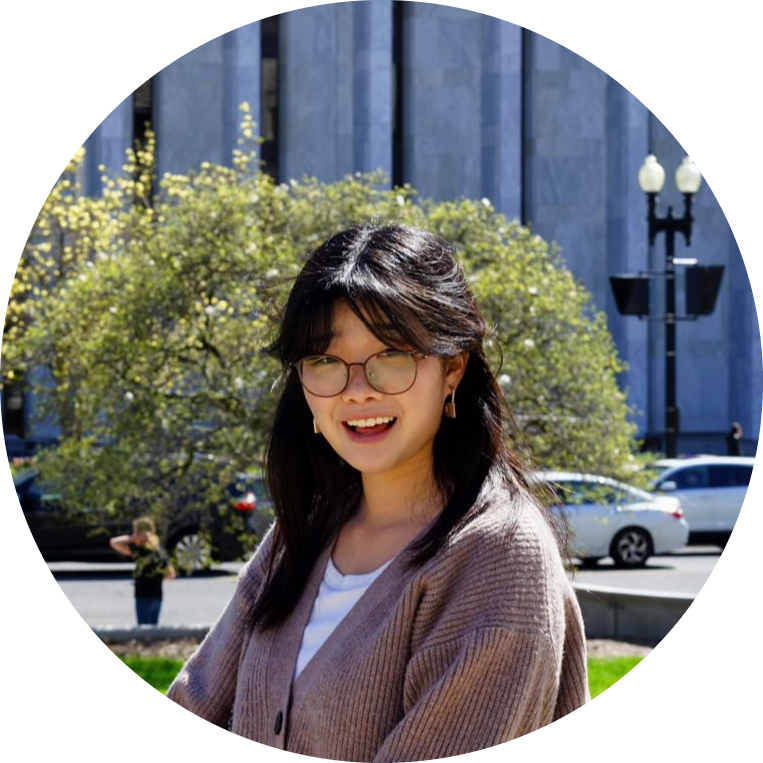
Hi! My name is Annabelle Kim and I'm a rising senior at Georgetown University. I am majoring in Public Policy and Economics. I'm from the San Francisco Bay Area–Pleasanton, CA to be specific. Throughout my studies and my career, I hope to contribute to improving educational equity in the U.S. K-12 system, with a special focus on marginalized students within high-performing districts.
I am currently completing my LiA project at the War and Women's Human Rights Museum in Seoul, Korea.
In summer 2024, I researched within-district disparities between continuation high schools and comprehensive high schools in California. Continuation schools (alternative high schools for students at risk of not graduating) have higher per-pupil funding than their traditional brick-and-mortar counterparts. Despite this, facilities and services provided to these students often fall far behind--I hope to clarify why that might be. My research builds on my experience researching school funding decisions nationwide with a faculty member of Georgetown's McCourt School of Public Policy.
A fun fact about me is that I've technically flown a plane before I got my driver's license...and that even now I'd far prefer flying a plane to driving on a California freeway.