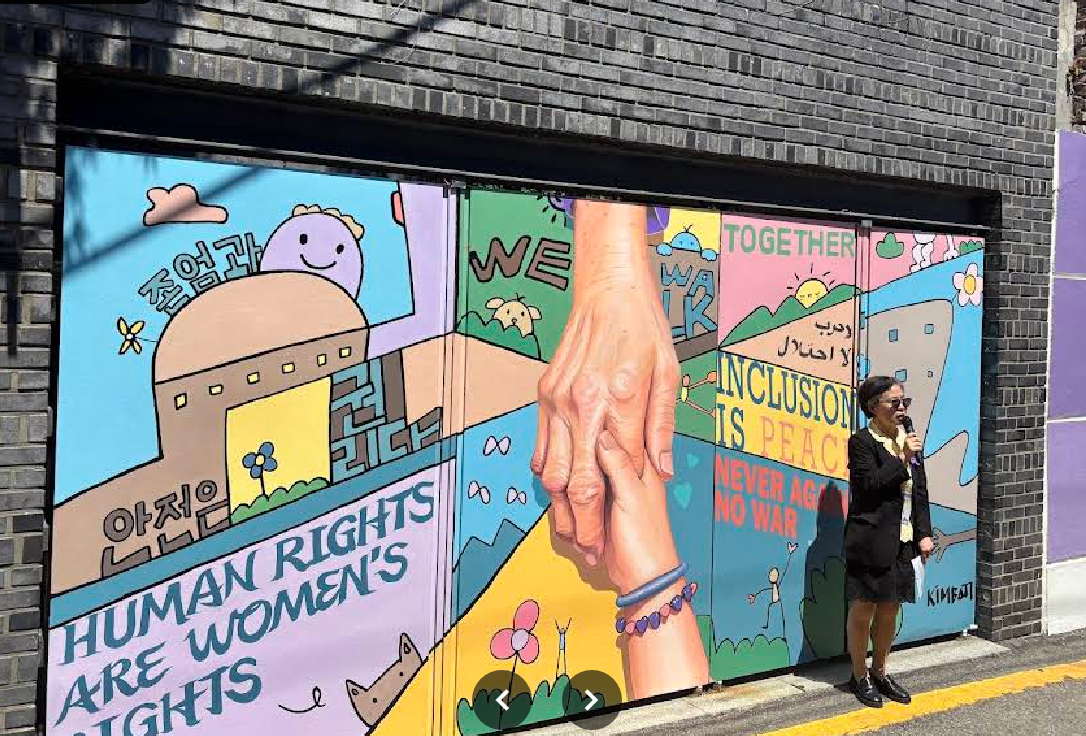
Last week, I described the grand unveiling of our mural, but I realized I omitted what I actually loved about this mural.
In stark contrast from the depictions of historical figures and events that lined the white walls previously, this new mural is intensely colorful, where large, humanoid beings clasp hands across the long wall to the left. Along their arms and in between their faces, glimpses of key historical moments in the fight for the “comfort women” appear–these too are brightly colored. Motifs appear in between the figures as well that signify international solidarity and peace, including an olive, a key, several native flowers to different war-torn countries, and a watermelon. On the main mural (metal door), an elderly woman's hand clasps the hand of the younger generation, surrounded by color. Next to her hand, a script in Arabic (the handwriting of an imam that we have remained in contact with) declares, “No War, No Occupation.” Across all of the murals, small purple and yellow butterflies flit in between the imagery; a symbol used throughout the movement to signify the halmonis (grandmothers) themselves. As butterflies emerge from their cocoons, so do the halmonis into the light of their truths and the fight for accountability from those responsible.
At the very end of the mural, a signature wall lists the names of participants. Under the “Staff” section, purple serif letters outline “애나벨 김”, my English name phonetically written in Korean. Of course, I have a Korean name that I typically go by, but something about being known as “Annabelle” at a Korean museum felt extra meaningful.
This week, the bulk of my responsibilities were at the info desk and creating a new digital audio guide transcript for the 10 languages we offer. Because our audio guides are only in Korean, English, and Japanese, the museum offers transcripts for Chinese (Traditional and Simplified), Japanese, French, Spanish, Portuguese, German, Italian, Russian, and English. Unfortunately, the leaflets that we used to use were now torn and unseemly, so we needed to find an alternative solution. I proposed a QR code that would lead to a site with each language, where visitors could navigate freely on their phones without having to hold a cumbersome paper guide. One quirk of the project that I found interesting was figuring out the natural word for a “Next” and “Back” button in each language! I designed the graphic for the QR code, and we printed it out. It is now at use at the museum, and many of the visitors have already been using it for their convenience!
On Friday, I attended the 49th day memorial for one of the victim-survivor halmonis that had recently passed away. In Buddhism and Korean mourning culture, the 49th day after one’s death marks the day of rebirth, in which the soul passes through all seven-day cycles of the Underworld and can be born into a better life. As activists from all across Korea joined the family in their celebration of her life and their wishes for her to be born into peace, we felt once again the urgency of the resolution and accountability of this issue. With only five reported “comfort women” still living, the pressure is tangible and the work more important than ever.
I sincerely hope the halmoni’s soul can rest in peace in her next life, and that we can make a world in which atrocities like hers do not recur.
Hi! My name is Annabelle Kim and I'm a rising senior at Georgetown University. I am majoring in Public Policy and Economics. I'm from the San Francisco Bay Area–Pleasanton, CA to be specific. Throughout my studies and my career, I hope to contribute to improving educational equity in the U.S. K-12 system, with a special focus on marginalized students within high-performing districts.
I am currently completing my LiA project at the War and Women's Human Rights Museum in Seoul, Korea.
In summer 2024, I researched within-district disparities between continuation high schools and comprehensive high schools in California. Continuation schools (alternative high schools for students at risk of not graduating) have higher per-pupil funding than their traditional brick-and-mortar counterparts. Despite this, facilities and services provided to these students often fall far behind--I hope to clarify why that might be. My research builds on my experience researching school funding decisions nationwide with a faculty member of Georgetown's McCourt School of Public Policy.
A fun fact about me is that I've technically flown a plane before I got my driver's license...and that even now I'd far prefer flying a plane to driving on a California freeway.