LiA Week 3: The Real Monkeys

After spending week 2 on pre-production preparation, week 3 marked the start of our travels across Southern China with middle school-aged Chinese-American campers who were enrolled in the "Mountains-Beyond-Mountains" US-China Exchange & Environmental Conservation Camp that Green Camel Bell (GCB) is co-sponsoring.
While it was an incredibly exciting and enriching week of sightseeing, I felt initially disillusioned with my expectation of the program's goals versus the execution.
In the Opening Ceremony of the camp, much emphasis was placed on anticipating the cultural exchange element between the American campers and the local Chinese people we would learn from and work with, in each city or village we visited.
However, with each new place we saw, I began growing frustrated as I noticed our own American student campers (most of them pre-pubescent boys) on their phones or goofing off amongst each other during incredibly valuable or educational opportunities. However, as disappointed as I was to see them failing to appreciate this rare and precious trip, I reminded myself I wasn't wasting my own experience---I was here with a purpose: to film. And therefore, regardless of how "authentically" the American students were "connecting" with China and learning about its environment, I would have something honest and purposeful to document into a story. So at first, I reassured myself with that thought. As long as I focused on my task while on this trip, my time would be of value. With an open mindset, no trip, no matter the constraints you may have, could truly be "wasted." This is what I told myself.
Knowing I was shooting my documentary, I already had composed a narrative I hoped to capture. I was initially filming anything that verified the ideas I'd brought in, such as anything in official museum placards or during our camp-organized presentations with locals that seemed limited or influenced by CCP censorship. When cultural-exchange activities failed to seem as "authentic" as I had hoped for them to be amongst our camp and the locals we met, I deemed the programming as "performative," thinking it was constrained by government agenda; I assumed (in my head) that the camp must not be making much effort to facilitate more effective interactions because it was by nature designed to "play it safe."
However, I only grew more and more restless. This explanation did not add up with what I was also observing about the passionate guides on our trip, especially Green Camel Bell's leader, my mentor Zhao Zhong---he was personally telling me and Stella fascinating insights behind the sites we were visiting, and the environmental conservationists, local village volunteer rangers, and farmers we were meeting. I couldn't help thinking the kids would get more out of this trip if they, too, were engaging with curiosity to scrutinize what they were being shown and to understand the WHY behind it, as me and Stella were able to do, with Zhao.
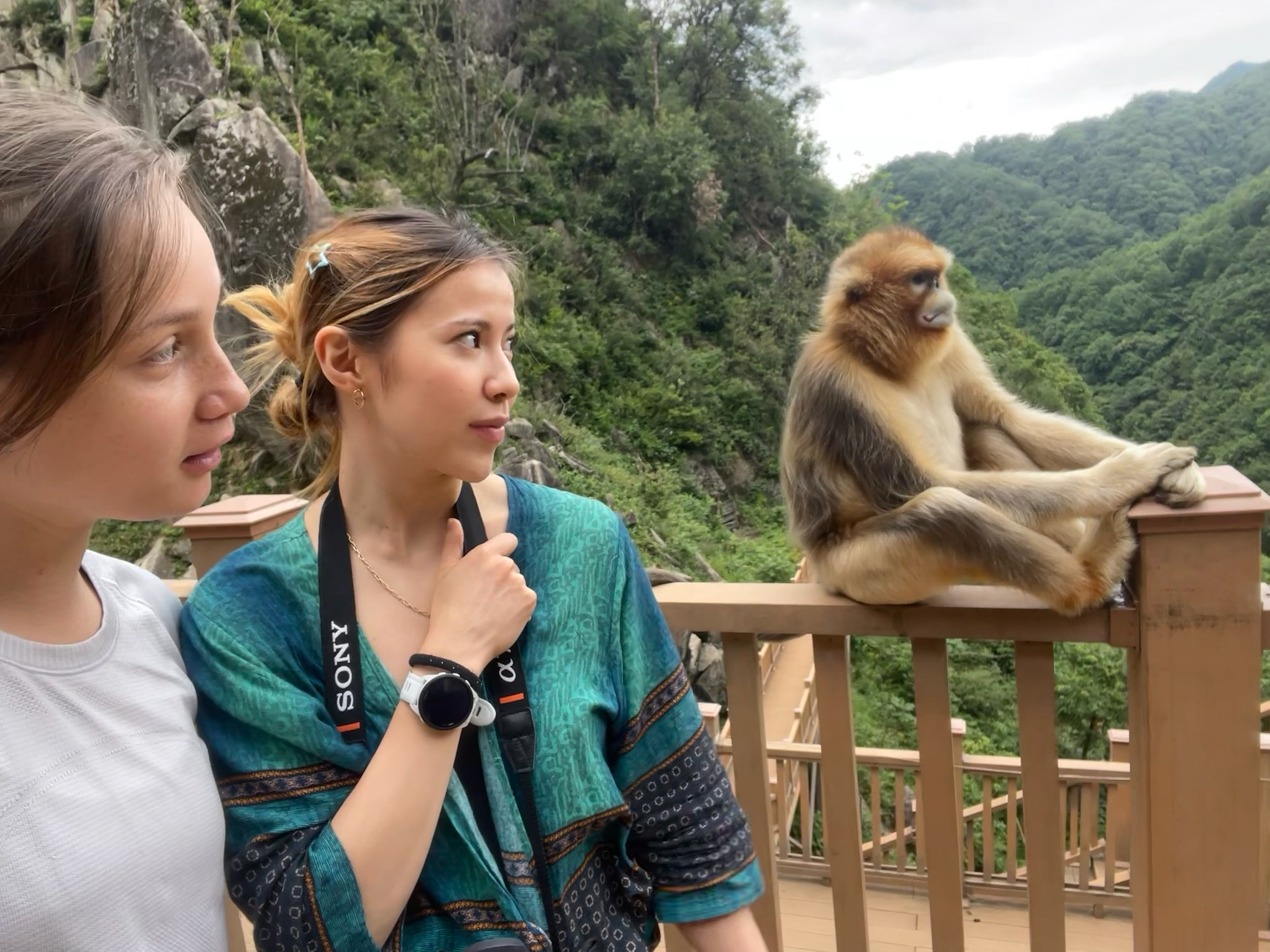
For instance, on June 11, we visited a Snubnosed Monkey conservation site in the Liangfu Gap area of China's 大熊猫国家公园 (Giant Panda National Park).
While the park policies emphasized protecting the monkey's safety, the structure allows visitors to essentially enter their enclosure on a wooden rail-lined path. Visitors cannot exit the path, but it is within the monkey's enclosure, allowing the monkeys to bypass and directly interact with humans at their will.
When we came, it was time for their feeding session, so an authorized ranger threw food towards them---which appeared to trigger the monkeys to run closer to the visitor viewing point. Soon, they were scrambling and jumping on people (I got karate-kicked by a monkey who used me as a launching pad, two seconds after Stella and I took a selfie beside him), and many of the campers were crowding around and petting them. Ironically, an automated loudspeaker recording would repeat in Chinese, "Protect the monkeys and prioritize their safety," yet I suspected the constant re-running of this recording, which even irritated me, was counteracting the stated mission, likely disturbing to the monkeys' peace.
It felt like a contradiction: a site meant to protect this species, yet enabling certain practices that were more meant to attract tourists, under the guise of supporting the monkeys' best interest. Zhao explained this paradox to me shortly after the visit: "This is a very Chinese model of conservation. We know it's kind of bad, we shouldn't be able to get *that* close to nature, to the wild animals, and it's not entirely safe for either the monkeys *or* the humans, but everyone's happy. It's preservation, but it's also a business."
I was fascinated to learn about this duality, but the younger campers simply came, played with the monkeys (and I watched them, thinking their loudness, likely disrupting the monkeys' peace, made them appear to me as more "monkey-like" than the monkeys themselves), and returned immediately to playing video games amongst each other on the bus.
As we drove to our next destination (the local village where we'd do a cultural exchange presentation/performance with villagers) on the bus, Zhao asked Stella and I to facilitate a reflective discussion with the kid campers about what we'd all experienced. He hinted at the same contradiction he'd discussed with us, the "good and bad, but everyone's happy" phenomenon, but most of the kids were reluctant to engage and when handed the mic, only talked about the fun of getting so close to the monkeys. I attempted to navigate the conversation to the challenge of conservation and profit needs coexisting, but the kids weren't really listening, so I returned to listening to music in my headphones.
That night, for our first ever cultural-exchange show with the local villagers, I was abuzz with excitement. It seemed like the epitome of what I hoped to capture in my documentary, as well as the leadership I hoped to practice on this LiA: how to genuinely connect with and understand China, its people, and, perhaps, uncover the underlying discrepancies in how national parks policy truly impacted farmers' lives. I attempted to draw connections between the authenticity of this US-China cultural exchange element, and my questions regarding whether national parks policy truly benefits everyone here or is a cover up for ethnic minority displacement. In both cases, I didn't have a clear answer yet. And it felt like I was forcing a connection between two narratives without knowing if those narratives were truly the story here, or the story I was simply trying to IMPOSE onto this experience.
For the first half of the showing, our own US campers had prepared videos and powerpoints discussing the US national parks system. I found it difficult to understand how this would resonate with the villagers here, given most of our audience was elementary school children with limited english, and since our own campers seemed like they barely connected with their presentations, too (one of them had made an AI-generated video with a robot voiceover about US parks that couldn't have been more impersonal, even though the stated purpose of these presentations was American kids sharing their own experiences to garner appreciation for the environment).
As expected, the impersonal presentations from the American campers weren't resonating with the local kids, either. They whispered and giggled and squirmed, most excited to talk to us. Many kids and their parents asked to take photos with me and the other campers so they could remember meeting an American. It was clear the thing that excited everyone the most was the opportunity to interact with one another after the formal presentation exchanges. I learned from some kids that they have to go to school at 7am each day, yet they stayed out til 9:30/10pm just to talk and dance with us! Touched, I began thinking how maybe the structure of this “cultural exchange” ought to be shifted to align with people’s true desire for connection being grounded in direct engagement /q&a, rather than a more one-sided show-and-tell.
I did not want my documentary to merely scrutinize the shortcomings and constraints of this program. There is already abundant criticism of US-China diplomacy that exists in both the East and West that assesses both sides from a place of judgement rather than compassion. I knew that the camp and its organizers were people worthy of compassion. If I understood the intent of this camp to be genuine, then my job ought to be how I could at least propose supporting its operations to achieve its goals. Feeling helpless that the area of "true connection" I thought would be the site of my LiA leadership wasn't playing out as I'd imagined, I realized I had to reframe what type of leadership I'd expected, and what type of leadership was actually needed to support the shared goals I knew both Green Camel Bell and I had. Stella and I discussed how, since we were on this trip, we had the opportunity to go beyond passively observing what we thought worked or didn't.
Was this our LiA call to action? To support the operation camp itself (internal leadership of the campers themselves), instead of just participating in/documenting the camp's stated activities (external leadership between campers and local villagers)?
I'm a current undergrad student at Barnard College pursuing a double-major in Theatre & Human Rights, with a minor in East Asian Studies. I'm often asked why I’m studying such seemingly divergent fields. For me, these subjects go hand in hand: my diplomacy and human rights practice are informed by an empathy uniquely cultivated from my experience in the arts; my acting on theatrical stages is enriched by my understanding of what is happening on the "world stage." Mastering both mediums is my answer to the seemingly unsolveable divisions we face today. My work bridges these fields in an innovative, urgent and radical effort to highlight our shared humanity at a time we need it most.