LiA Report: When Science Dances

1. Where I started
One of the main reasons I originally applied to Laidlaw was because of the amazing opportunity that the programme offered. The support and funding to first complete a research project and then a Leadership in Action project was something I found really valuable, especially because I would also be doing the programme alongside other scholars who were going through a similar experience. I hoped that through the programme I would gain experience working and collaborating with other people, make new friends, and establish connections that I could continue building on in the future.
At the start of the Laidlaw Programme, my understanding of leadership was quite simple. I thought leadership was mainly about working with the team that you were in charge of leading, being hands-on, and not being afraid to get dirty yourself. I remember learning an analogy where a boss is someone sitting on a high throne, bossing everyone around and telling people what to do, while a leader is the person at the front pulling a plough, with everyone else following behind them. A leader, therefore, led by example, because of this, I thought leadership was quite closely connected to authority. You were a leader because you were in charge of something or because you had been given a position where other people were expected to follow you. During the Laidlaw Programme, I have since learned that leadership does not necessarily require that. It can instead be an internal drive, as well as a combination of characteristics and skills that allow somebody to inspire, support or influence other people without necessarily having authority over them.
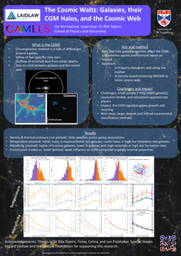
My research project was very different from my Leadership in Action project. For my research project in summer 1 of the programme, I looked at whether the properties of the circumgalactic medium of galaxies change depending on the properties of the galaxy and where it is located within the cosmic web. I looked at quantities such as temperature and metallicity and compared galaxies based on their stellar mass, gas metallicity, specific star-formation rate, peculiar velocity, and environmental density. Some of the results were very surprising and quite counterintuitive, which in itself was a useful lesson that the outcome of research does not always match what you initially expect.
For my LiA, I spent four weeks in Glasgow working with Science Ceilidh on their gravitational waves project with P6 pupils at a primary school. Through this, I learned how to communicate complicated scientific ideas to audiences with much less background knowledge, and then how those ideas could be reinforced through ceilidh dances that were largely created by the participants themselves. The aim was to teach them about gravitational waves, to make science feel less distant and mysterious, and to encourage the young participants to see themselves as young scientists who could understand and talk about science.
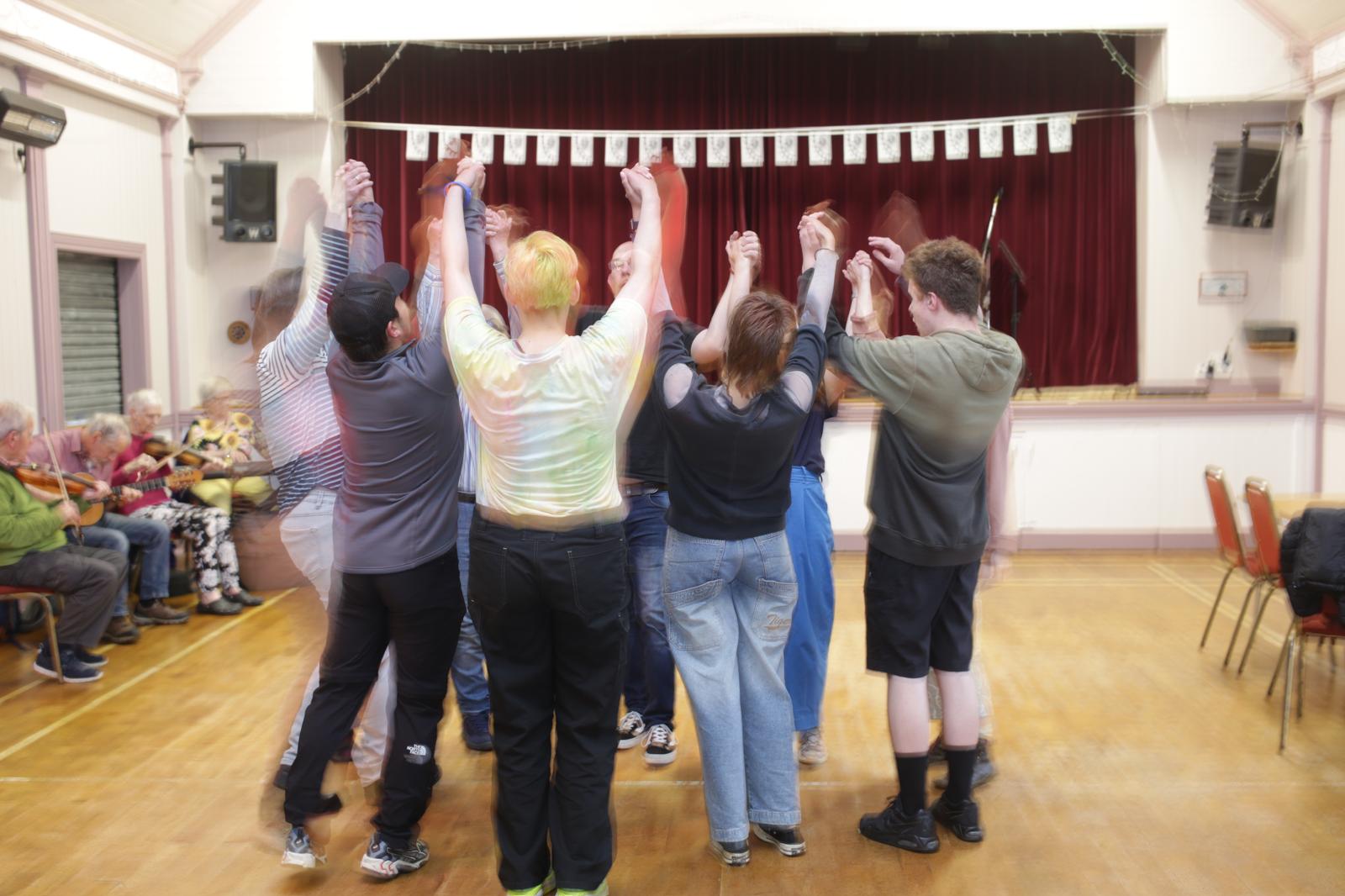
For the final two weeks, I travelled to Shetland with my fellow Laidlaw Scholar Alina. There, we ran two public workshops for different audiences, as well as three school workshops for P5, P6, and P7 classes. These workshops were around 1.5-2 hours and were essentially a condensed version of the longer Glasgow programme (which was a collection of six 2h workshops about different fundamental ideas regarding gravitational waves, the steps of how they happen, and the steps of how they are detected). For our own workshops, we split each one into two parts. The first half focused on explaining the basic concepts behind gravitational waves by simplifying the physics and breaking the ideas down into understandable language. The second part focused much more on participation, during which we first introduced a few dance steps that Alina and I had come up with, before asking the participants to create their own movements and help complete the dance, which summarised what they had learned in the first part.
My three SMART goals focused on these parts of the project: firstly, contributing to the existing workshops in Glasgow and then delivering my own; secondly, condensing the longer series of gravitational wave workshops into something that could be delivered to different audiences; and thirdly, continuously evaluating and changing the resources to make them more useful. None of the three goals ended up looking exactly the way I had originally imagined them, and I think this became one of the most important parts of the LiA itself.
2. What I learned about my character – SMART Goal 1
My first SMART goal was to facilitate Science Ceilidh’s existing workshops in Glasgow and then, after learning from those workshops, deliver one of my own. The aim of my workshop was originally to bridge the gap between the general public and scientists and to make the idea of studying or becoming a scientist seem more accessible and attainable to the P6 pupils.
Before starting the LiA, we completed the Oxford Character Programme, where we learned about different character traits and how virtues can be developed, but can also turn into something less useful if taken too far, vices. I found some of this quite difficult at first, as I am a very sceptical person and I have struggled before with the lack of concreteness that I sometimes find in humanities subjects or more reflective work. I am used to maths and physics, where things are built from first principles, assumptions can be tested, and there is usually a clearer foundation to start from. I remember wanting something similarly concrete when we were discussing character. During the LiA, though, some of those ideas became much easier for me to understand because I was actually experiencing them rather than discussing them theoretically. One of the biggest ones for me was responsibility.
Due to organisational and time constraints, my original plan of delivering my own separate workshop had to be adjusted. At first, I saw this quite straightforwardly as something I had said I was going to do and therefore something I should find a way to complete, but as the project continued, it became clearer that forcing another workshop into the programme just so that I could say I had achieved the SMART goal would not necessarily have been useful to Science Ceilidh or to the young participants.
Instead, I looked at what could actually be useful at that point in the project. One of the things I ended up doing was creating educational colouring sheets connected to the science we had been teaching. These could be used during activities, but could also be taken home by the young participants, which meant that they could continue interacting with the ideas themselves and even share some of what they had learned with their friends and family, becoming ambassadors. Science Ceilidh could also keep and reuse them at future events.
Later, my contribution to the resources also became much more creative than I had originally planned. My original proposal talked about producing a more conventional PDF resource, but this eventually developed into a zine of the gravitational wave dance and the science behind it. My contribution therefore became a bit more passive in some ways than I had originally imagined. I was not standing at the front running my own complete workshop, but I think it actually became better aligned with what the project needed at that moment. This tested something about my character that I had not really thought about before: my ability to relinquish control and to be more fluid and adjustable. I like knowing what the plan is and why the plan is the way it is. When I have decided that something is the best course of action, I can become quite attached to making sure it happens. In this case, however, sticking too rigidly to the plan would have meant prioritising something I had written months earlier over what the partner organisation and project actually needed.
I think this changed my understanding of responsibility. Previously, I would probably have considered responsibility to mean following through on what I had promised to do. I now think it also means being able to recognise when what you originally promised is no longer the most useful thing to do. I would therefore describe my first SMART goal as partially achieved, but changed. I did not run the standalone workshop exactly as originally planned, but I still contributed to the underlying aim of the goal: communicating science in an accessible way, helping with the existing workshops, and creating materials that could continue being useful beyond one session.
This also taught me something about humility. I came into the project with specialist knowledge in astrophysics, but that did not mean that I knew the best way to use that knowledge within this particular community. Science Ceilidh had much more experience of working with the pupils, the teachers knew them much better than I did, and the young people themselves reacted to the activities in ways that no one could have completely predict in advance. The out-of-the-box thinking that allowed me to adapt meant that my overall contribution was more useful than if I had tried to impose my original idea simply because I believed it should be beneficial.
I still think determination is a strength of mine. What I learned was that determination and stubbornness can sit very close together, and being adaptable does not mean giving up on the purpose of a goal. Sometimes it just means finding a better way of achieving it.
3. How my ability to lead developed – SMART Goal 2
My second SMART goal was to work collaboratively with Alina to condense the longer series of Science Ceilidh’s Glasgow gravitational wave workshops into a single workshop of around two hours. The workshop needed to explain the important scientific concepts in an age accessible way, include movement and creative activities, and eventually lead into a gravitational wave ceilidh dance. I also wanted to create versions that could work for both school pupils and members of the general public.
This goal was mostly achieved, although again the final result was a little different from what I originally expected. By the time we went to Shetland, Alina and I had created a workshop that lasted around 1.5–2 hours and could be adjusted depending on the audience. We ran it at two public events on different days, in different places and on the same day, in one primary school for P5, P6, and P7 classes. I had originally imagined that there would be quite substantial differences between the different versions of the workshop, but in practice, the differences were smaller than I expected. The underlying science stayed largely the same, while the way we phrased things, the pacing and how much time we spent on different sections changed depending on the group. I had also originally wanted to include regular movement breaks during the scientific presentation because some of the teaching literature I had read supported this. In practice, this did not work particularly well with the time and space we had available, as constantly switching between explanation and movement would have broken up the workshop too much. Instead, we ended up with a clearer structure where we first built up the scientific concepts and then moved more fully into the participatory dance section.
One of the biggest lessons from this goal came from working with Alina. Before my LiA, because of my disability and because I have to ration my energy between university, basic life tasks, and other responsibilities, I had become quite used to doing less practice for presentations than some other people. I knew what I was able to manage and would often rely on being comfortable enough with the material to improvise slightly if necessary. Alina approached preparation differently. During both Glasgow and Shetland, we spent whole days going through workshops, practising explanations, checking how sections connected together and making sure that we both understood not only what we were saying but why we were saying it. This was quite different from how I would naturally approach things, but I think it made the final workshops much stronger. The repeated practice meant that when participants asked unexpected questions, we were less likely to become stuck because we had only mastered one way of explaining something. We had gone through the concepts enough times that we could approach them from slightly different directions. Had I done this project alone, I do not think it would have been as impactful or had the same positive effect as it did through us doing it together.
I also had to change the way I approached scientific accuracy and precision. I was taking the lead on making sure that the scientific content was correct, and this was something that mattered a lot to me. I did not want us to simplify gravitational wave physics so much that what we were saying was no longer accurate. At the same time, I slowly realised that accuracy and precision does not mean giving the most thorough explanation possible. As an astrophysics student, I think there is a temptation to believe that if an explanation has more detail, more caveats and more technical precision, it must automatically be better and easier to understand. For somebody learning about the topic for the first time, that is often not true, it can actually make the main idea much harder to see, through all the clarifications, rigid language, and specific terminology. For example, in Shetland we had to explain enough for the participants to move from understanding that space and time can be thought of together as spacetime, to understanding that objects with mass influence its geometry, then to the idea that the movement of very massive objects can produce ripples in spacetime, and finally to how those ripples can be detected. There is a huge amount of physics underneath every one of those statements. We could not explain all of it in two hours, and trying to do so would probably have made the workshop worse.
Working with Alina and Science Ceilidh helped me start asking a different question. Instead of asking myself, “What other scientific detail should I include or clarify?”, I started asking, “What is the absolute minimum that this audience actually need to know to understand the next idea?”. That is a question I think I will continue using.
The dance section also changed how I thought about leadership. We did not just teach participants a complete dance and ask them to copy it. We gave them example steps and enough information about the science, and then asked them to come up with movements themselves, whilst we were still there to help and follow their lead. That meant giving up control over the final result, as well as unavoidably introducing our bias int their own creation. Previously, my understanding of leadership had been very focused on leading from the front. In this project, I learned that sometimes a leader does need to stand at the front and explain something, but rather sometimes leadership means giving somebody else enough structure and confidence that they can take over part of the process themselves, whilst you are still available to them as a resource, if they ned it.
I also realised that I am more willing to compromise than I originally thought. I had previously imagined my leadership style as quite goal focused, where I would push through whatever was necessary to achieve the outcome. During the project, I found that I was actually much more interested in finding compromises that kept the most important parts of the goal while allowing other parts to change. The rigid commitment I initially had to being as accurate and precise as possible was not always practical and was not always the best way to communicate. Through working with other people, we created something that was still scientifically responsible but was also accessible, understandable, and enjoyable.
I think the main thing I learned from this goal is that good collaboration does not weaken leadership. It can actually make the outcome much stronger because other people notice things, bring skills and challenge assumptions that you would not necessarily see yourself.
4. How my perspective widened – SMART Goal 3
My third SMART goal was to continuously assess and adjust the workshops and resources throughout the project so that they became as effective and useful as possible. I think this ended up being the SMART goal that was most consistently part of what we actually did.
The workshop was not created once and then delivered in exactly the same way every time. We practised it, ran it, discussed what worked and what did not, and changed things before running it again. Some of the changes were quite small, such as wording or pacing. Others were bigger: the movement breaks that I originally thought would be useful were reduced because they did not fit practically into the structure, the different audience versions ended up being less different from each other than I expected, and the PDF resource I originally imagined eventually became more creative resources, including colouring sheets and a zine.
At the end of each of our public Shetland workshops, we had asked the participants to complete an evaluation sheet, in addition to a check-in that we had in our presentation. We repeated a question we had asked at the start of the workshop: “Do you think that science and creativity can go together?”. Participants answered by giving a thumbs up for yes, thumbs down for no, or holding their thumb sideways if they were unsure. What surprised me was that even at the beginning, quite a lot of people already answered with a thumbs up. I think I had expected that part of our job would be convincing people that science and creativity could fit together. Instead, a lot of the audience did not need convincing. By the end we had an even larger majority agreeing with the statement, but I think the more important lesson for me was actually what happened at the beginning. I had made an assumption about the audience without really noticing I had made it. This links quite closely to what I learned about having a global mindset and about being a changemaker.
I grew up in a very international country where more than 80% of the population are immigrants, so I became very used to being in multicultural environments. A lot of the people I met growing up had completely different backgrounds, nationalities, cultures, beliefs, and experiences from one another, because of this, I think I became quite comfortable with having very few shared experiences with the people around me. The communities I worked with during my LiA were very different to this. In Glasgow and particularly in Shetland, I was working with people who often had quite strong shared connections to a place, to the community around them, and to Scotland. In some cases, people had grown up together or had shared histories and cultural references that I did not have. I found that this was more intimidating than I expected.
I think before the project I might have assumed that because I was used to cultural difference, entering a different community would therefore be easy for me. Instead, I realised that being used to diversity is not the same thing as understanding every community. There was a lot of local knowledge that I simply did not have. This made the idea of entering a community as a learner much more real to me. The people we worked with were not blank slates waiting for us to arrive with science. The young participants already had ideas, curiosity and their own ways of understanding things. Science Ceilidh already had experience working with those communities. Teachers knew much more about what would and would not work with their classes. In Shetland, people understood their own community in a way that we could not possibly understand after being there for two weeks. This made me think differently about whose knowledge matters. My specialist knowledge in astrophysics mattered because I could help make sure that the physics we were teaching was accurate, but that was only one kind of knowledge within the project. The knowledge of how to communicate with a class, what activities young people would respond to, what would work in a particular room, how a local community engages with an event, or even what questions people were interested in asking were all equally important to whether the project worked.
It also changed the way I think about unequal opportunities in STEM. A lack of access to science is not necessarily caused by a lack of curiosity or interest. People can already be interested and capable, but not have the same access to researchers, resources, enrichment activities, or opportunities to imagine themselves within STEM. I therefore do not think outreach should begin with an assumption that you are bringing curiosity into a community. It should start with trying to understand what is already there and whether there are barriers around it that you can help reduce.
My third SMART goal was therefore achieved through a continuous process rather than through one final revision. Every workshop, audience and piece of feedback gave us information that we used to improve what came next. I think that habit of adjusting based on what actually happens, rather than what I imagined would happen beforehand, is one of the main things I will take from the LiA.
5. How I will carry this forward
The Laidlaw 3Cs model talks about Change Maker Values, Character, Capacities, and how these three things work together in ethical leadership. At the start of the programme, I think I would have found this slightly too abstract. After the LiA, I understand it more clearly.
- My values give me a direction: integrity, honesty and courage are particularly important to me and affect how I want to behave even when doing so is inconvenient.
- My character affects the decisions I actually make while following those values. This includes whether I am responsible enough to change direction when something is no longer working, whether I am humble enough to recognise when somebody else knows more than I do, and whether my determination remains useful rather than becoming stubbornness.
- My capacities are the skills that actually allow me to do something with those values and character traits: communicating, collaborating, planning, listening, adapting, and critically assessing what is happening.
There are a few things I want to continue doing after Laidlaw. Firstly, I want to continue reflecting on my character rather than only doing it when I am required to write a reflection. I think one of the most useful questions for me will be asking whether I am protecting the actual purpose of something or just protecting the method I originally chose. This is something I can use in future research, group projects, and leadership roles.
Secondly, I want to continue developing the science communication skills that I gained through the LiA. Astrophysics includes a huge number of concepts that are difficult to explain and can seem completely inaccessible to people outside the field, or even sometimes inside the filed, if that topic is not their area of expertise (I know from personal experience). I do not think that complexity should become an excuse for making science resources understandable only to other scientists. At the same time, I do not want accessibility to mean making the science inaccurate or imprecise. I want to continue practising how to find the line between those two things: giving people enough information to understand something properly without overwhelming them with details that they do not need. The LiA also made me much more interested in creative forms of science communication. Before this project, I do not think educational colouring sheets, a zine or a ceilidh dance would have immediately come to mind if somebody asked me how I would communicate gravitational wave physics. I now know that creative communication is not exclusively reserved for humanities subjects, but works quite well with science ideas too.
Finally, I want to continue approaching unfamiliar communities with more awareness of what I do not know. If I work in outreach, research or any other international or community based setting in the future, I want to make sure I first understand who is already doing the work, what knowledge already exists and what the people involved actually want. I also want to remain involved, where possible, in making science more accessible to people who may not automatically feel that universities or scientific institutions are spaces that they belong in. I do not think one workshop, one resource or one person can fix structural inequality, and I think it would be dishonest to pretend otherwise, but I can still make choices about who I communicate science to, how accessible I make my own work and what kinds of projects I choose to contribute to.
When I started the Laidlaw Programme, I thought responsible and ethical leadership meant being the person at the front pulling the plough instead of sitting on the throne. I do still think there are moments where leadership means going first, taking responsibility and leading by example. However, I now think there are also moments where the best thing a leader can do is stand beside someone else, follow somebody else's expertise, create space for other people to contribute, or recognise that the original plan is no longer the best one. My LiA did not teach me that being a good leader means always knowing exactly what to do. If anything, I think it taught me almost the opposite. Leadership can mean having enough confidence to make decisions while also having enough humility to change them when the people around you, the evidence, or the situation shows you that something else would work better. That is probably the biggest change in how I understand leadership, and it is the part that I want to carry forward after Laidlaw.