Learning to lead through the Laidlaw Programme
I’m sitting on the bed. A light blue blanket over white sheets, covering a plastic blue mattress. Everything here has been chosen with safety in mind. I am allowed a pillow. My head sinks into the soft white fluff of it every night, but I’m still here. I’m not allowed to leave freely.
The windows can’t be covered. It’s not safe. Even the little privacy curtain can be pulled open from the outside.
I came here because I needed help. At the time, it seemed like I was going to get it. Now, I feel like another number; another passing body added to a tally of people kept safe and prevented from being hurt. I want to feel that someone sees the person occupying this bed.
~ ~
Just a few months earlier, I had made a very last-minute plan. I reached out too close to the Laidlaw application deadline and didn’t leave enough time for things to happen. When I asked a lecturer whether they could support my application, they already had three students: the maximum they could take on.
My plan hadn’t worked, but I would find another way. It was just one year until I could reapply, I kept repeating to myself.
It’s easy to say that. It’s completely different to live it.
So much happened in that year, but I made sure I approached another lecturer with ample time the next time round. I was excited by their area of research. I’d never done anything like it before, but with the financial and organisational support of the Laidlaw Foundation, this first taste of research seemed as though it could be rather delicious.
Writing and submitting the application took considerable time. Being disabled meant that the work involved more than simply sitting down and getting it done. I don’t remember much of how I felt or what else was happening.
I do however remember being successful in the initial stage and being invited to the interview portion.
I remember coming out incredibly panicky and doing my best to hide it. I thought I needed to be perfect, to be an aspiring leader already. I remember going for a cuppa and then to the beach with my friends. I remember calling the duty line and speaking with C. I was not doing well. Even underneath the very good, very rigid mask I had built, I was lost.
Every fibre of my being was sure they wouldn’t want someone like me. Someone so unsure, so nervous and stressed. Someone I had come to think of as broken.
While I was waiting for C to call me back, a congratulatory email arrived. I had been offered a place on the programme.
To say I didn’t believe it would be an understatement. When C called back, my brain still refused to accept the email as true. It must have been a mistake. If I believed it and someone later quoted a technical error, it would hurt more than refusing to believe it in the first place.
I’m very good at pretending everything is okay. After all, I’ve had my whole life to practise.
Back on a blue bed. A different county and a different view from the window, but the same bed, the same room, the same rules. The blue bed was mine for the whole time I was there. I think I only left it when I absolutely had to.
It’s strange to hold one of your lowest moments alongside something you had hoped for so much.
I am a Laidlaw scholar.
Looking back, I can see how much my understanding of leadership needed to change. I had treated being nervous, needing help and being capable of leading as things that couldn’t coexist. That belief followed me into the programme. It would take more than an acceptance email to question it.
~ ~
It’s terrifying trying new things. It’s even scarier when you don’t know what to expect and therefore can’t prepare. A small jar of salt, some tape, scissors, rope, and blank paper seemed like useful supplies for the leadership retreat. Just in case it was a competition. Just in case I needed to solve something. Just in case this was all one big prank and I was about to be found out they didn't actually want me.
You’d think that after a life of being excluded for being different, for being disabled, you would get used to feeling on the outside. I never have.
I packed my larger backpack with what I thought would be useful, a few just-in-case items and, of course, snacks. I got help packing; previous experience taught me that, left entirely to myself, I might miss the bus. On the way to the bus, we stopped for chocolates. Everyone likes people who offer chocolates, right?
I was one of the first to arrive. Great, I thought. I could meet everyone and say hi. After twenty years, I was still overestimating how social I could be when anxiety had already drained my battery before the trip even began. It’s a cruel joke, that.
How could someone so terrified of even making friends be a leader?
The leadership weekend concluded without anyone telling me I didn’t belong. We were all so different, yet here we were, doing this together. Having no internet was honestly quite lovely.
The Tower of Hanoi with tyres instead of wooden discs was certainly a change. I knew how the puzzle worked, and I wanted to direct everyone. My way would be faster. We needed to win.
I don’t regret holding my tongue and focusing instead on making sure we did it as a team. Looking back, I can see the difference between knowing a solution and helping a group work together. I could explain my thinking and still leave room for someone else’s. The exercise gave me a chance to practise listening while feeling that very strong urge to take over.
Perhaps following my instructions would have been faster that time. But what about the next problem, when I didn’t know the answer? A team that could think together would still have somewhere to start.
That experience started to change what I valued in leadership. I began to see how much depends on the relationships around a task: whether people can contribute, ask questions and rely on each other. Those are capacities I can develop even when I feel anxious. Starting with that weekend, and continuing through the events and cuppas we organised, I had people to practise with.
~ ~
Having never done research on this scale before, I was terrified of messing up and being kicked off. Working with my supervisor and the other scholars gave me my first experience of trying to complete a research project while still learning how research worked. Somehow, I managed to finish it and create the necessary outputs.
I still tend to say “somehow”, as though the work I put into it doesn’t quite count. Looking back, completing that project is evidence I need to take seriously. I started with uncertainty and learned enough to produce something. I also had support around me. Both things belong in the account of how it happened.
Research gave me another reason to reconsider the idea that a leader should already know the answer. Asking questions is part of how you find out. I want to carry that understanding into future work, especially when the fear of embarrassment or anxiety makes me want to stay quiet. Admitting a gap in my knowledge gives someone else the opportunity to help, and gives me the opportunity to learn.
I remember a talk during our first summer, organised through Laidlaw, which I think was about psychology. I couldn’t tell you exactly what it covered now. What I remember is leaving with the feeling that something had clicked.
Character could change.
The Cambridge Dictionary describes character as “the particular combination of qualities in someone or something that makes them or it different from others”. It’s a word we use often, but I hadn’t spent much time considering how those qualities develop, or how much they influence the way we lead.
The Oxford Character Project gave me more room to explore that. Connecting to monthly video sessions with Laidlaw scholars across the world made it clear how many perspectives there were beyond our own cohort. Learning about character through Dr Corey Crossan’s teaching gave me a framework I could return to during my Leadership in Action project. Humility, courage and integrity became qualities I could look for in particular decisions.
Humility mattered when I needed to admit I didn’t know something. Courage mattered when I tried something unfamiliar while still feeling frightened. Integrity mattered when I had to consider whether my actions matched what I said was important to me.
The possibility of developing these qualities meant a lot. I had spent so long treating some of my reactions as fixed parts of who I was. Recognising a habit gave me somewhere to begin working on it. Change could be gradual, and I could still be responsible for how my behaviour affected other people while learning to understand why I behaved that way.
Laidlaw’s 3Cs framework brings together character, capacities and changemaker values. I can now connect those ideas to things I actually did. Listening during the retreat involved practising humility alongside collaboration. Applying again to the Laidlaw programme, and later entering unfamiliar work, gave bravery and determination a meaning I could recognise in myself. My curiosity brought me into research; developing the skills to communicate what I learned would help me share it.
~ ~
Completing my LiA in the country I was getting ready to call home was not what I had imagined, but having done it, I would not change it.
With Science Ceilidh, our project explored how to communicate gravitational wave physics through movement, drawing and storytelling. My role centred on scientific accuracy and finding accessible ways to connect the physics with the dance. It asked something different of me from research: I had to consider how someone else might encounter an idea for the first time.
Our original plan involved a curriculum linked PDF. As the project developed, the output became a visual zine centred on the gravitational wave dance. Adapting the format meant returning to what we wanted the resource to do and considering which approach would serve that purpose. The planning still mattered, but I learned to allow the method to change as our understanding of the project developed.
This was also a practical lesson in ethical communication. A movement or drawing can make an abstract idea easier to approach, but the analogy has limits. I needed to think carefully about what had to remain scientifically accurate and where a metaphor could help. Making science accessible carries a responsibility to the people learning from it.
Doing a joint project with Alina meant I could talk through experiences I was unsure about, as well as develop a friendship and learn alongside someone else. My perspective was useful, but it was still only one perspective. Explaining an idea to another person gave us something to examine together, including the assumptions I might otherwise have missed.
There’s a saying I’ve often heard: “Say yes and then figure out how to do it”. It has always felt absurd to me. If someone asked whether you could fly a plane and you said yes without knowing how, figuring it out afterwards would be a rather unsafe approach. An absurd example, perhaps, but it captures why the saying unsettles me.
During this project, I learned new skills in a much tighter timeframe than I would have chosen. I became more willing to attempt unfamiliar work, while recognising that I needed to be honest about what I could do and where I needed support. That is a version of saying yes I can live with.
I also noticed how much I needed to have something to do in order to feel content. I’m still thinking about that. If I want to contribute reliably over time, I need to understand my limits and make room for rest. I know how easily I can hide what is happening underneath. Learning to communicate what I need is part of becoming someone others can work with and rely on.
~ ~
Growing up, we all develop different ideas about what the world is like and what we can expect from it. My childhood was unusual, and my later experiences have made me cautious about trust.
I’ve known what it’s like to go shopping without worrying about the price, considering only whether something is what you want. I’ve also learned how to find the best deals, remember prices and keep a running tally. I know how much time those calculations take, and how tiring it is to keep deciding what you can and cannot afford.
Those experiences gave me a particular understanding of struggle. They also gave me assumptions that are often invisible to me. Having struggled myself doesn’t mean I automatically understand someone else’s circumstances. The conversations throughout Laidlaw, within our cohort and beyond it, gave me reasons to keep questioning what I thought I knew.
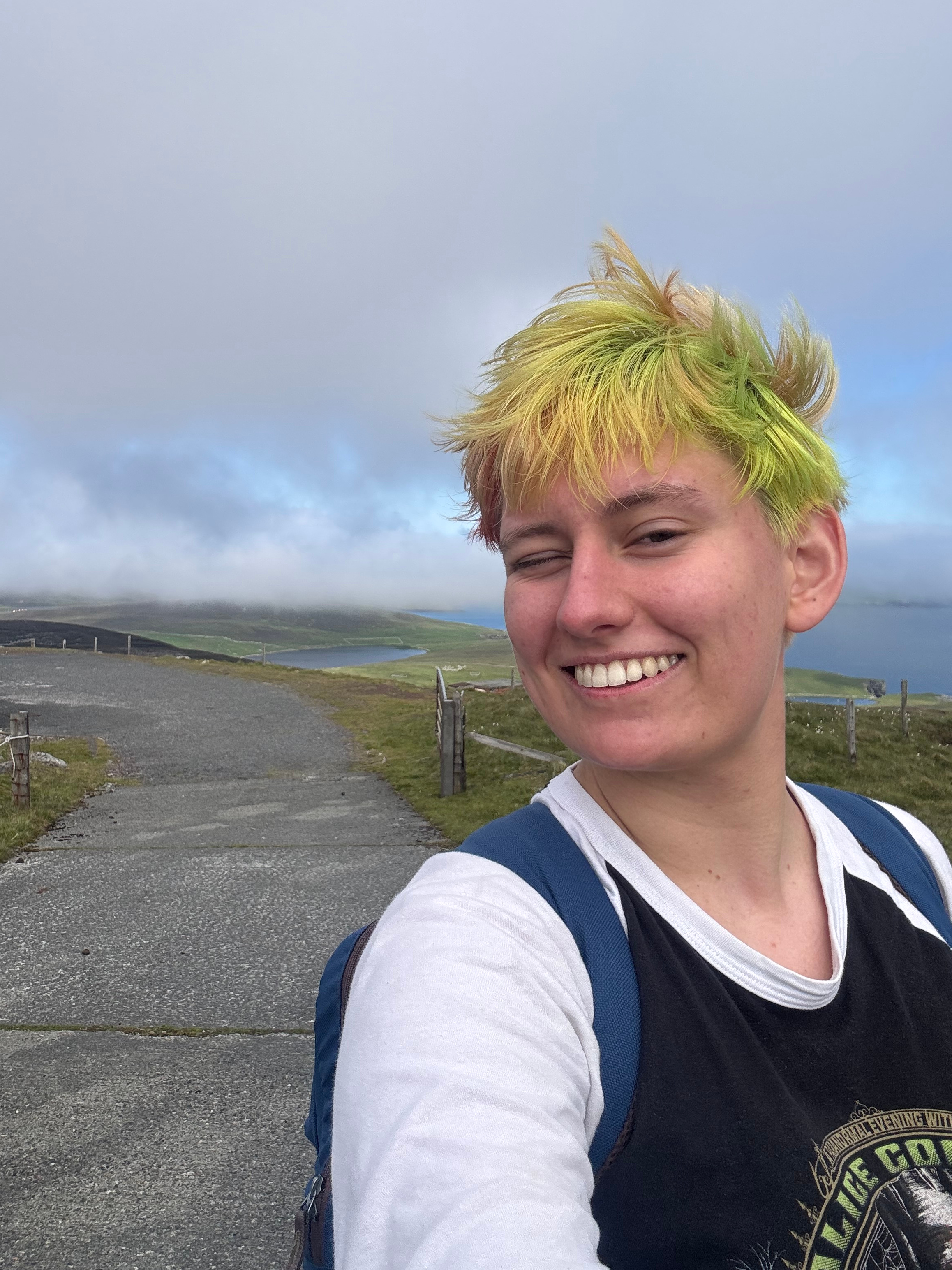
Shetland belongs in this reflection too. Being in nature there is something I want to hold onto. It was part of getting to know the country I was preparing to call home, and of remembering that there was more to the experience than the next thing I needed to finish.
I had imagined developing a global mindset would involve travelling to another country. Staying in Scotland made me reconsider that expectation. There was still so much to learn about the places and people around me. A national border tells me very little about how familiar another person’s life will be.
For me, becoming a global citizen involves taking that seriously. I need to ask what matters to people, listen to their answers and recognise the limits of the experience I bring. It also means considering who can access the things I help create. Our science communication work made that question practical: how could someone take part if the usual way of explaining the physics didn’t work for them?
Movement, images and storytelling offered different routes into an idea. I want to keep considering those routes in future work, especially because I know what it feels like when participation seems to depend on being a particular kind of person.
~ ~
Beyond Laidlaw, I want to continue making science accessible wherever I have the opportunity to share it. I will keep asking who an explanation is for and whether I have given them a useful way into it. I want to be clear about the limits of my knowledge and of the models I use, and willing to correct something when I get it wrong.
In future research and teamwork, I want to practise the lesson from those tyres: explain what I think, then give other people room to contribute. When I feel certain that my approach is best, I want to ask what I might be missing. When I feel out of my depth, I want to ask for support before pretending I have everything under control.
I also want my decisions to take account of people whose experiences differ from mine. That means seeking their views before deciding what would help, giving proper credit to the people I work with, and paying attention to barriers that I might not personally face. These are things I can practise in the communities I already belong to, as well as any I join in the future.
Leading ethically has become closely connected to how I want people to feel in my presence. I know how painful it is to feel reduced to a number or judged by what you can manage on a difficult day. I want to remember the person behind the task, including when I am busy or frustrated. And I want to remain open to being told when I have failed to do that.
I am grateful for the practical support of the Laidlaw Foundation and the University of St Andrews, and for the people who have made these experiences possible. Their support gave me opportunities to discover what I could do while still needing help.
When I think back to the blue bed, or to packing a jar of salt for a weekend I was frightened to attend, I can see how much of the programme I entered while waiting to be told I didn’t belong.
I still have things to learn. I still get nervous. But I can look back at the research, the conversations and the work we made together, and recognise my part in them.
I am a Laidlaw scholar. I’m getting better at believing it.