LIA in Japan – Weeks 3 & 4: Understanding Japan
At the end of my first two weeks in Tokyo, Volunteers Japan existed.
We had recruited our first group, four of us had survived the great Sunday-morning test of actually showing up, and together with Grama Seva Japan we had completed our first volunteering event.
So naturally, I assumed the next stage would be easier.
It was not.
If the first two weeks had taught me how difficult it was to turn interest into participation, the following weeks taught me something rather different: building an organisation in a country you do not fully understand requires considerably more than enthusiasm and well-written introductory emails.
I had arrived in Japan with a very European instinct.
Need a partner? Find their website, email. Write something polite that would show the benefits from both sides. Press send. Wait. Perhaps send a follow-up. Wait more.
This strategy was producing an impressive collection of unanswered emails.
Of course, unanswered cold emails are hardly a uniquely Japanese phenomenon. I am fairly certain inboxes in London, Rome and Madrid are equally capable of ignoring you.
What I was beginning to understand was something more subtle.
Although we had started building a volunteer community, I still knew relatively little about the environment in which that community was supposed to grow. I wanted to understand which social issues we could meaningfully contribute to, how local organisations operated, how businesses approached social initiatives and, more broadly, how relationships were built in Japan.
So I started asking people.
Through a personal connection, I met an Italian entrepreneur who had lived in Tokyo for more than a decade. What was supposed to be a coffee became something closer to an informal exchange of ideas about Japanese society, business and human relationships.
One idea stayed with me in particular.
He described Japanese social life through circles.
Your colleagues might form one circle. Your family another. University friends another. The parents of the children on a football team another. People naturally have limited time and energy, he explained, and much of it is invested in maintaining the relationships within these existing circles.
Someone completely outside them therefore starts from a very different position.
It was not necessarily that people were unwilling to meet someone new. Rather, an unknown person asking for time, trust or collaboration was competing with relationships that had already accumulated years of familiarity and obligation.
That explanation gave language to something I had already been experiencing.
There is actually a Japanese distinction that captures part of this: uchi and soto, broadly the idea of “inside” and “outside”. The boundaries are not fixed, but relationships can feel very different depending on where someone currently sits in relation to a group.
And suddenly the importance of introductions made much more sense to me.
I had been trying to enter rooms without using the door.
The problem with my cold outreach was not simply that people did not answer emails. People fail to answer cold emails everywhere.
The more important issue was that I was approaching people with almost no bridge of trust between us. I was a 21-year-old foreign student representing a new organisation that barely existed in Japan, asking people who had never met me to give us their time and, in some cases, their credibility.
An introduction changed that equation.
If somebody they already knew introduced me, I was no longer completely outside the network. A small part of their existing trust travelled with the introduction.
So I changed approach.
Instead of asking, “Who can I contact?”, I started asking, “Who can introduce me?”
That small change altered almost everything.
Through that first conversation came another introduction, and then another. Eventually, I was put in contact with an Italian restaurant owner in Tokyo who had been living and working in Japan for years.
Meanwhile, we had another problem to solve. Time.
Our original intention was to organise an event roughly every two weeks, and the calendar seemed to have developed an unfortunate habit of moving faster.
For our second event, we decided not to abandon what had worked, but to deepen it.
We returned to Grama Seva Japan, but this time I understood much more clearly what they actually needed.
Food distribution itself was only one part of the challenge.
Sarah explained that much of their funding depended on one major donor who had been supporting the project for a long time. That support was expected to stop as the donor moved away from Japan, and unless Grama Seva could find someone willing to replace it, the organisation would soon face a very big problem.
So visibility and fundraising events mattered to them because they could lead to new funding.
But it mattered for another reason too.
The more I researched homelessness in Japan, the stranger the numbers seemed.
The official national survey for January 2026 identified only 2,481 homeless people across the whole of Japan. For a country of more than 120 million people, the number initially seemed extraordinarily low.
Then I looked at what was actually being counted.
Under the legal definition used by the survey, “homeless” refers to people living in places such as parks, riverbanks, roads, stations and other public facilities. The annual count itself is conducted through visual patrols.
Someone without a permanent home who manages to spend the night in an internet café is experiencing something very different from somebody sleeping in Yoyogi Park, yet they do not fall neatly into that same visible category. Tokyo has studied this separately: a 2018 survey estimated around 4,000 people per day in Tokyo alone were staying overnight in internet cafés and similar establishments while lacking stable housing. It is an older estimate, calculated differently from the national homelessness survey, so the two figures cannot simply be compared or added together. But the contrast changed the way I thought about the headline number.
And housing was not the only form of hardship that could remain relatively invisible.
Japan is also an ageing country, and some older people live on very limited incomes. The OECD estimates that roughly 20% of people over 65 in Japan live in relative income poverty, above the OECD average. Japan's demographic structure is also placing increasing pressure on its pension system.
Speaking with people involved in Grama Seva made those statistics feel much less abstract. Some people might technically have somewhere to sleep, yet still struggle to afford something as basic as a proper meal.
And Tokyo makes all of this surprisingly easy not to see.
It is one of the most organised, efficient and visually immaculate cities. You can walk through it every day and come away with the impression that very little is wrong.
That was perhaps the most interesting contradiction.
The issue was not simply whether homelessness existed.
It was what we meant when we counted it, what remained outside that definition, and how easily hardship could exist without becoming part of the image most people saw.
How do you solve a problem that most people rarely see?
Suddenly, our second event had a clearer purpose.
Helping Grama Seva distribute meals still mattered. But if funding and visibility were two of the organisation's greatest challenges, perhaps we could contribute differently too.
We could listen.
We could document.
And, with permission, we could help some of those stories travel further than Yoyogi Park.
Our group had meanwhile grown to around fifteen people, and the second event was scheduled for Sunday 23 August in Yoyogi Park.
But before Sunday came Saturday night. And Saturday night brought perhaps the most unusual networking meeting of my six weeks.
I went to meet the Italian restaurant owner who had been introduced to me through the network I was slowly building. I explained Volunteers Japan, what we had already done in Europe, what we were trying to create and why I thought a youth-led volunteering community could become something meaningful in Tokyo.
His first reaction was immediate:
“Oh, sei giovane…” which translates into “Oh, you are young.”
There are probably contexts in which this is a wonderful thing to hear.
A meeting in which you are trying to convince an experienced entrepreneur to take your organisation seriously is not necessarily one of them.
Still, I continued.
As the conversation progressed, something shifted. The fact that we were students began to seem less like a weakness and more like the point. We were not presenting ourselves as experts arriving with solutions. We were trying to build a community of university students willing to contribute, learn and organise.
And then the evening became rather surreal.
He started introducing me to people.
One person in the restaurant.
Another over the phone.
Someone connected to the Italian community in Japan. Someone in finance. Someone involved in football. Someone with experience organising food support following natural disasters.
One introduction became several, and several began producing introductions of their own.
After spending weeks trying to make people answer my messages, I suddenly had the opposite problem:
people were answering.
A lot of them.
By the end of the evening, my network had expanded faster than my ability to decide what to do with it.
Which, admittedly, was precisely what I had been asking for.
The following morning, slightly short on sleep but considerably richer in contacts, I returned to Yoyogi Park for our second event.
This time, eight Volunteers Japan members showed up.
Eight. Double the first event.
Objectively, this was still a very small number of people. Emotionally, it felt enormous. More importantly, we were beginning to operate differently.
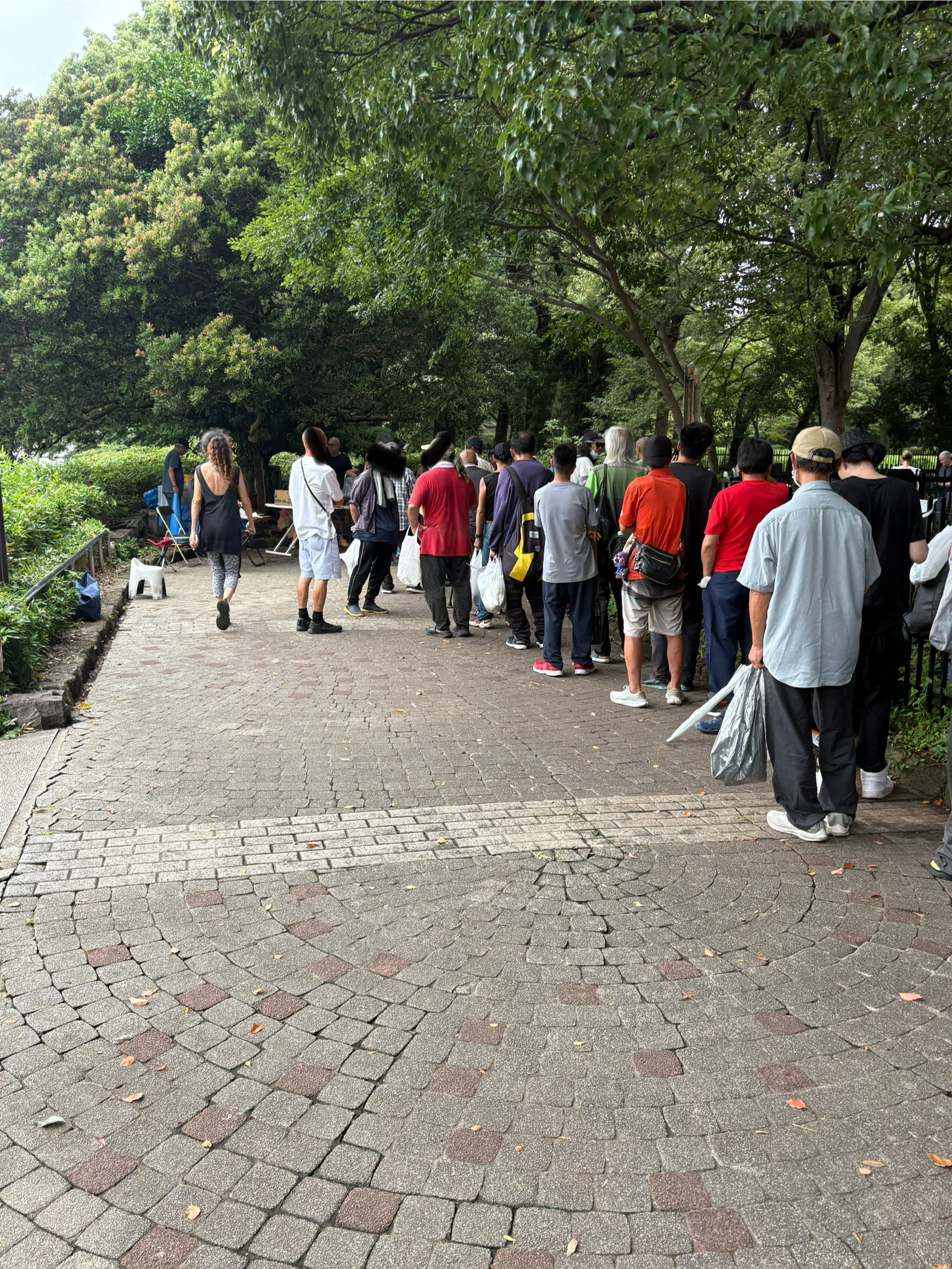
We divided responsibilities. Some volunteers helped serve food. Others organised donated clothing. A small group approached people to ask whether they might be willing to share their experiences with us. I moved between taking photos and videos, coordinating the group and speaking with Grama Seva about what we could build next.
We were fortunate enough to receive a few positive replies and had several conversations with people receiving support. One man agreed to speak with us for more than twenty minutes about his life, how he had ended up in that situation and his experience of homelessness in Japan.
It changed the atmosphere of the morning. Statistics can tell you that a problem exists. A person explaining how that problem became his life does something different.
I began thinking more seriously about the role Volunteers Japan could play. We were a tiny group. Even if we worked extremely hard, there would always be a limit to the number of meals we could personally distribute or streets we could personally clean.
But our contribution did not have to stop there. If we could use our community, social media and future partnerships to make overlooked issues more visible, and, importantly, show people practical ways to contribute, then the effect of an event could travel further than the event itself.
That idea would become increasingly important to how I thought about Volunteers Japan.
But first, naturally, we went for coffee.
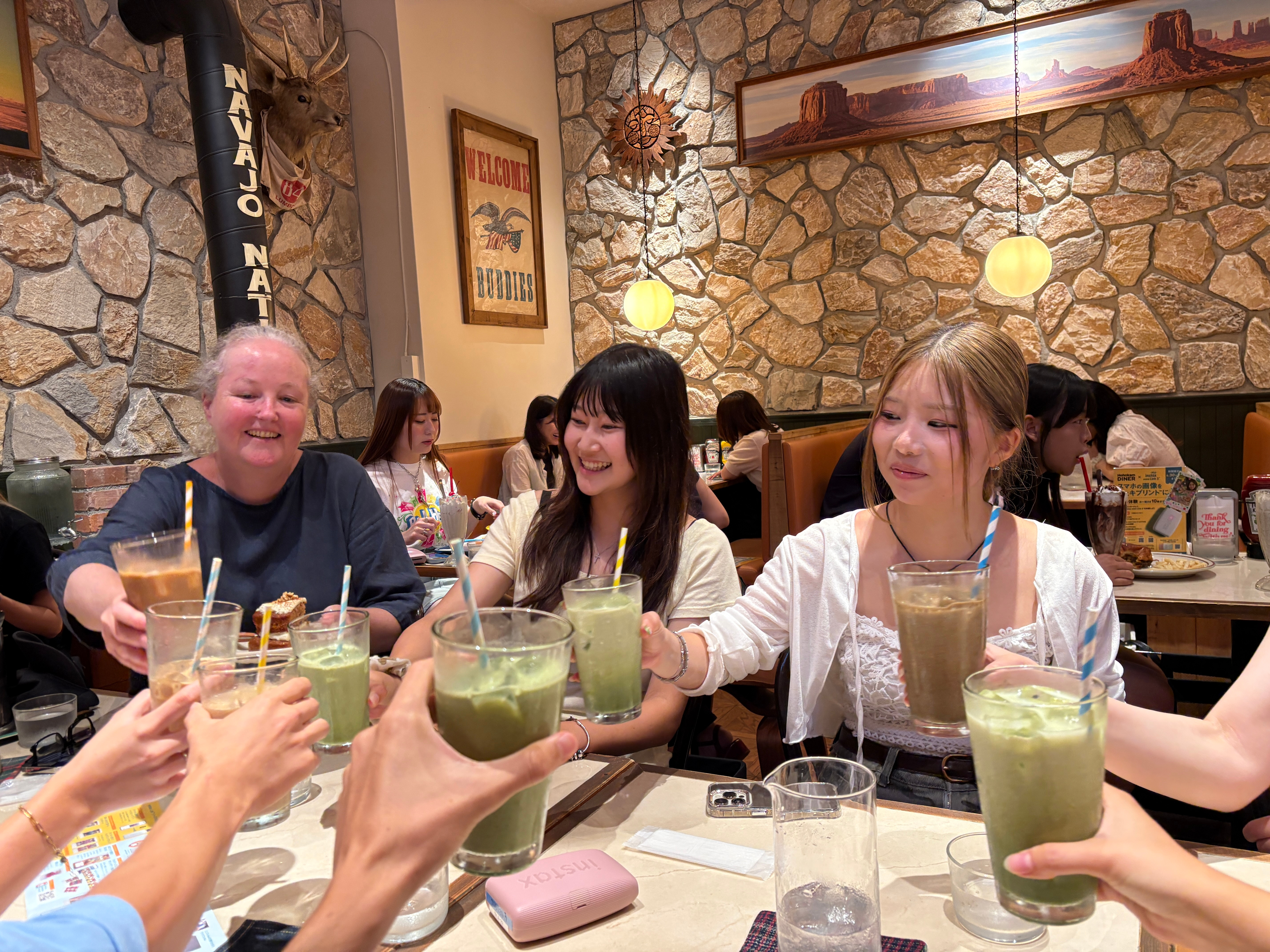
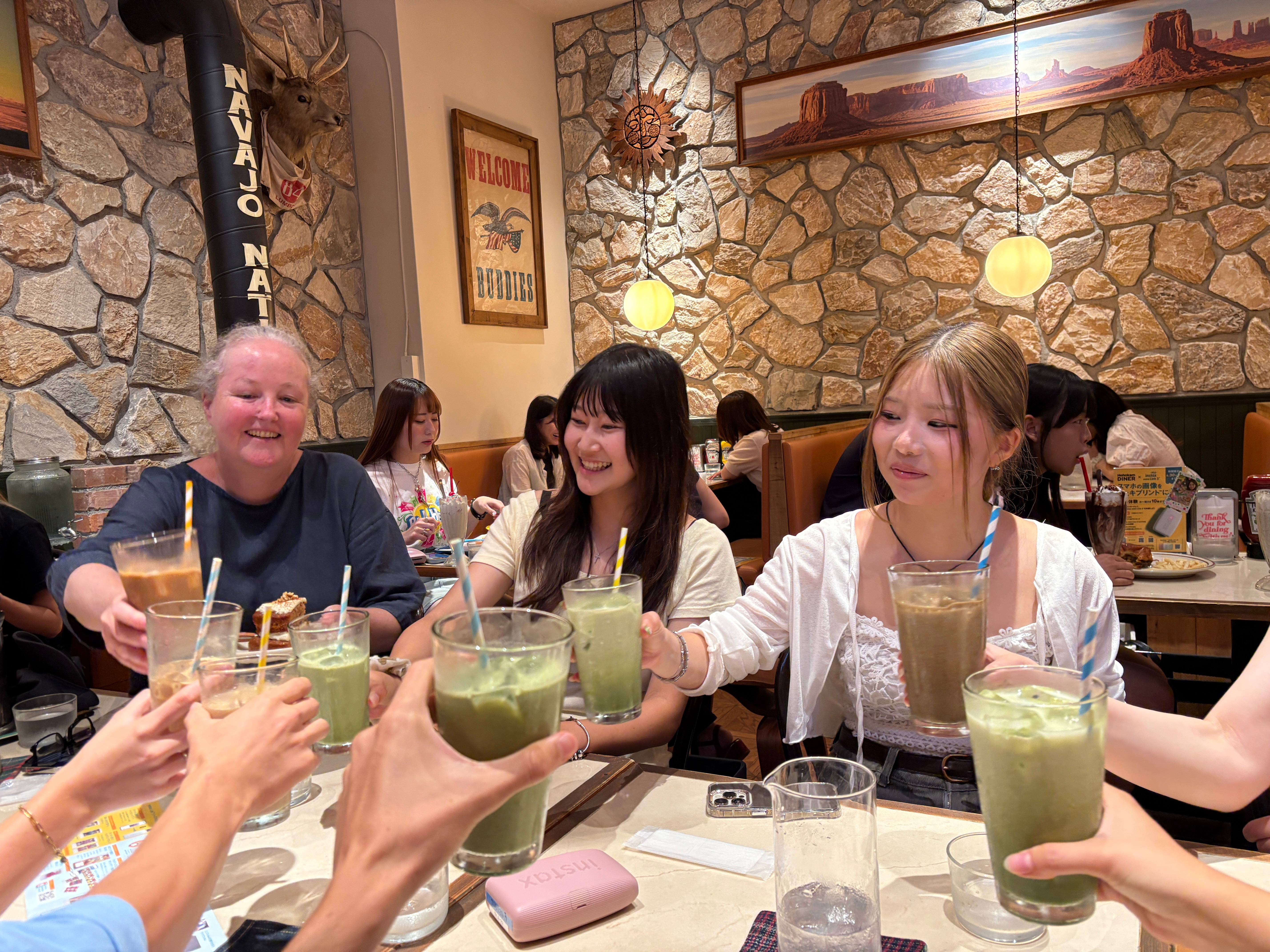
The same café as after the first event, as a sort of tradition.
This was slowly becoming one of the most important parts of the project. People stayed.
New volunteers got to know those who had come before. We talked about the event, but also about ourselves. We discussed possible projects, the people I had met, partnerships we could pursue and what Volunteers Japan might eventually become.
Something in the dynamic had changed. People were actually interested.
They questioned things. Suggested alternatives. Started imagining projects I had not proposed.
This mattered particularly because many of the Japanese students I met were navigating intense pressure around internships, recruitment and the highly structured process of job hunting. Time spent on something without an obvious line on the conventional career ladder was therefore not trivial.
Yet they kept coming back.
Perhaps partly because the volunteering mattered.
Perhaps partly because the friendships did.
Probably because the two were becoming difficult to separate.
By then, it was clear to everyone that building Volunteers Japan would not simply mean importing a successful European model and translating its Instagram captions.
It would have to grow through the people, habits and relationships around it.
Japan was changing how I thought about networking, society and leadership.
Trust came before opportunity more often than I had expected. Introductions carried weight. Coffee could accomplish what hours of laptop work could not. And sometimes the most productive thing you could do for an organisation was simply spend enough time with people for them to understand why it should exist.
By the end of that second event, several doors had opened.
The group was larger.
Our relationships were stronger.
Potential partners were appearing faster than I could follow up with them.
And, most importantly, the volunteers were starting to behave less like people who had joined my project and more like people building our project.
I was delighted.
There was only one slight problem.
If Volunteers Japan really was becoming ours, then eventually I would have to be less at the centre of it.
And with only two weeks left in Japan, I was about to discover that stepping back could be considerably harder than stepping forward.

Ciao! I'm Leonardo, a Laidlaw Scholar passionate about entrepreneurship, leadership, and creating meaningful change in this world. I come from Italy, and at 17, I took an uncomfortable step by moving alone to the UK to pursue my studies, determined to gain access to an English university, networks, and growth opportunities.
My research title is: "Using Points of Interest Data to Understand Retail Change in Great Britain, 2015 – 2025", which deeply connects with my entrepreneurial objectives. Through Laidlaw, I'm excited to expand my leadership capabilities, refine essential entrepreneurial skills and find new people within this amazing network! I'm passionate about engaging with Laidlaw's diverse global community, exchanging perspectives, and fostering long-lasting connections. I look forward to contributing my experiences, collaborating with fellow scholars, and continuously growing as both a leader and an individual.
Please feel free to connect; I’m genuinely excited to share ideas, collaborate, and explore innovative solutions together!
Leonardo
Linkedin
leonardogareri05@gmail.com