LIA Field Journal Week 5
This week was filled with more unexpected experiences. On Wednesday, I got to travel to the United Nations Headquarters for a member-state affiliate conference on SDG16. But before I get into the details of that experience, I want to share some updates on the projects I've completed and the people who have helped shape them, both this week and throughout my time at ILF.
This week was primarily dedicated to one of my biggest deliverables: creating a 6-month social media content bank and rollout plan ahead of ILF's Instagram launch. This task has been demanding, as the ILF had no Instagram presence before I started. However, tapping into Instagram is essential for reaching new audiences and gaining new donors, and so much of my work has been to strategize for such a launch and map out a way to present ILF's work in this format -- one that stays true to authentic case stories while protecting the anonymity of clients and staff. To do this, I sorted and reorganized over 1,000 ILF photos taken across more than 20 years of operations in all of ILF's jurisdictions. This was a meticulous task, but also an exciting one, as it gave me a clearer picture of ILF's on-the-ground work in a way that conversations with team members and case stories alone never could. From there, it was my job to curate images and create infographics for the content bank, pairing in-country photos with text explaining ILF operations, country profiles, composite stories, and lawyer spotlights.
Although creating the Instagram content bank allowed me to exercise a lot of creative liberty, there were notable setbacks that proved eye-opening. After creating what I thought was a strong country profile for Afghanistan -- overlaying a photo of an ILF lawyer teaching a law class to other Afghan women -- I was informed by my supervisor that the content was unusable. Since the Taliban took over Afghanistan in 2021, the ILF has been working toward recertification as a legal aid provider, which requires operating within the current regime and under Sharia law, a context in which women lawyers are absolutely not tolerated. This pattern of unusable content continued, as many interviews and case stories have been deemed unusable due to political persecution and government restrictions across jurisdictions. It has been a compelling and frustrating window into the realities of international humanitarian and legal aid work, and it has made me realize that in our current era, the services that aim to establish an equal and equitable playing field are not only under attack -- their messages are being silenced too.
With that said, I am proud to work alongside women I can call colleagues and mentors, who are fighting relentlessly despite these challenges. Leah, my direct supervisor and ILF's Communications and Advocacy Director, is one such person. Despite the challenges of bridging confidentiality and advocacy, Leah is at the forefront of ILF's public-facing content, always approaching it with deep on-the-ground knowledge and a commitment to anonymity. She wears many hats at ILF: representing the organization at international forums (including UN events), managing fundraising operations, coordinating with in-country teams to schedule interviews, and overseeing promotional content and ILF reports. Through it all, Leah has shown me what it takes to lead an NGO through difficult terrain with precision and purpose.
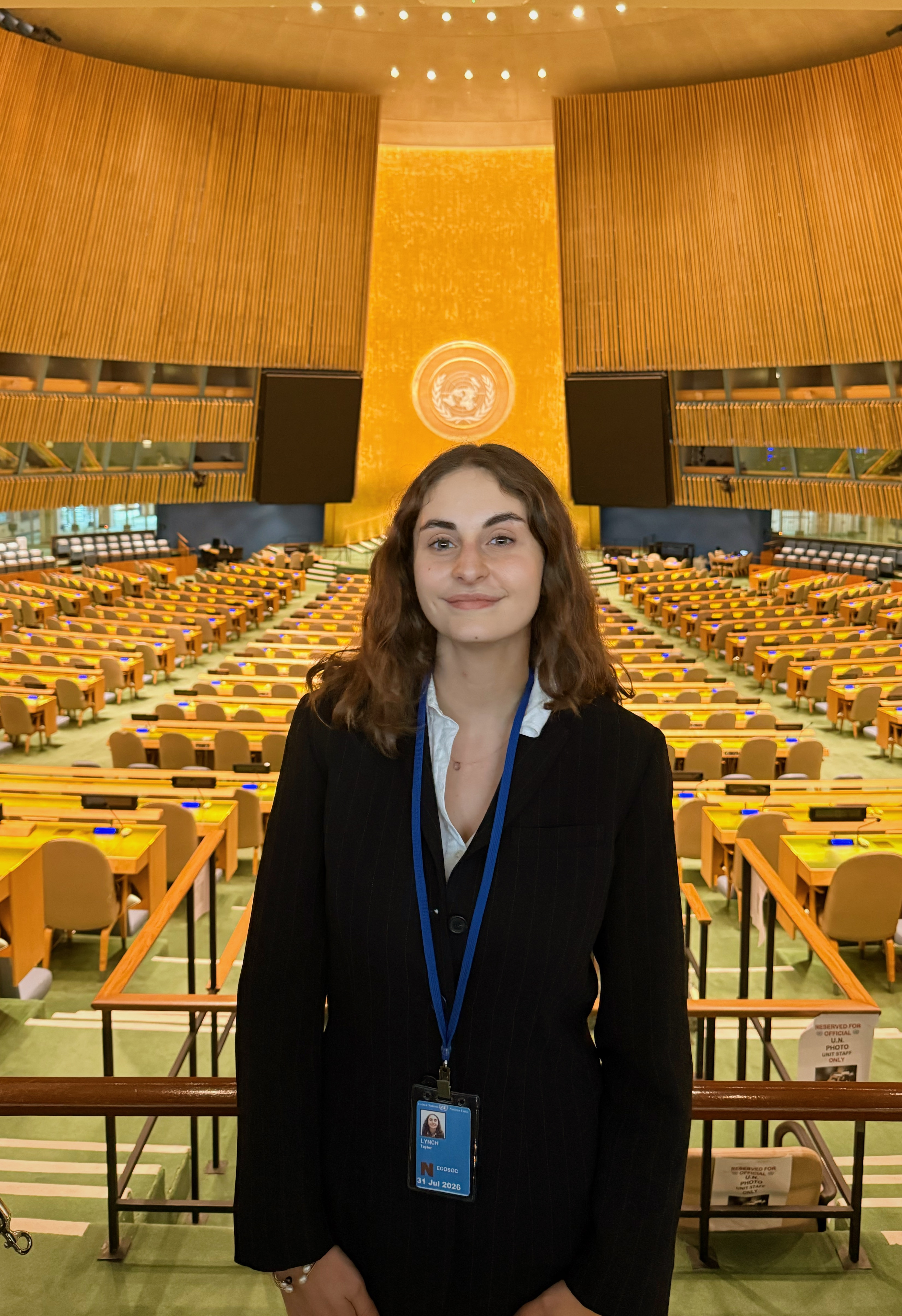
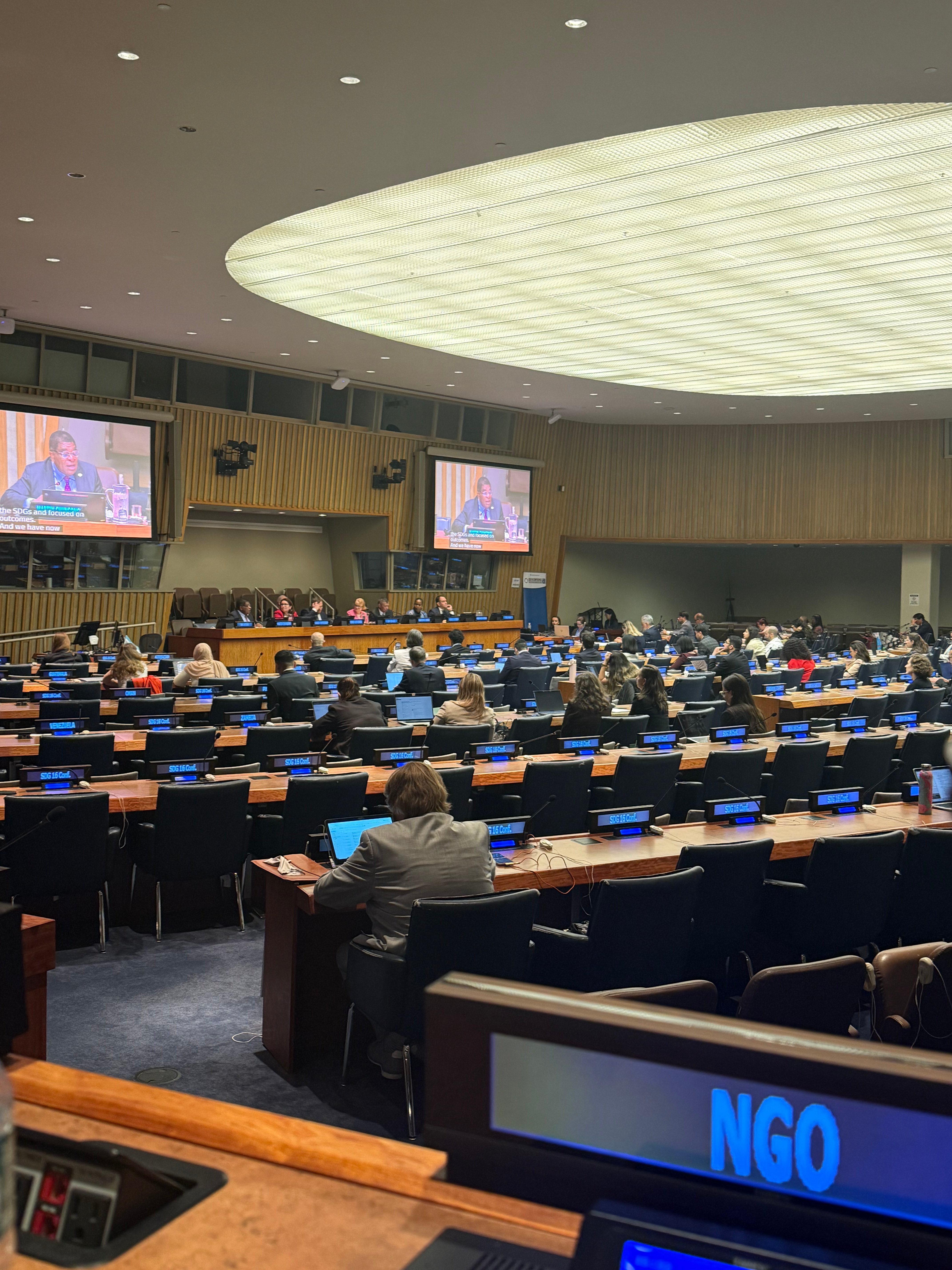
Now, to the conference itself: "Driving Transformation and Coordinated Action for Sustainable Development," held at UN Headquarters. As a delegate representing the International Legal Foundation, this experience was eye-opening in understanding how an international forum operates at the event, organizational, and interpersonal levels. SDG16 is one of the 17 United Nations Sustainable Development Goals for 2030, established in 2015, which together aim to create a more peaceful and prosperous world. SDG16 specifically seeks to "promote peaceful and inclusive societies for sustainable development, provide access to justice for all, and build effective, accountable and inclusive institutions at all levels." The day's three panels addressed a range of approaches to achieving this goal, including increasing the inclusivity of societal progress through public programs, investment, and innovation, and establishing tangible accountability for civil society organizations.
The speaker who left the greatest impression on me was Enzo Romero Muniz, a mechatronics engineer from Peru and the CEO of LAT Bionics. As someone who himself lives with a prosthetic arm, Enzo has dedicated his career to ensuring that disability does not become a barrier to opportunity, through a commitment to inclusive innovation. His words were the most inspiring of the day:
"The hardest barrier was the assumption that disability means less possibility."
"Innovation is about asking who has been left out, who can access it, and what happens to the people for whom systems were never designed to help them?"
"Innovation without inclusion is inequality."
As I head into my final week and prepare for what comes next, I will carry Enzo's words, the lessons I've learned from Leah, and the creativity I've developed here -- in service of SDG16 and in continued advocacy for universal legal aid as a human right.