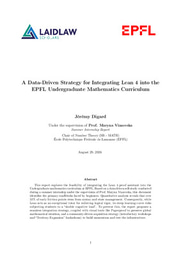
During my summer research ( Report ), I focused on formalizing the Max-Plus Spectral Theorem.
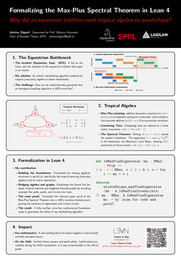
I initially used this tropical algebra framework to optimize scheduling and spot bottlenecks for the Equissima equestrian triathlon (Poster | Application) . But the beauty of mathematical modeling is that the same math can be applied almost anywhere.
Curious to see how this scales to a much larger system, I decided to look at one of the densest and most precise networks in the world: the Swiss railways.
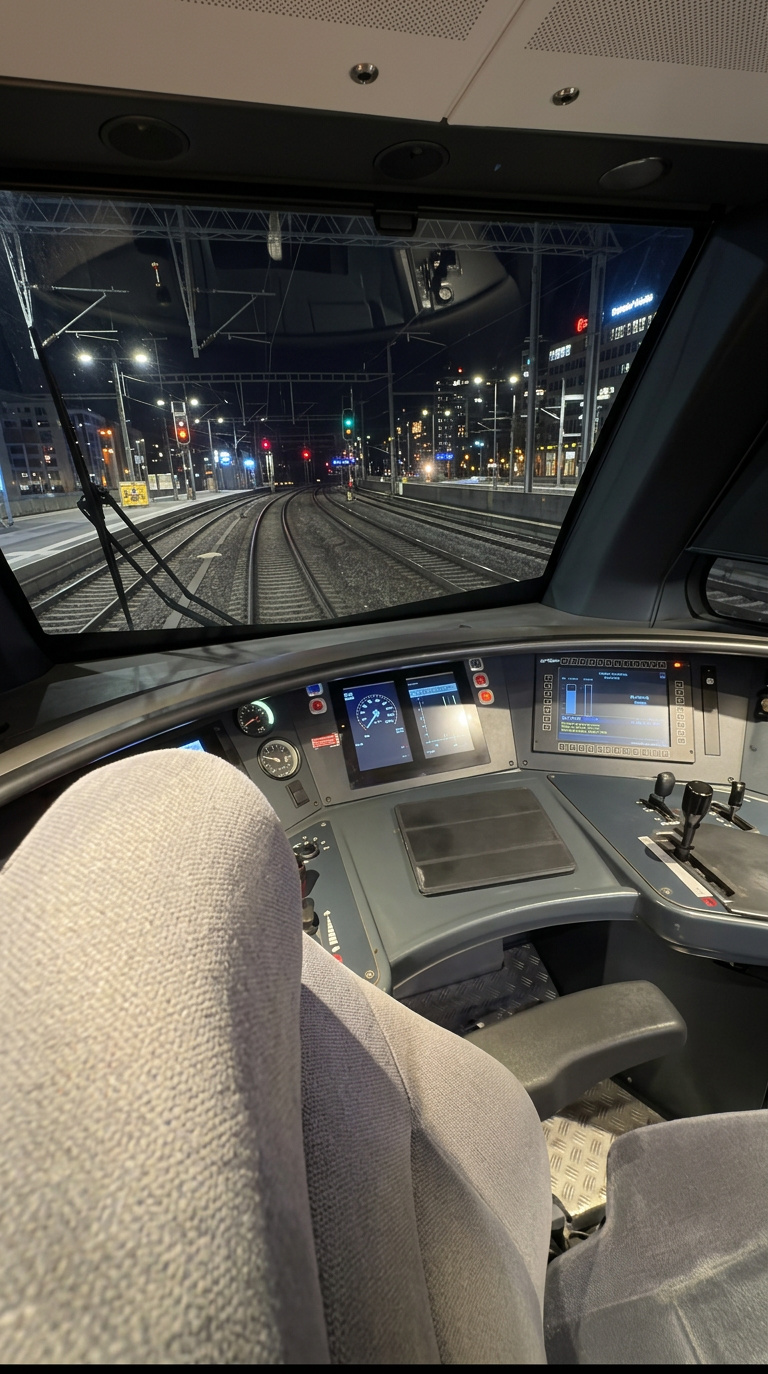
Recently, I had the privilege of riding in the control cabin with a train driver on Lausanne's R1 line. Watching the operations firsthand allowed me to see the real-world delays, track synchronizations, and tight schedules that dictate railway traffic.
By mapping the physical constraints of the train's progression into a weighted directed graph, we can theoretically apply the Max-Plus eigenvalue λ to predict network bottlenecks with O(1) complexity (code). Even more importantly, watching the human side, how the driver anticipates and reacts to signals, me things that pure theory simply misses.
Stepping out of the lab reminded me why I love formalizing mathematics: beyond abstract rigor, it gives us the tools to build reliable foundations for the infrastructure we use every day.
A huge thank you to the railway staff for welcoming me aboard and helping me bridge the gap between pure math and real-world logistics!
 taught

Mathematics researcher at EPFL, Laidlaw Scholar, and systems optimizer. I specialize in formalizing mathematics in Lean 4 (currently researching with Fields Medalist Prof. Maryna Viazovska) and building high-performance software.
I don't just study systems; I look for their underlying logic to optimize them. My recent work ranges from deploying production software that uses Max-Plus algebra to reduce event logistics complexity to , to building decentralized parametric insurance on the blockchain and coding real-time cognitive analysis AI pipelines.
With a background in local politics (former Town Councilor) and a certification in behavioral psychology (PCM), I am fascinated by the intersection of human behavior and pure logic. When I'm not writing proofs or coding, you can find me rowing or trying to teach Lean 4 to my grandmother.
GitHub : github.com/jeremydigard