- What new ideas, challenges, or other issues have you encountered with regard to your project (this might include data collection, information that contradicts your assumptions or the assertions of others, materials that have enriched your understanding of the topic or led you to change your project, etc.)?
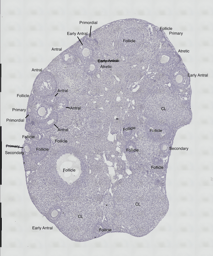
Today, as I was completing my data analysis of the final ovarian tissue sample of my collection (of 30 tissue samples), I realized that the follicle structures I had so diligently labeled on each sample had not saved in the correct order in ImageJ, a Java-based imaging program. I thought about going back to each image and double-checking the measurements (particle area and particle number) I had already completed, but realized this might be inaccurate and inefficient. Instead, I decided to completely restart the measurement process. Obviously, this is not ideal and set back about a week's worth of progress, but I honestly think this is for the better so that the measurements I am making are accurate and useable for subsequent data organization.
- How have these ideas or challenges shaped the bigger picture of your research? Has the scope or focus of your topic changed since you began this project? If so, how?
This challenge is not a large hindrance to my project, but my project has changed in other ways since I began it. My initial plan to research DNA Helicase B would have taken me well over 6 weeks to even start, so I pivoted my project to continuing one my lab mentor has already been working on, which focuses on ZNF518A, an understudied gene that is related to earlier menopause and earlier ovarian aging. As of now, we have knocked-out (aka removed) this gene from mouse ovaries ranging in ages, collected these tissues, imaged them, and now I am in the midst of data analysis.
- Now that you’ve engaged in Part II of the Leadership Retreat, reflect on a learning point that remains with you as a new way to understand leadership, and to incorporate into your own engagement, in the future.
Something that really stuck with me in Part II of the Leadership Retreat is the idea that your work can easily be viewed in different ways according to different audiences. I haven't really considered before how feedback, whether it is positive or critical, could be heavily biased. Rather, I have always taken feedback as verbatim and perhaps that has caused me to doubt some of my capabilities in the past, or even be overconfident in certain areas. I loved the idea of taking what serves me and letting go of what doesn't. Of course, I think all opinions are important and valuable, but if it means progressing as a leader and growing in confidence of my own place in class, the lab, or beyond, then I find this advice incredibly helpful.
Hello! My name is Lauren Suh and I am a rising sophomore at Columbia University from San Diego, California. I am majoring in Neuroscience and Behavior on the pre-medical track and plan to minor in Music (I play the flute!).
This summer, I will be working at the Columbia University Irving Medical Center under the supervision of Dr. Yousin Suh. My research project delves into ovarian aging, a critical marker of systemic body aging as one of the first organs to exhibit signs of aging. I will be researching whether DNA Helicase B, or HELB, delays or impacts ovarian aging.
I love yoga, running, thrifting, and baking! I am hoping to learn pottery this summer, so please reach out if you would like to join!