Field Journal: Week 4
- While all Laidlaw Scholars will be presenting their research at the Columbia Undergraduate Research Symposium in the fall, what are the more immediate expectations that you have for your research? Are you writing a paper? Will your research be part of a larger scientific study? Do you hope to produce an annotated bibliography that you reflect on down the line? Is your research now the first phase of a project you’ll continue to work on throughout the year, and/or next summer? Now that we are nearing the one month mark of the program, please write about your expectations for your research.
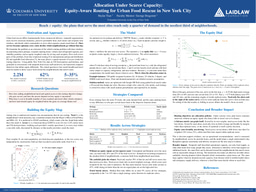
This week for me was rewarding and challenging at the same time. The math modeling side has been going well. I found three different methods to solve the routing problem: the heuristics method used by Google Maps, the set partitioning method used by the world's top optimization company, and the theoretical integer combinatorial solution. However, after talking to the head of Logistics at one of the largest food distribution non-profits in the city, I realized that I might not get the perfect data I was expecting. Instead of having an automated routing model, this organization has many seasoned drivers with 20-30 years of experience. They have tribal knowledge about which church needs what kind of food, and where to deliver them. So the routing process is much relied on human intuition and judgements.
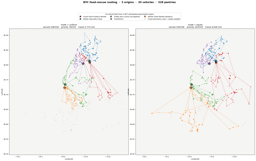
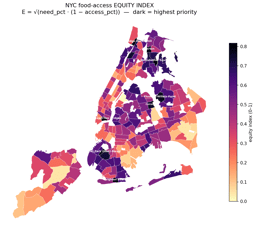
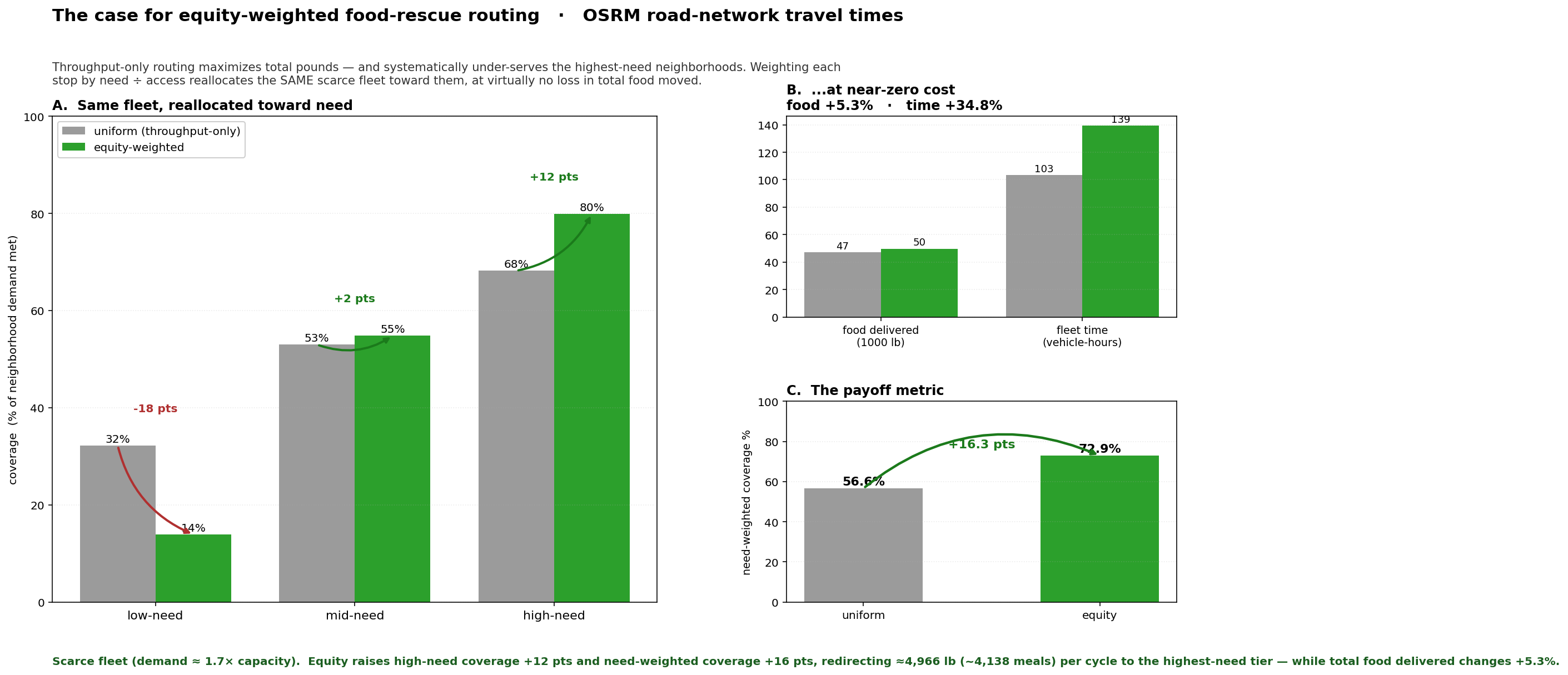
This poses an interesting challenge for me on whether I should try to find the most reasonable parameters to estimate unknown data, or should I shift the focus of the paper I aim to produce. After discussing with my PI, I've decided to go with the former. After so much mathematical exploration, there is a lot of existing modeling framework that I can apply, not to mention the challenge of translating human/natural language information into math would be a fun one. I plan to model three different routes, one purely based on algorithmic optimization, one mimics the current preferential delivery in-place, and one that models both equity and efficiency. I want to produce a research paper at the end of the semester, send tangible results and suggestions to non-profits, and publish the paper in some economics or operations academic journal. I would love to continue the work and refining the algorithms throughout the semester and bring the framework to a new country next year, which would also bring more operational challenges.
- Why does your research matter? Explain the significance of the question you are investigating, and why you are interested in it.
Foos insecurity has been a global issue since the birth of humanity. In the modern world, we have reached a level of cilization where its disappearance is very much realistic, yet there are 1.4 million people just in nyc who are food insecure. There are so many nonprofit and governmental efforts done towards eliminating its harm, and I really want to try my best to maximize the impact of these help, and bridge the gap between need and supply. Many food distribution organizations still run on systems developed decades ago, and by my efforts I hope to provide a new insight, a new potential, for the distribution system. Of course, it will still take a lot of back-and-forth for the strategies to be implemented, but with data and real-life examples, I hope to bring the new possibility to more non-profit organizations and facilitate a more efficient and equitable delivery methods.