Analysis of Stochastic Vehicle Routing on Urban Networks
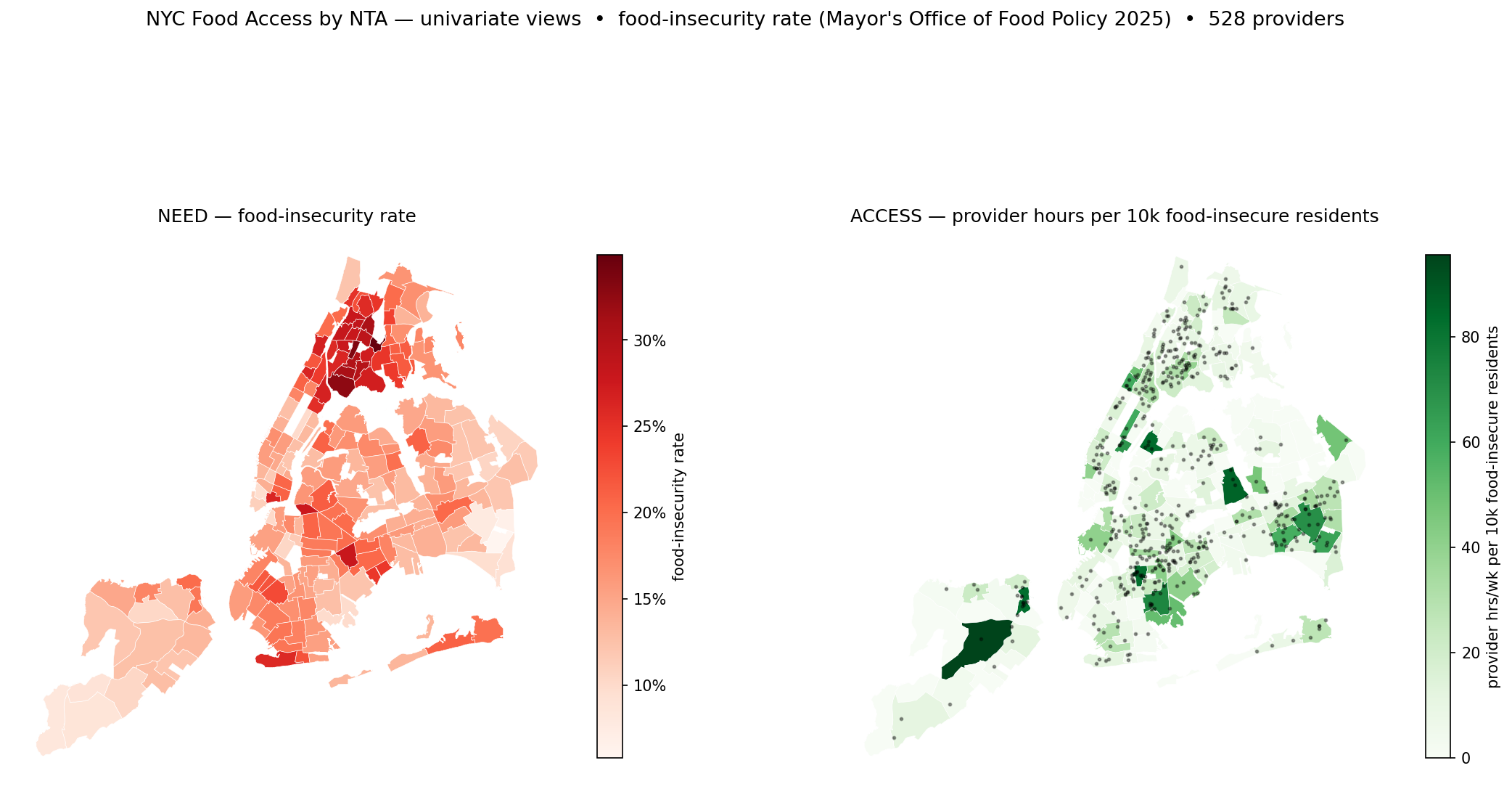
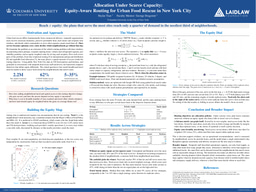
My project investigates how mathematical optimization can make urban food rescue logistics more efficient, reliable, and scalable. Many food rescue organizations coordinate daily pickups from restaurants, grocery stores, events, and suppliers, then redistribute that food to community partners. These routes must account for vehicle capacity, pickup windows, uncertain donation quantities, and city traffic. Mathematically, this can be modeled as a Vehicle Routing Problem with Time Windows, a central problem in combinatorial optimization.
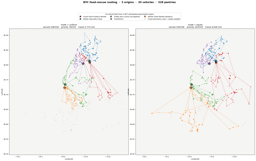
During Summer One, I will develop a focused routing model for urban food rescue operations, beginning with a borough-level pilot inspired by New York City networks. I will formulate the routing problem, study its linear programming relaxation and structural properties, and implement an Adaptive Large Neighborhood Search heuristic in Python. The goal is to generate feasible routes within a realistic time limit and compare algorithmic solutions against benchmark or available nonprofit routing data. If real data access is delayed, I will begin with synthetic and public routing instances while continuing outreach to organizations such as City Harvest.
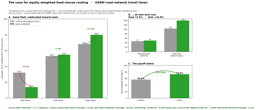
The project is both theoretical and practical. On the mathematical side, I will study how solution quality depends on graph structure, stochastic travel times, and random demand. On the applied side, I hope to produce a working prototype that can help nonprofit coordinators evaluate route efficiency, reduce unnecessary mileage, and increase the amount of food rescued per trip. This work reflects my interest in using rigorous mathematical ideas to study real systems with direct human consequences. It also lays the groundwork for Summer Two, where I hope to adapt the model to a London-based food rescue organization and test whether the approach can transfer across cities and operational contexts.