- What new ideas, challenges, or other issues have you encountered with regard to your project (this might include data collection, information that contradicts your assumptions or the assertions of others, materials that have enriched your understanding of the topic or led you to change your project, etc.)?
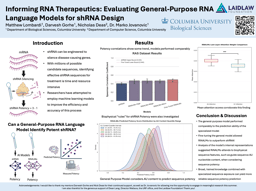
My project sought to evaluate two different RNA language models in their ability to accurately predict potent RNA sequences for RNA therapy. As with most evaluation tasks, there is often the hope that a clear answer arises. One model performs better, and one model performs worse. From this, we can begin to ask why that is the case, inspecting the training, implementation, and testing protocols in an attempt to inform better models in the future. Unfortunately (or, interestingly), both models performed almost the same, with very slight variance between the two. This is an incredibly surprising result, as the training sizes, intended uses, and even AI types (transformer versus Convolutional Neural Net) are noticeably different. Naturally, a plausible answer could be that the general model was only able to learn as much as the specialized model could. But unfortunately, that doesn’t help to contextualize what the numbers mean, nor get us closer to building a better model in the process.
- How have these ideas or challenges shaped the bigger picture of your research? Has the scope or focus of your topic changed since you began this project? If so, how?
Luckily, research is not a static process. It can change and grow as the scope and results vary. My project’s scope has moved beyond this evaluation as a result of my inconclusive(ish) findings. Because the model performance values were so similar, part of my project has grown to try and understand if there exists a performance threshold, and if so, why? In other words, is there a limit to how well these models can predict potency, and are they all converging to that upper bound? Or is there something else at play, such as an artifact of the data. One way to see this was to first fine tune the general-purpose model on these specific sequences before testing. This would be comparable to giving a student the test before test day to read and familiarize them with the questions, without giving them the answer. The aim was to see just how good the model could be when handed all the tools needed to be successful, as an upper bound to contextualize my findings. I am still in that process, and am anxious to see what that investigation will yield. The next step is to build an extremely naive, simple model. This model would be blind to biology and merely seek to find patterns from the sequence text given. If that naive model is able to perform just as well as these sophisticated models, there is likely something inherently inadequate about the models as a whole, or at least some bounded performance threshold.
- Now that you’ve engaged in Part II of the Leadership Retreat, reflect on a learning point that remains with you as a new way to understand leadership, and to incorporate into your own engagement, in the future
The idea of leading from within truly stayed with me. Leading from security in one’s beliefs, worth, and values allows us to lead with intention, without fear, and open to criticism and suggestions from the perspective of growth rather than a challenge to authority. Without question, I often try to lead from the front, attempting to practice what I preach, set an example, and work as hard as I can. When I work as a teaching assistant, I am also forced to lead from beside, as it is helpful to work through problems, questions, and concerns alongside those who I am teaching, viewing them as peers who simply want to be caught up rather than tutees. But through all of those moments, I have the desire to be seen, recognized, and praised. I believe this is natural, but it can be a hindrance when it prevents you from making decisions that are best for the team for the sake of your own position or worth. Leading from a place of confidence in oneself also allows for a humility and serenity of leadership that I can often attribute to leaders around me, but have to date struggled to attain myself. This retreat put that phenomena into words for me, and I hope to focus on growing internally by questioning if my actions and attitudes come from a secure place.
Photo: 46th & Bliss, Sunnyside, Queens