
- While all Laidlaw Scholars will be presenting their research at the Columbia Undergraduate Research Symposium in the fall, what are the more immediate expectations that you have for your research? Are you writing a paper? Will your research be part of a larger scientific study? Do you hope to produce an annotated bibliography that you reflect on down the line? Is your research now the first phase of a project you’ll continue to work on throughout the year, and/or next summer? Now that we are nearing the one month mark of the program, please write about your expectations for your research.
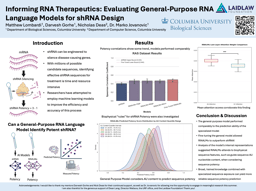
As I near the one month mark, I find myself surprised by how quickly time has flown! I definitely feel as though I am growing with my project, and my expectations have increased as time goes on. I originally hoped for a mere comparison between a general-purpose RNA model’s ability to predict potent RNA sequences versus a specialized model. However, now I am realizing that I am ready to take a step further and try to fine tune the general model for greater performance. That is, building upon the existing general model in an attempt to see just how good the prediction ability can get. I expect that this initial foray into biomedical machine learning will be part of a greater project to understand what biological information machine learning models are understanding/learning, which I hope to continue throughout the school year and into next summer. Though I certainly hope to publish a body of work, for now I want to focus on producing a quality report and presentation, both for in-lab presentation and communication with the Laidlaw/Columbia Research community. Ultimately, if there are takeaways about these models that would enable me to build a better model for this RNA Therapy task, that is a process I sincerely hope to attempt.
- Why does your research matter? Explain the significance of the question you are investigating, and why you are interested in it.
On a personal note, several genetic disorders have impacted my family, including most recently with my uncle who was diagnosed and ultimately passed away with ALS (Amyotrophic Lateral Sclerosis). Neurodegenerative disorders like ALS or Huntingtons, that are heavily influenced by genetic risk factors, show promise in being treated by RNA Therapy. These therapies harness the power of RNA to silence mutated or disease-causing genes without full-on gene-editing. However, identifying the appropriate RNA sequences for therapy via experiment is a time-consuming task with billions of combinatorial possibilities. Researchers have employed machine learning models in an effort to improve this process, but these tools aren’t quite as effective as they can be. Ultimately, a deeper understanding of the computational tools available for this therapy development task can improve the reliability and consistency of RNA sequence identification, potentially lessening a current roadblock to RNA therapy.