A Reflection on the Value of Self-Reflection

Reflecting on the utility of Laidlaw’s leadership training programme, what struck me as most valuable was the opportunity for a focused self-examination of my leadership values and processes. Structured time and space to turn inward and examine my principles enabled me to build my leadership approach on a more deliberate foundation that centered the values important to me. Thus, I can use this greater sense of self-understanding to direct and amplify the positive impact I wish to pursue on my leadership in action project.
Self-reflection is not a passive act, and the sessions made that clear early on. Working through different behavioural models and frameworks gave me a vocabulary and a structure for analysing not just how I lead, but why. I found myself considering the values that have quietly underpinned my approach to leadership in sports, volunteering, and general social situations without me ever explicitly naming them. Qualities like respect, co-operative community well-being, and a genuine investment in people's development have shaped my interests and intentions, but were not previously conscious commitments. The training encouraged me to surface those values and examine them directly — and in doing so, I feel they have become more permanently embedded. Thus, workshops that allowed me to state, and plan around key values will help ensure they consistently and resiliently hold up under pressure.
One of the most practically useful elements was the focus on goal-setting, and in particular the application of SMART goals. In a sports context. In familiar sporting contexts, this is a framework that appears constantly, but I have too easily dismissed it as a trivial approach. The sessions challenged me to be more open to the benefits of qualifying and quantifying aspiration through such a structure. Going forward, I want to plan more deliberately, set clearer short and medium-term goals across my leadership roles, and build in the kind of checkpoints that allow for honest evaluation of progress. This is an area where I can see immediate application, and one where I recognise I have sometimes been too loose in the past.
Alongside goal-setting, the training prompted me to conduct a more thorough personal SWOT analysis than I might have done independently. Two areas stood out clearly as things I want to actively develop: resilience and organisation. Resilience, particularly the ability to maintain composure and direction when plans shift or people disengage, is something sports environments test constantly. Organisation, meanwhile, is the unglamorous backbone of effective leadership — and if I am honest, it is an area where I rely on momentum and enthusiasm more than systems. Having the incentive to confront these shortcomings directly, with the knowledge that looking to improve either aspect would greatly improve my overall performance and output quantity and quality, I hope will inspire me to further actions to improve both qualities.
The collaborative dimension of the training was also something I valued, though I think it could have been deepened further. Hearing about other people's experiences ,both within the cohort and from facilitators drawing on real-world examples, grounded some of the more theoretical frameworks in a way that made them feel genuinely applicable. This also helped to drive more passionate engagement from all involved. In particular, the discussion around volunteerism versus voluntourism felt like a thread that generated engaged discussion, and perhaps could have been explored further. It is a complex area without clear distinctions between well and mal-intentioned or impactful projects, and one highly relevant to the kind of international leadership the cohort of volunteers were stepping into, certainly generating some healthy self-doubt, and reactive determination to ensure to the best of our abilities that our efforts fell on the right side of the spectrum.
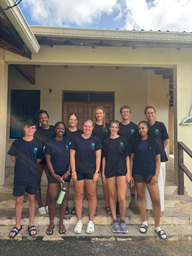
All of this feeds directly into the work ahead of me. My Leadership in Action project centres on developing a coaching framework for United Through Sport's programmes in St Lucia, a framework that needs to be coherent, adaptable, and genuinely usable across different sports and contexts. The training has sharpened my thinking about what that involves. A good framework is not just technically sound; it needs to reflect clear values, set meaningful goals, and be built with an honest understanding of the context it is entering. The conversations around voluntourism, the work on behavioural models, the push toward SMART planning all feed into how I want to approach this project, in a manner that is community-driven, and with an output structured to ensure a long-lasting legacy. .
Overall, the sessions have reminded me that taking time to analyse, to examine values, assess behaviours, and plan with precision, is not a distraction from leading. It is part of it.
I am a History student at Durham University, and part of the 2025 Laidlaw Scholar Cohort. My first year research project explored citizenship education in relation to social cohesion, and sporting provision supporting refugee and asylum seeker integration. Following the publication of my research report, I became a member of the Academic Advisory Group to the All Party Parliamentary Group for Political and Media Literacy. I also work within UK refugee sports provision trying to drive positive change in the sector, through starting my own initiative in Durham, and spotlighting and networking with projects nationwide, through an article series I edit for ConnectSport. In my second year summer, I worked with United Through Sport in St Lucia to produce a coaching handbook for incoming volunteers, to improve their delivery of sports teaching to local children from underprivileged backgrounds.