Research Poster - The hidden signal of the Universe
Preview
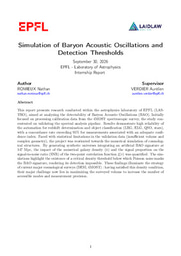
My research internship at the EPFL Laboratory of Astrophysics focused on detecting this subtle signal. Initially, I validated an optical spectrometry analysis pipeline to classify galaxies and determine their redshift, laying the groundwork for precise mapping of the Universe.
However, faced with the challenge of extracting this faint signal from limited-volume samples, I pivoted to a complementary approach : simulation. By modeling a Universe with fractal structures and artificially injecting BAO shells, I was able to characterize the signal's detectability thresholds. By varying the density of simulated points and the signal proportion, my work highlighted a critical relationship : reliably detecting these cosmic oscillations requires galaxy surveys of massive volume. This confirms the necessity of current large-scale cosmological surveys to probe the fundamental structure of our cosmos.