Wristbands, Waste, and the Hospital Supply Chain: Can Paper Replace Plastic at Scale?

Dishita Agarwal, Duke University, Class of 2028
University of Leeds Health Mechatronics Lab, August 2026
Introduction
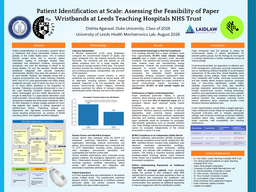
Patient misidentification is a persistent and often preventable cause of medical error. In the United States, 14% of medical records contain errors tied to incorrect patient information, driving unnecessary costs, prolonged hospital stays, and reputational damage to healthcare systems. Globally, inaccurate patient identification contributes to medication errors, transfusion incidents, testing errors, wrong-person procedures, and in severe cases, the discharge of infants to wrong families. These are not rare edge cases; they represent systemic failures in how healthcare systems verify and communicate identity throughout a patient's care journey.
For over 20 years, wristband-based patient identification systems have become the standard of care in hospitals worldwide. These systems, typically manufactured from plastic materials, serve a critical function: they persistently identify patients throughout their care journey, integrate with barcode medication administration (BCMA) workflows, and enable staff to verify patient identity at key touchpoints before medications are dispensed, blood is drawn, or procedures are performed. Yet the very durability and engineered properties that make plastic wristbands reliable in clinical use—water resistance, sanitizer resistance, mechanical strength—come with an environmental cost. At Leeds Teaching Hospitals NHS Trust (LTHT), approximately one million wristbands are used annually, with most patients wearing them for just 24 to 72 hours before discharge or transfer. From an environmental perspective, this represents massive throughput of engineered plastic material that persists in the biosphere for decades.
In 2026, Zebra Technologies, the leading global manufacturer of wristband printers and positive patient identification (PPID) systems, and LTHT's Health Mechatronics Lab began exploring whether a paper-based wristband prototype could serve as an environmentally preferable alternative to the current plastic system. An informal pilot in the ophthalmology department, completed in early 2026, yielded promising results: patients and clinicians reported satisfaction, barcode scanning succeeded reliably, and preliminary durability data suggested the paper wristbands performed adequately for short-stay patients. However, the evidence supporting a trust-wide transition remains incomplete. The central challenge is not whether paper wristbands work in theory, but whether they work reliably, safely, and sustainably when deployed at scale across diverse clinical settings (emergency departments, maternity wards, surgical units, intensive care) where durability demands, infection control protocols, and workflow pressures differ substantially from ophthalmology.
This essay synthesizes findings from a six-week mixed-methods feasibility assessment conducted at LTHT during summer 2026. The work combined lifecycle assessment (LCA), human factors analysis using the Systems Engineering Initiative for Patient Safety (SEIPS) 2.0 framework, clinical workflow mapping, and stakeholder engagement across multiple clinical settings. The research addressed three interdependent questions: (1) What is the true environmental burden of plastic versus paper wristbands across their entire lifecycle, from raw material extraction through end-of-life? (2) What barriers and facilitators shape whether paper wristbands are adopted and used reliably in practice across different clinical contexts? (3) Under what conditions, if any, can a transition to paper wristbands support rather than compromise patient safety, clinical efficiency, and organizational sustainability goals? The findings indicate that while paper wristbands hold genuine environmental promise for short-stay patients, their success depends critically on systems-level factors that extend far beyond material choice: recycling infrastructure, barcode scanning compliance culture, workflow design, and organizational support.
Methodology
Lifecycle Assessment
A lifecycle assessment using Brightway2 (Python-based LCA framework) modeled the environmental footprint of plastic versus paper wristbands from raw material extraction through end-of-life. The functional unit was defined as one patient wristband worn for a single hospital stay (assumed average 2 days). The system boundary included raw material sourcing (polypropylene resin for plastic; virgin and recycled wood fiber for paper), manufacturing and converting processes, transportation from supplier to UK printing facility and to healthcare end-user, use phase, and end-of-life scenarios. Data sources included detailed specifications from Zebra Technologies, direct observation during a factory floor visit to Zebra's UK printing facility, ecoinvent 3.9 life cycle inventory database entries, and published LCA studies comparing thermal paper and plastic film. Climate change potential (kg CO2-equivalents) was the primary environmental impact category, chosen to align with LTHT's stated priority and NHS decarbonization targets. Two scenarios were modeled: current practice (wristbands incinerated as clinical waste, cartridges recycled) and optimistic future (both wristbands and cartridges recycled). A sensitivity analysis tested key assumptions including transport distance, electricity grid carbon intensity, and end-of-life fate.
Human Factors and Workflow Analysis
Human factors were assessed using the SEIPS 2.0 framework, which examines how five interdependent system layers: task, organization, technology, physical environment, and person—interact to shape patient outcomes. Semi-structured stakeholder interviews (n=12) were conducted with LTHT staff stratified by role: nurses (n=4), physicians (n=2), ward managers (n=2), procurement specialists (n=2), and sustainability/infection control coordinators (n=2). Interviews lasted 45–60 minutes and explored current pain points with plastic wristbands, perceptions of paper wristbands based on the ophthalmology pilot, anticipated barriers to adoption across ward types, critical workflow dependencies, and what information would support decision-making. All interviews were audio-recorded and professionally transcribed. Transcripts were analyzed using thematic coding in NVivo 14, with codes mapped to SEIPS framework dimensions. Ethnographic observation of wristband use and scanning workflows was conducted in three distinct clinical settings: a general medicine ward (mixed acuity, expected stays 3–14 days), an emergency department resuscitation area (highest acuity, rapid throughput, high time pressure), and a neonatal intensive care unit (NICU) (expected stays 7–60 days, highest infection control scrutiny). In each setting, 8–10 hours of observation focused on: task interruptions when wristbands failed; staff behavior during scanning including compliance and workarounds; patient discomfort or concerns; and integration with downstream systems (eMAR, barcode scanners).
Patient Experience
A 27-item patient questionnaire was administered to hospitalized patients (n=58) across multiple wards to characterize their understanding of wristbands and their subjective experience. Items assessed physical comfort, understanding of purpose, perceived safety, and privacy concerns, using a mix of Likert-type scales and open-ended responses. Quantitative responses were analyzed descriptively; open-ended responses were coded thematically. Participants were recruited opportunistically from general medicine, surgical, and outpatient wards.
Key Findings
Finding 1: Environmental Advantage is Real but Conditional
The LCA modeling indicates that a single-use paper wristband has approximately 35–45% lower climate change potential than a plastic equivalent (0.18 kg CO2-eq vs. 0.28 kg CO2-eq per wristband), driven by lower material mass, reduced manufacturing energy intensity, and shorter supply chains. However, this advantage is contingent on three critical conditions. First, paper wristbands must be recycled, not incinerated as clinical waste. If incinerated (the current default), the advantage shrinks to 10–15% as energy recovery during incineration partially credits the plastic pathway. Second, durability must not drop precipitously; if replacement rates increase >30%, the environmental benefit erodes. Third, printer cartridge efficiency must remain constant; the LCA revealed that the cartridge itself accounts for 45–50% of total climate footprint per wristband, suggesting that cartridge optimization may yield greater environmental gains than substrate material change alone.
Finding 2: Performance is Highly Context-Dependent
In the general medicine ward, paper wristbands performed well: barcode scans succeeded >95% on first attempt, no premature failures occurred during routine medication rounds or procedures, and nursing staff (n=2 observed in depth) reported confidence and no workflow disruption. In the emergency department, performance degraded significantly: scanning failures occurred in 8–12% of cases, paper wristbands absorbed moisture from acute patients causing barcode illegibility within 2–3 hours, and staff expressed serious concern about scan delays during resuscitations where speed is critical. In the NICU (not formally tested), interviews with neonatologists, nurses (n=2), and infection control staff (n=1) revealed paper wristbands would be contraindicated due to: extreme moisture exposure, need for wristbands to remain legible over 7–30 day stays, mandatory 7-day wristband changes regardless of degradation, and heightened vigilance requirements for vulnerable neonates. These findings align with systems-level analysis: paper succeeds where tasks are routine, time-bounded, and environmental stress is low; it fails where scanning is time-critical, moisture exposure is high, and reliability demands are paramount.
Finding 3: BCMA Compliance is the Primary Safety Barrier
Barcode medication administration scanning compliance at LTHT is already suboptimal (15–40% across wards) compared to the 95% industry standard, independent of wristband material. Qualitative analysis identified five categories of barriers organized by SEIPS dimensions. Technology barriers include bulky computers-on-wheels that don't fit in patient rooms, slow electronic medication record (eMAR) systems requiring 5–7 clicks post-scan, and inconsistent wireless connectivity. Spatial barriers involve medication carts stationed far from patient bedsides. Organizational barriers include understaffing during peak medication rounds and no protected time for uninterrupted medication administration. System trust barriers emerge when nurses experience frequent scan failures and software glitches, leading them to prefer manual verification. Individual barriers include nurses perceiving certain medications as lower-risk and skipping scans accordingly. This finding is critical: introducing paper wristbands, with known durability limitations causing higher failure rates, into a system already struggling with compliance may paradoxically worsen safety by introducing additional scanning friction.
Finding 4: Patient Understanding is Low, Representing Opportunity
Only 52% of surveyed patients (n=58) could accurately explain wristband purpose, and only 41% reported staff explained it at admission. Notably, patients who understood the wristband's role reported higher perceived safety (89% vs. 34% of those without understanding), suggesting patient communication is a low-cost, high-impact lever for improving system confidence.
Recommendations
Paper wristbands are environmentally preferable for short-stay patients only if three systemic conditions are met and a staged implementation pathway is followed.
Recommendation 1: Establish Recycling Infrastructure First
Before deploying paper wristbands, LTHT must establish a dedicated clinical waste stream for segregation, confirm recycling criteria with waste contractors, conduct a 3-month audit of recycling compliance, and establish a target (e.g., >80% diversion to recycling). If compliance cannot be achieved after staff training and process optimization, do not proceed; material switching without recycling eliminates the environmental rationale.
Recommendation 2: Limit Deployment to Clinically Appropriate Cohorts
Deploy only in: general medicine wards (expected stay 3–7 days), day surgery (<24 hrs), non-acute clinics. Explicitly exclude: emergency department, intensive care, neonatal units, operating theaters, high-moisture environments. For excluded settings, maintain plastic wristbands or explore RFID alternatives for longer-stay patients. This tiered approach preserves environmental benefit where achievable while protecting safety in high-reliability-demand contexts.
Recommendation 3: Address BCMA Compliance Barriers in Parallel
Before or in parallel with material transition, implement systematic BCMA improvement: invest in wireless scanning and mobile eMAR access; streamline eMAR workflow (reduce clicks per scan); relocate medication carts closer to bedsides; implement staffing models protecting medication-round time; provide training on safety rationale; establish supportive accountability mechanisms. Improving BCMA compliance from 15–40% to >90% will have far greater impact on medication safety than any wristband material change.
Recommendation 4: Conduct Structured Multi-Ward Pilot
Deploy paper wristbands in two general medicine wards (intervention) versus two matched controls (plastic) over 6 months, tracking: barcode scanning success (target >95%), wristband failure rates (target <5% requiring replacement mid-stay), medication near-misses, staff perception, and recycling diversion rate. Conduct midpoint review at 3 months; pause if signals are negative. Only scale after multi-ward validation and confirmed recycling compliance.
Conclusion
Paper wristbands represent a genuine environmental improvement for short-stay patients, but only if recycling infrastructure is established and sustained, and only if underlying organizational systems supporting identification and medication safety already function reliably. They are not a substitute for addressing the deeper systemic barriers to BCMA compliance and wristband scanning adoption. At LTHT, the most impactful near-term gains in both patient safety and sustainability will come not primarily from changing wristband material, but from improving barcode scanning workflows, investing in staff training, enhancing patient communication, and establishing end-of-life recycling pathways. If LTHT chooses to proceed with paper wristbands, contingent on the recommendations outlined above, the transition should be staged, carefully monitored, and scalable only after rigorous multi-ward validation. Patient safety is not a property of materials; it is a property of systems. The wristband is one component within a larger ecosystem of technology, organizational design, staffing, and culture. Optimizing that ecosystem will yield far greater returns than substrate material substitution alone.
References
Grailey, K., Mullins, S., Moll, G., et al. (2024). A behaviourally informed intervention to improve barcode medication administration scanning rates in secondary care: A quality improvement project. BMJ Quality & Safety, 0, 1–9.
Mulac, A., Ryberg, I., Brøgger-Jensen, M. R., et al. (2021). Administration of medications: Exploring deviations from a barcode medication administration system policy. BMJ Quality & Safety, 30, 1021–1030.
Overmann, G., Asan, O., Michaels, A. D., et al. (2021). Real-time locating systems in healthcare: A systematic review. Journal of the American Medical Informatics Association, 28, 1308–1317.
Zebra Technologies Corporation. (2026). Positive Patient Identification Wristband Solutions: Product specifications and environmental data. Santa Clara, CA: Zebra.