When the Training Became Real | LiA Week 2

Entering the camp, working directly with refugee applicants, and finding my place within a very international team. I think the biggest difference between my first and second week was that everything I had spent the previous week learning suddenly became real. Week 1 had been training: learning about ELIL, the asylum process, interpretation, trafficking, the EU Pact and the wider protection system on Lesvos. This week, I actually started working directly with applicants.
My routine also started settling into something fairly consistent. On Monday, Wednesday and Friday mornings, from 10 a.m. to 1 p.m., I worked at the Protection Legal Aid Hub inside the camp during drop-in hours. Applicants could come with questions about their asylum procedure, interviews, documents or other concerns. The afternoons were generally spent back at the office doing research, attending interviews, taking notes and working on case preparation, while Tuesdays and Thursdays were entirely office-based and usually involved some combination of the same.
Entering the camp for the first time
There are certain details from my first day inside the camp that I remember much more vividly than I expected to. I remember showing my passport ID to security, seeing Frontex and other border-control personnel around the site, and being surprised by the large scale of the camp. More than anything, though, I remember the brightness. Lesvos in June was incredibly hot, and between the white structures, pale ground and the glare from the sun, the brightness genuinely hurt my eyes. And then, right beside it, was the sea. The contrast was strange: this beautiful blue water that you would normally associate with being on a Greek island, right beside a place where people were living while waiting for migration decisions that could completely change the direction of their lives.

I was much more nervous when we reached the legal-aid trailer than I expected to be. Importantly, I wasn't doing any of this alone. I was there as the Legal Assistant alongside a lawyer and an interpreter, both of whom had worked with ELIL for years and knew the environment far better than I did. Still, I had somehow convinced myself that after a week of training I should be prepared for whatever question somebody walked through the door with. Obviously, I wasn't, and I don't think anyone could be. What changed over the following shifts wasn't that I suddenly knew every answer. I simply became more comfortable with not having one immediately, and with understanding that knowing when to ask someone more experienced was also part of doing my job properly.
My first interaction and a lesson in language
One of my first interactions made that lesson especially clear. A young man came in who spoke Pulaar, a language spoken in parts of West Africa, including Senegal. I had never even heard of Pulaar before. His friend could communicate with him in Pulaar and then speak French, while our French-speaking interpreter helped bridge the conversation with us. What might otherwise have seemed like a relatively simple conversation was suddenly moving across several people and languages.
I found that experience surprisingly humbling because I had arrived in Lesvos quite conscious of the fact that I speak Hindi, Urdu and Punjabi. I had even spent part of my first week preparing a glossary of legal and asylum terminology in those languages because I expected interpretation to be one of the main ways I could contribute.
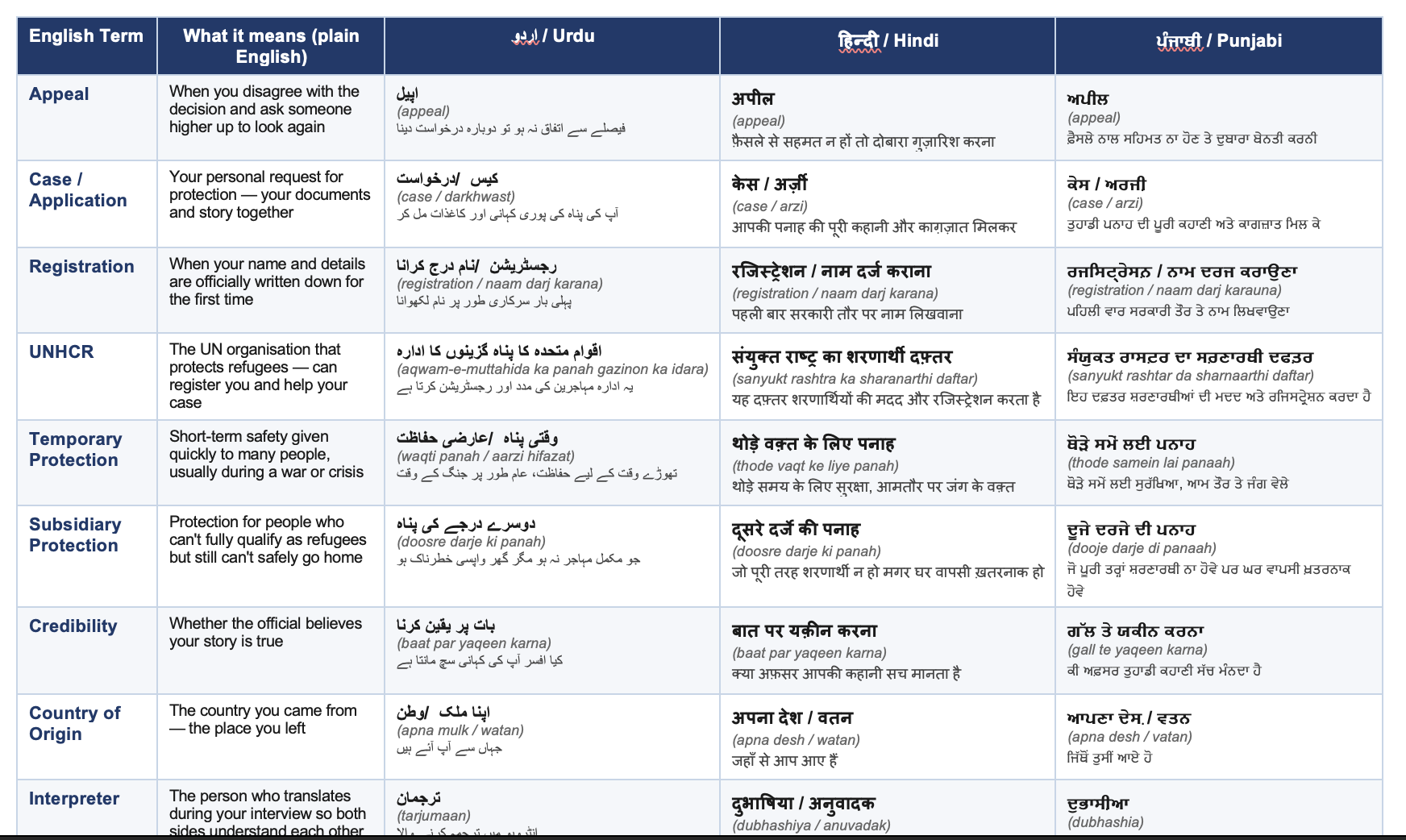
Instead, one of my first interactions introduced me to a language I did not even know existed. It made me realize how enormous the linguistic diversity around me actually was and changed the way I thought about being useful. I had arrived thinking about the skills I could bring to the organisation; very quickly, the more important question became what the person sitting across from me actually needed.
That interaction also made the importance of language access feel much more concrete. A friend may be able to help someone communicate informally, but an official asylum procedure is different, and appropriate interpretation becomes part of a person's ability to meaningfully participate in it. Looking back, I think this was one of my first real lessons in cultural humility: not trying to arrive already equipped to understand everyone, but being comfortable recognizing what I did not know and adapting accordingly.
A new law, on the ground
The timing of this week was also kind of surreal. On 12 June, the EU Pact on Migration and Asylum entered into application after a two-year transition period. I had spent time learning about it during training, but now I was on Lesvos at the exact moment a major reform of the European asylum system was beginning to apply.
What interested me most was what happens after a law officially starts. A regulation can say that something changes on 12 June, but what does that actually look like inside a legal-aid trailer the next morning? How quickly can organisations adjust? Are there enough resources and trained people? How does an applicant experience a legal change that may look very neat on paper?
I kept coming back to the same thought: a legal date can change overnight. Institutions and everyday practice usually cannot.
Learning how to listen
Another big part of my week was sitting in on client meetings and taking detailed contemporaneous notes, usually two or three meetings each week. The typing itself was probably the part I was most prepared for because my work as a criminal court reporter at the Ontario Court of Justice has made me very comfortable listening and typing at the same time. The setting, though, was completely different.
Most meetings involved an interpreter. A question could move from the lawyer to the interpreter, then to the applicant, and all the way back again. Someone might hesitate, return to something they had said earlier, or need a question phrased differently. I had to capture the conversation accurately while also keeping up with how layered it was.
The lawyers relied on those notes afterwards to understand the case, identify what needed clarification or research, and prepare for next steps. Sometimes I would use them to help prepare a case memo. That made accuracy feel different. Missing something wasn't just missing a sentence. It could mean losing a detail somebody else would later rely on.
The people behind the work
Something else was happening by this point too: the office was starting to feel less like 'my placement' and more like a little community I was becoming part of. There were also plenty of moments in the office that had absolutely nothing to do with serious legal work. At one point we tried to sketch the team on the whiteboard. I would not say any of us discovered a hidden artistic talent, but that was probably what made it fun.
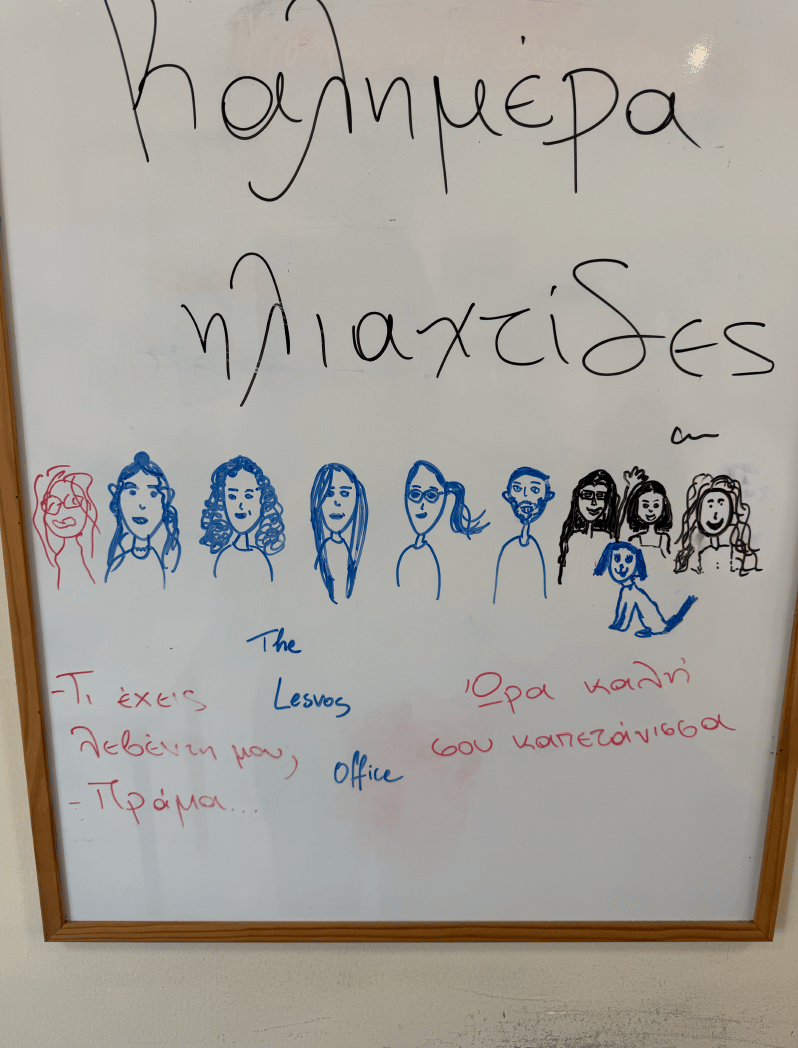
Our attempt at drawing the Lesvos team. The resemblance is... debatable.
What I'm taking from Week 2
By the end of the week, I was noticeably less nervous. Once I stopped believing I needed an answer to every possible question before somebody walked through the door, the work became much easier to settle into. My job was not to magically solve everything. It was to listen carefully, contribute within my role and know when somebody more experienced needed to step in.
I don't think this week involved leadership in the stereotypical sense. I wasn't directing anyone or making major decisions. But I started understanding that being useful without needing to be the person in charge is its own kind of leadership. Sometimes that means knowing the answer. Sometimes it means finding the person who does. And sometimes it means sitting quietly through a long interview and making sure there is an accurate record at the end of it.
Last week, I wrote that all the pieces of training were starting to form a picture of what protection looks like in practice. This week, I actually stepped inside that picture. It was much messier, more collaborative and much more human than a legal framework makes it look.