I've always thought that everyone should prepare to be a leader, but not everyone should be vying to be the leader. Everyone should be fully capable of leading. That belief is a big part of why I applied to Laidlaw. I wanted research experience ahead of my fourth-year capstone, and I really wanted to improve my leadership and coaching. I've coached rugby and taught science, and I've always been really proud of other people. I've always wanted to help others shine brightest.
Two summers later, here's what Laidlaw taught me. Before Laidlaw, I thought good leadership was creating a system for great people to do their best work. I left with that belief reaffirmed, because I've seen first-hand what happens without one.
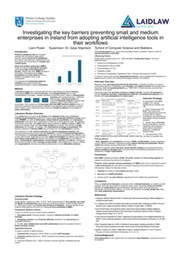
In my first summer, my research looked at AI adoption in small and medium-sized businesses. The first three weeks were very quiet: sifting through papers, reading abstract after abstract after abstract, then distilling the most useful ones down and understanding them. It could be lonely. I was on my own for most of a 35-hour week, so I built a routine: a fixed start time, a weekly call with my supervisor, and the interviews to look forward to. It taught me how to focus on one problem for hours on end, how to pace myself, and how to think deeply.
The interviews were immensely enjoyable. Seeing how hard these small business owners work was really humbling, and I wanted to give back and give them advice where I could. My headline finding was that the barriers to AI adoption were organisational, not technical. The frontier AI labs are obviously building something amazing, but the real beauty is in helping people.
In my second summer, for my Leadership-in-Action, I joined ALPACA Assessment, a Trinity spin-out that screens around 60,000 children a year for dyslexia. It mattered to me personally, because I had signs of dyslexia as a young child.
The summer didn't go to plan. My supervisor had left before I started, the team went from ten people to five, and halfway through I was pulled off the tool I was building to help with the main production. So I did what I could: I set up systems, like better triaging and ticketing, that let the team get through the work. It was difficult, but it was eye-opening. It also meant I was coaching, supervising, and some days leading the team, which is exactly the leadership I came to Laidlaw for.
Looking back, what got me to ALPACA in the first place was curiosity, the Change Maker Value I relate to most. It's constantly spoken about at Laidlaw, and I felt like I was being reminded of it wherever I went. One of the compliments I heard most, even at ALPACA, was "Wow, you're so curious." I only found such a meaningful LiA because I bumped into ALPACA's founder, Joe, at a conference. After we got talking, Joe just said, "I really like how curious you are. Please come join us."
I think character is something you never fully get a hold of. In college it's hard to balance humility with putting yourself out there, bigging yourself up to get into rooms you'd otherwise miss if you always stood in the corner. Being part of the Laidlaw cohort always keeps me humble. I'm surrounded by people who are incredibly passionate about what they do, and it gives me a burning urge to care about something and do something good with that passion. The character sessions helped too. At one LEAD day, about 30 of us had to go up, one by one, and talk about something on the spot. We were all scared, but we all did it. It really spoke to me how normal people do scary things all the time, and it's a confidence I use every week. At ALPACA, humility also meant owning my mistakes. Late one night during a stressful release, I told a teammate the responsibility wasn't ours. They stayed on the call anyway, so nobody had to work alone, and we got the job done.
ALPACA also taught me you don't need a title to lead. I was the newest member of the team, but because I was bridging the commercial and technical sides, I was essentially leading the engineering team as a product owner, helping them prioritise which issues to solve. That meant very clear communication, systems that worked for everyone and not just me, and staying patient and calm under pressure. The triage and ticketing systems I built cut the engineers' resolution time by around 50%. Instead of sifting through the codebase, they get a problem, a priority and a proposed next step, and can tackle each issue one at a time.
Beyond ALPACA, the Laidlaw experience that widened my view most was the conference. You're exposed to some of the best and brightest from across Europe, and even the world, people who care about such niche and interesting topics. One Scholar I connected with was Samuel from the University of Toronto, who spent his LiA at the International Legal Foundation in New York, telling the stories behind legal aid work in Afghanistan, Myanmar and the West Bank. While I was deciding on my own LiA, I was inundated with stories like his from Laidlaw Scholars and alumni, and I knew I wanted to do something meaningful with the opportunity. That's what had me settle on helping Irish kids get access to learning support. Around 85% of four-to-six-year-olds, in Ireland and internationally, are never screened for literacy difficulties, so when I was offered the chance to help, I knew I had to. Seeing Scholars take on problems all over the world made me realise my local problem is part of a global one.
None of this happened on my own. I can't emphasise enough how supportive Kate and Darren have been the entire time. Whenever my travel arrangements or my schedule messed everything up, they were always there to help. My Summer 1 supervisor, Dr. Gaye Stephens, was incredibly supportive, gave me a lot of advice and steered me in the right direction the whole time. Joe and the ALPACA team gave me real ownership over real problems, and they've been a pleasure to work with. And I struck gold with my Laidlaw cohort. Everyone is so kind, caring, passionate and curious about each other.
If I could tell next year's Scholars one thing, it's to throw yourself into your Laidlaw work, because you've no idea what might come out of it. For me, some of the most meaningful things Laidlaw led to are my community work with Hack Europe and my current part-time job. I was referred to Hack Europe based on my Laidlaw project, and that role led to my job. That's why I always try to get to the Laidlaw talks and extra sessions. You'll never regret spending extra time on Laidlaw.
As for what's next, I'm continuing to do meaningful community work through Hack Europe, a tech community across the continent. I've used my Laidlaw skills to help a cohort of students prepare for the Foundation Scholarship exams, as a science teacher at the Trinity Walton Club, and in my rugby coaching. Everyone should be ready to lead, and Laidlaw helped show me how to step up if the time comes. Whatever new opportunities come my way, I'll always know that Laidlaw helped start opening doors for me right at the beginning.