Before Laidlaw, I think I had a fairly conventional idea of leadership. I associated it with initiative, decisiveness and responsibility: seeing that something needed doing, making a plan, and then making sure it happened. I still value all of those things, but over the past two years I have become much less convinced that leadership is mainly about being the person with the clearest answer.
A lot of my experience with Laidlaw has instead involved situations where the answer was incomplete, where other people understood the context better than I did, or where I could complete what I had set out to do and still not control what happened afterwards. That has made my understanding of leadership less tidy, but probably more realistic.
The Oxford Character Project was important in changing how I thought about this. A recurring theme in the lectures and conversations with other scholars was that leadership is not simply a set of skills. Character matters because the same skill can be used well or badly depending on the judgement behind it. We discussed qualities such as humility, humanity, courage, drive, temperance and integrity, but what interested me most was how easily apparently positive qualities can come into tension with each other.
Drive is a good example. I have generally seen being driven as one of my strengths. I like making progress, and when I can see what needs to be done, my instinct is normally to start doing it. In discussions with other scholars, however, I began to think more seriously about what happens when a strength is overused. Drive can become impatience. Determination can turn into persistence with an idea that is no longer working. Wanting a group to move efficiently can mean giving other people less space to contribute.
That made the idea of temperance much more interesting to me. I had previously thought of self-restraint as quite passive: essentially, not doing something. I began to see it instead as creating enough space between an instinct and an action to exercise judgement. Sometimes the better leadership decision is not to speak first, not to settle a question immediately, or not to assume that because I have an answer, I have the answer.
Talking about these ideas with other scholars also made it obvious that there is no single ideal leadership personality. Someone who naturally hesitates may need more courage and drive. Someone whose instinct is to act immediately may need patience and humility. The same character trait can help one person and hinder another depending on the context.
That was probably one of the most useful things I took from the OCP: good leadership depends less on possessing a particular collection of admirable traits than on knowing which of them a situation actually requires.
My summer research gave me a different version of the same lesson.
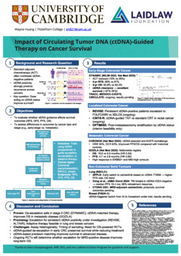
My project looked at whether circulating tumour DNA could be used to guide cancer treatment in ways that improve patient outcomes. What initially attracted me was the technology itself. Liquid biopsies are an exciting idea, and there is something intuitively compelling about being able to detect molecular evidence of disease through a blood test and then adapt treatment accordingly.
But the project quickly forced me to separate what sounded promising from what the evidence actually supported.
There was a tempting narrative available: if ctDNA can detect residual disease earlier and predict recurrence, then acting on that information should improve outcomes. The difficulty was that prediction and intervention are not the same thing. A biomarker can be strongly prognostic without proving that changing treatment because of it will help patients. Some applications had convincing clinical evidence, while others were still being tested. My review therefore ended with a conclusion that was necessarily uneven rather than a simple yes or no. research report
I used to find conclusions like that slightly unsatisfying. There is a pressure in research to feel that a good project should eventually resolve the question it begins with. Instead, I became more comfortable with the idea that responsible research may end by defining more clearly what is known, what is plausible, and what remains uncertain.
That taught me something about leadership too. Confidence is not the same as certainty. Sometimes taking responsibility for an argument means refusing to make it cleaner or more exciting than the evidence allows.
That became surprisingly relevant during my Leadership in Action project with Cambridgeshire Deaf Association.
I went into the LiA with a fairly clear plan. The main aim was to produce a professional-facing information and signposting resource that could help clinicians and other professionals understand what CDA offers and when someone might benefit from its support. I had also set myself the goal of developing some basic BSL.
At first, I saw this as a relatively straightforward project. CDA had been positive about the idea of improving signposting and communications, and I assumed the main task would be turning that idea into a useful final product.
Spending time at CDA changed my understanding of the problem before it changed the project itself.
As a medical student, my starting point was naturally quite medical. I tended to think first about hearing loss, audiology, hearing aids and access to clinical care. These things matter, but speaking with people at CDA made that framework feel incomplete. One regular attendee described CDA less as a formal “service” and more as somewhere she could communicate naturally and spend time with people without continually adapting herself to a predominantly hearing environment. 306748440
That stayed with me because it changed the way I thought about what CDA was actually providing. Its value could not be reduced to a list of services. Communication, independence, social connection and belonging were part of it too.
It also made me rethink my role. I had arrived interested in how professionals could signpost people more effectively. But before deciding how to explain CDA to outsiders, I needed to understand what they were being signposted to.
That sounds obvious in retrospect, but I think there is a genuine leadership trap in arriving somewhere new and immediately asking, “What can I create?” rather than, “What already exists, and where would something from me actually be useful?” It is particularly important in community work, where enthusiasm can very easily turn into an outsider designing something that reflects their own priorities more than the organisation’s.
The final information pack therefore became less about creating a new pathway and more about making CDA’s existing services and signposting clearer to professionals. It was a relatively small adjustment, but it reflected a much bigger shift in how I thought about the project.
My experience with BSL made the same point in a different way.
I had put learning basic BSL into the project plan because it seemed like an obvious part of working with a Deaf organisation. I started learning, but it quickly became clear that developing meaningful competence would take much longer than I had imagined. At a Deaf Community activity, my limited BSL sometimes made it difficult to enter conversations, and I relied on simple signs, gesture, writing and help from other people when communication broke down. 306748440
Initially, I felt that I ought to keep devoting significant time to BSL because it was something I had said I would do. But CDA staff were quite practical about it. The project I was actually working on was aimed mainly at professionals and did not depend on my becoming independently conversational in BSL. If I needed to speak with service users in more depth, there were people who could interpret.
So I changed the plan and concentrated more heavily on the information pack.
That was a small decision, but it changed how I thought about adaptability. I had previously thought of changing direction mainly as something you do when a plan fails. Here, nothing had exactly failed. I simply had better information. Continuing to prioritise BSL because it was written into my proposal would have meant being loyal to the plan rather than to the purpose of the project.
It also challenged the idea that being useful means becoming capable of doing everything yourself. There were already people at CDA who understood BSL, Deaf culture and the local community far better than I could after a few weeks of introductory learning. I did not need to become the expert in those areas. My useful contribution lay elsewhere: understanding something of the healthcare perspective, organising information, and translating CDA’s existing support into a form that might be easier for professionals to navigate.
One of the questions in the Laidlaw reflective material asks when leadership might mean supporting rather than leading. I think this project gave me a very concrete answer. Sometimes somebody else is simply better placed to lead.
The more difficult part came later.
The information pack itself was completed broadly as I had originally imagined. What became less clear was what would happen to it afterwards. CDA had seemed quite enthusiastic about the idea at the beginning of the summer, but as time went on their engagement with it became more limited. There was never a clear rejection of the project, but I received less feedback than I had expected and the work became increasingly self-directed.
By the end, I had a finished resource, but I did not know whether CDA would actually use it.
My first instinct was to treat that as a problem I needed to solve. Perhaps I needed to follow up more. Perhaps the pack needed another round of refinement. Perhaps if I made it sufficiently good, implementation would follow.
Eventually I became less convinced by that way of thinking.
I could take responsibility for producing the strongest resource I reasonably could. I could make it accurate, clear and useful. But CDA is its own organisation, with its own staff, constraints and priorities. I could not turn my project into their priority simply because it mattered to me.
That was probably the point at which my understanding of leadership changed most clearly.
I had previously associated taking responsibility with taking ownership of the outcome. I now think those are different things. I can be accountable for my decisions and my work without pretending that I control everything around them.
It also forced me to be more careful about the language of impact. It would be easy to say that my project “improved signposting” or “strengthened access to support”. That was what the resource was designed to do. But I do not have evidence that it actually did.
What I can honestly say is that I produced a professional-facing resource intended to make CDA’s existing support easier to navigate, and that its eventual uptake remains uncertain.
I think integrity in leadership includes being willing to make that distinction.
Curiously, this connected back to my research. There, I had spent a summer asking whether something promising actually changed patient outcomes. In the LiA, I faced a much smaller version of the same problem. A resource can be well designed and theoretically useful without being adopted. An idea can make sense without yet having demonstrated impact.
In both cases, the difficult part lies between something being plausible and something actually changing an outcome.
The LiA also made me think differently about systems. CDA sits somewhere between healthcare, social care, voluntary support and community. During a Hearing Aid Maintenance session, I saw how something as simple as changing tubing or replacing a battery could determine whether an NHS-provided hearing aid remained useful in everyday life. 306748440 No single organisation controls that whole system. Healthcare provides one part, voluntary organisations another, and people themselves often have to navigate the gaps between them.
My information pack was, at most, a small intervention at one of those points of connection.
That has made me more cautious about the language of “making change”. Six weeks is a short period, and most social problems are sustained by structures and relationships that existed long before one student project and will continue afterwards. I do not think that should make us passive. It should simply make us more realistic about scale.
My understanding of a global mindset has changed too. I used to associate it mainly with international experience: crossing borders, working in different societies and being exposed to unfamiliar cultures. I still think that matters, but CDA reminded me that unfamiliarity can exist much closer to home.
For most of my life, I have moved through environments designed around spoken communication without thinking very much about it. In a BSL-dominated setting, even briefly, that assumption was reversed. I was the person who could not automatically follow what was being said.
I would not equate that short experience with living as a Deaf person in a predominantly hearing society. But it made one point very clearly: what feels normal often reflects the environment that happens to have been built around people like us.
For me, global citizenship now has something to do with recognising that my own assumptions are not universal, whether the difference in front of me is national, cultural, linguistic or social.
If I had to identify the qualities that developed most over the course of Laidlaw, I would probably choose judgement and humility.
Humility, not in the sense of making myself smaller, but in becoming more comfortable with the limits of my knowledge and contribution. And judgement because none of the other qualities works particularly well alone. Drive matters, but sometimes it needs temperance. Ambition matters, but curiosity should sometimes make you question what you are being ambitious about. Courage matters, but so does recognising when another person should lead.
I still value decisiveness and initiative. I do not think the lesson of the last two years is that leadership means endlessly listening and never acting. If anything, I feel more comfortable taking responsibility than I did before.
The difference is that I am less likely to confuse decisiveness with certainty.
I can make a decision while knowing that I may need to change it. I can lead a piece of work without assuming that I am the most knowledgeable person involved. I can finish something properly without overstating what it achieved. And I can take responsibility for the part of an outcome that belongs to me while recognising that other people and systems retain their own agency.
That is a quieter idea of leadership than the one I started with. But I think it is one I will actually be able to use.