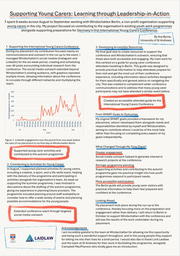
Going into my final year, I have found myself doing a lot of interviews: specifically, virtual interviews where you sit alone in your room in business-attire and talk to your screen about your life experiences for anything between 20 to 45 minutes. One unexpected consequence of this is that you get to the point where you already know what questions they are going to ask. For example, every interview begins with a baseline practice question: ‘what is the weather like where you are now?’. The next question (graded but ungraded) is always: ‘what is an aspect of your everyday life that you really enjoy?’. The right answer for me is reading my large collection of free articles which my university library sends to my email daily, where I first came across the idea of an ‘internal locus of control’, the topic of my final Laidlaw output.
On August 31st (just over halfway through my placement), Andrew Palmer of the Economist’s Bartleby published his weekly column on ‘the quality you should wish most for your children’, with a unique answer you may never have heard about before: an internal locus of control. A quick search reveals a psychology term which (for once!) has not yet been co-opted by pseudoscientific course-selling voices. The term, coined by Julian Rotter in the 1960s, refers to the understanding that some people have that they are able to influence the world around them, as opposed to those with an external locus of control who believe the world operates on fate, luck, or any combination of the above (Rotter, 1966). The column itself discussed a collection of studies on the topic: from the newly unemployed in Germany to expectant mothers to virtual coins (Cobb-Clark, 2015; Lekfuangfu et al., 2014; Levitt, 2016), drawing this back to the Bartleby focus of businesses. But what interested me was not how I use the concept to develop my hiring processes (maybe in the long run?!) but how closely it seemed to describe what I had developed in my two years as a Laidlaw scholar. At the beginning of the programme (in hindsight very starry-eyed, although definitely felt jaded at the time!) and in spite of parroting the idea of leadership as wide-ranging, I really only understood it in very narrow terms: responsibility, taking on a role, completing a task, contributing to a team.
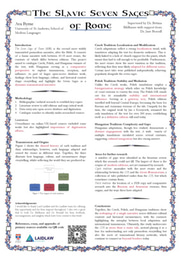
Looking back, the thesis of this blog was there from the very start of my research summer, although I didn’t see it at the time. My first Laidlaw project, Unveiling Slavic Adaptations of the Seven Sages of Rome, involved researching different versions of the text to present my findings in the final Laidlaw essay; however, as part of a wider Arts and Humanities Research Council project to catalogue the tradition, my work also needed to be uploaded into an open-access database (Bonsall, Bildhauer, and Nöth, n. d.); in the end, I think it was the database which made the strongest contribution to understanding where my role and others fitted into the wider world of kncwledge, thinking on the broadest level about the relationship between information and interpretation. A database appears on the surface to just organise existing knowledge, but through meeting with my supervisors, I saw firsthand how the categories we choose, the connections we make, and the information we decide shape future users’ conceptualisation of the story. This is where the idea of agency came in: there was no single prescribed way to organise the data I found, it was a constant exercise in decision-making surrounding what I already have, where do I need to go next, what would a future potential user most need. I would have said before that I was an empathetic person, but empathy with a hypothetical individual definitely pushed my beyond my comfort zone! If I had been aware of it then, I like to think I would have started to identify this with the idea of an internal locus: my influence over how I engage with what is in front of me and how this impacts people I will never even meet.
Over the following two years, this became less confined to Laidlaw and spread across all areas of my life. Through volunteering, committee work, student representation, and other roles, I increasingly found myself in situations where my actions affected other people. Practicing taking initiative regularly made me not only more comfortable with my own place in controlling circumstances, but helped me place where others fit: when you should make a decision yourself, when you should ask for support, and how this will shape the future for yourself and others. One of the key moments that I was able to recognise Laidlaw’s impact was in a different academic module; writing up a reflection on a conference discussion for an international relations grade, my experience with Laidlaw looking at how actively research (i.e. the actions of a few people in an environment with very specific rules) can shape the wider world allowed me to submit a piece of work which my professor subsequently submitted for publishing!
My Leadership-in-Action project with Windschatten Berlin offered me the first opportunity to knowingly put my understanding of agency into practice. I arrived with three SMART goals, but also the understanding that (particularly over the summer) things are inevitably less predictable than a planning document that you Frankenstein-ed together months beforehand. Rather than viewing this as an obstacle, I was able to view it as an opportunity to further shape my experience in the programme, and to put something out that I was really truly proud of, creating over 40 promotional posts for social media and putting together a guide to Berlin for young carer attendees of this year’s International Young Carers Conference. In many ways, this brought together things I have been working on throughout my experience in Laidlaw: the ways we organise and present information, the ways in which our actions shape lives beyond our own.
After two years of Laidlaw, I would define the idea of leadership very differently: it’s not about managing every circumstance, and it’s not about having responsibility for everything ever. It’s about recognising where you fit, where you have agency, taking the lead on what you can change and understanding when something is out of your reach and you need the support of other’s. Having started the programme with the idea of leadership as control, I am concluding it seeing the idea a bit more gently, as shaping.
Bibliography
Bonsall, Jane, Bettina Bildhauer and Maximilian Nöth (eds), ''The Seven Sages of Rome'' Database (2024–2026) https://db.seven-sages-of-rome.org/index.php?title=Main_Page&oldid=8394
Cobb-Clark, D.A. (2015) ‘Locus of control and the labor market’, IZA Journal of Labor Economics, 4(1). doi:10.1186/s40172-014-0017-x.
Lekfuangfu, W.N. et al. (2014) ‘Locus of control and its intergenerational implications for Early childhood skill formation’, The Economic Journal, 128(608), pp. 298–329. doi:10.1111/ecoj.12414.
Levitt, S. (2016) ‘Heads or tails: The impact of a coin toss on major life decisions and subsequent happiness’, NBER Working Paper 22487 [Preprint]. doi:10.3386/w22487.
Rotter, J.B. (1966) Generalized expectancies for internal versus External Control of reinforcement. Washington: American Psychological Association.