The Heartbeat of Hinohara | LiA Week 4




Fujikura Lion Dance
Each district within Hinohara has its own distinct history and traditions, many of which are celebrated through local festivals. In Fujikura, where the NPO has its main base, this takes the form of the Fujikura Lion Dance. Although the festival itself is only held once a year in September, I was fortunate enough to attend a rehearsal this week.
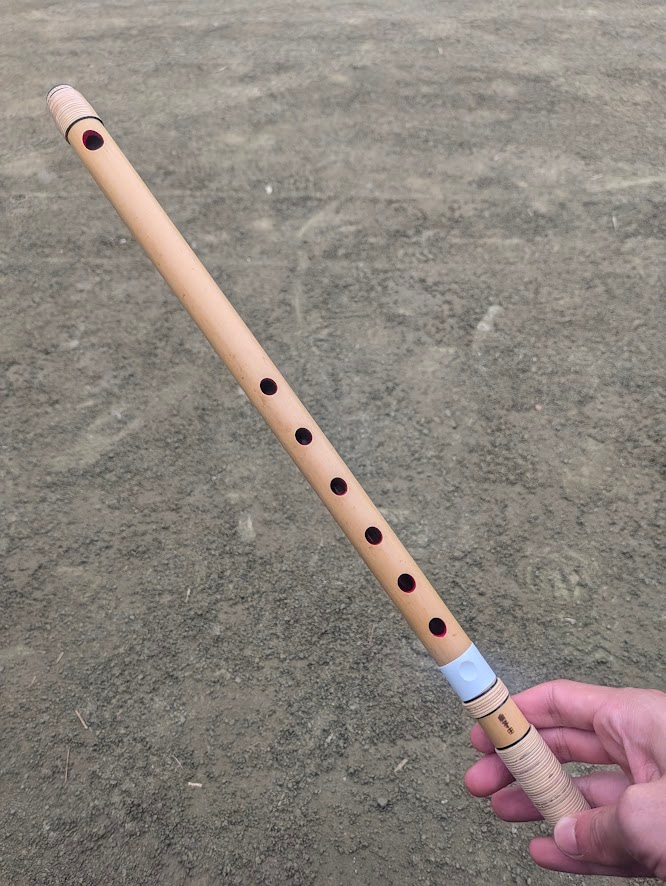
Passed down through generations, the performance has strong ties to the region's Shinto traditions and was historically performed to ward off evil spirits and pray for abundant harvests. Dancers wear brightly coloured costumes representing a lion while playing the tsuzumi, a traditional hourglass-shaped drum. Their performance is accompanied by the shinobue, a bamboo flute whose distinctive sound forms the melodic backbone of the music.
Today, the event also serves as one of the most important community gatherings of the year. Listening to the musicians rehearse, it was immediately apparent how deeply embedded the tradition is within the community. The flutes blended together, their melodies spilling out through the open doors of the practice hall and across the valley. There was a calmness to the music that made it easy to see why people continue to dedicate their time to preserving it.
I was even given the opportunity to join in. The tsuzumi itself was not especially difficult to play, but combining the rhythm with the choreography proved far more challenging, particularly when the movements involved repeated deep squats. The shinobue was an entirely different challenge. With plenty of encouragement from the locals, I eventually managed to coax a few hollow notes from it. Compared with the clear, beautiful sound produced by the experienced musicians, my efforts were laughable. Nevertheless, the experience provided another opportunity to connect with local residents, whose enthusiasm and patience continually make me feel welcome.
Building a Hut
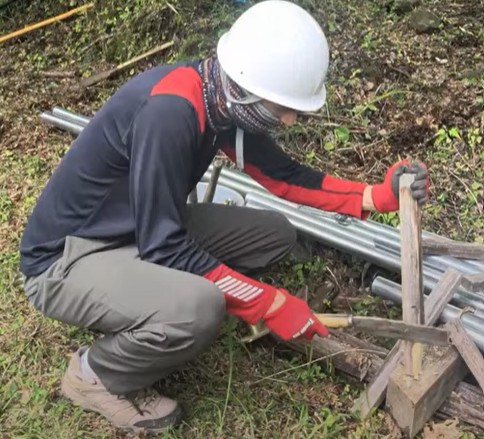
The NPO undertakes a variety of environmentally conscious construction and restoration projects. One of the current projects involves building a small hut that will be used for soil blocking, an environmentally friendly technique that compresses soil into self-contained cubes rather than relying on plastic seed trays.
Working on the structure has provided an opportunity to learn how to use a variety of traditional Japanese tools, including the kama, a serrated sickle, and the ryoba, a double-edged saw. One of the NPO staff members, a retired architect, is leading the design and construction process, and working alongside him has offered fascinating insight into traditional building methods and practical craftsmanship.
Feast for the Ages
This week also marked the NPO's annual general meeting. To celebrate afterwards, members gathered for a large communal feast.
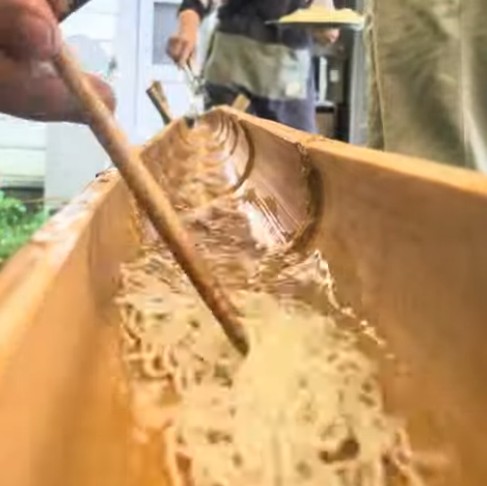
The highlight of the meal was nagashi somen, a style of eating cold noodles that involves sending them flowing down a bamboo water slide. Diners attempt to catch the noodles with their chopsticks before dipping them into a soy-based sauce and eating them. It is a surprisingly competitive activity, and my chopstick skills were tested more severely than ever before. Unfortunately, my success rate was not particularly impressive, largely due to the fierce competition, which meant my portion size remained rather modest.
Two local delicacies were also on offer. The first was venison, prepared with butter, garlic, and rosemary before being roasted over an open fire. Served simply with salt and wasabi, it was among the best venison I have ever tasted. The second was local ayu, a prized river fish often referred to as the "Queen of Clear Rivers". Commonly eaten during the summer months, it was grilled whole over the same fire. As the fish is traditionally eaten complete with bones and innards, the flavour can be rather bitter in places, making it something of an acquired taste.
Mount Fuji
On my day off, I woke to a forecast promising clear morning skies across the region -- a rare gift during the rainy season. There was only one possible destination.
Standing at 3,776 metres, Mount Fuji is Japan's highest peak and remains an active stratovolcano. Its last eruption occurred in 1707, over 300 years ago. While that may sound reassuring, Kawakami-san tells me that many people worry that centuries of dormancy have allowed pressure to build beneath the mountain, meaning that whenever Fuji's overdue eruption occurs, the effects could be felt far beyond its slopes.
What makes Fuji so striking is its isolation. Unlike many mountains, it rises almost entirely alone from the surrounding landscape. From my viewpoint overlooking Lake Kawaguchi, I found myself staring at it for hours. The scale of the mountain was difficult to comprehend. Its slopes appeared almost impossibly smooth, as though they had been painted in a single sweeping brushstroke.
Occasionally, the clouds parted just enough to reveal the mountain in greater detail. Bands of bright farmland gave way to dark forests, then bare volcanic rock, before finally reaching the streaks of snow that lingered near the summit. Looking out across the landscape, it became easy to understand why Mount Fuji occupies such a significant place within Japanese spirituality.
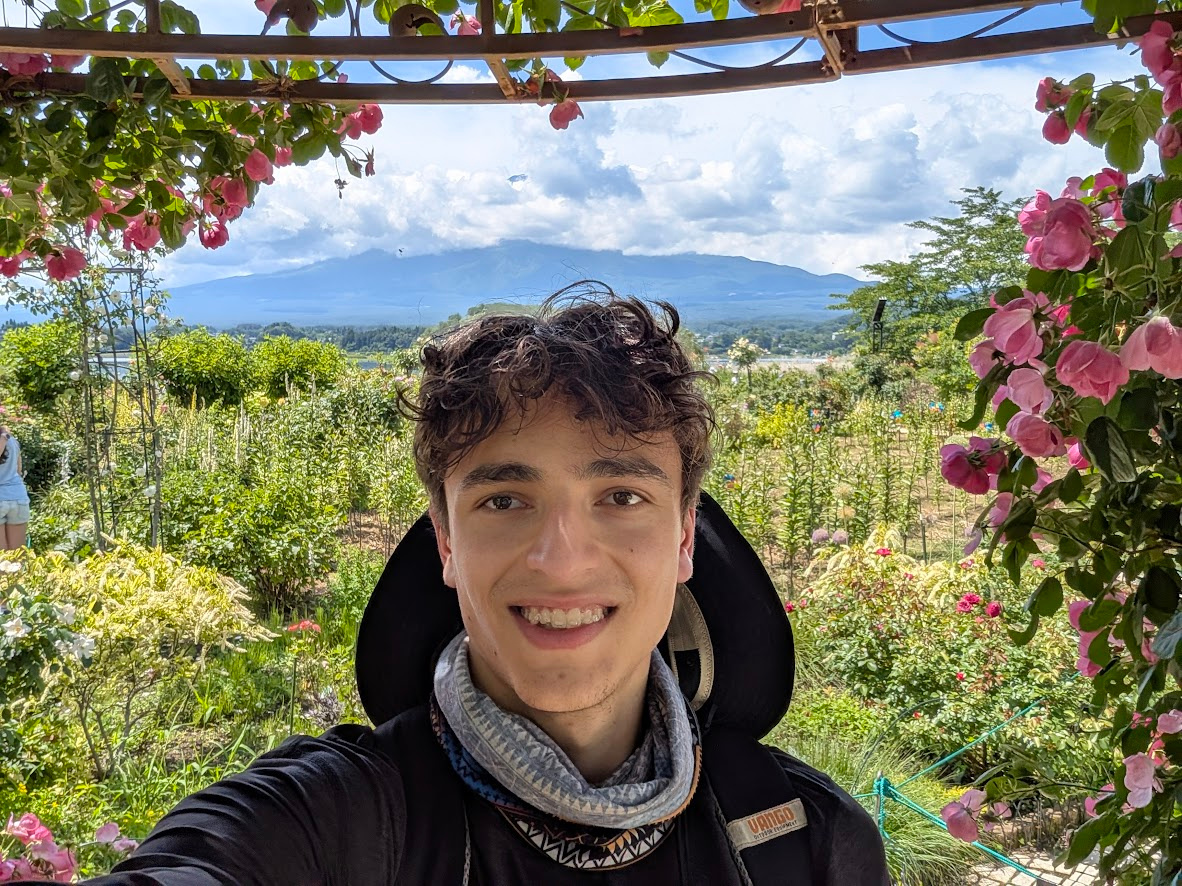

Hello! I am an incoming third year at the University of St Andrews, studying Mathematics.
My summer 1 research focus was on applying Bayesian networks to electroencephalography (EEG) data. My research poster was presented at the 2025 Global Laidlaw Scholars Conference in Durham, where it was selected by Taylor & Francis to be published.
My summer 2 Leadership in Action project is based in Hinohara village, Japan. I am partnering with Satoyama School Tokyo to support their ongoing efforts in learning, preserving, and sharing the traditions of a "satoyama" lifestyle: an old, nature-focused way of living in mountain villages.