Scholarship reflection: Character, leadership and Global Citizenship
My Laidlaw scholarship has been a truly transformative experience, from my work on avian populations in Surinamese mangroves, to presenting at conferences, to my LiA on erosion management strategies for Lake Ziway, Ethiopia. All of these experiences taught me something different about character, but contained common threads of listening to others, being honest about the limitations of research, and communicating effectively.
In my research project, I used audio from Autonomous Recording Units (ARUs) and the machine-learning tool BirdNET, to investigate the abundance and species of birds in different types of mangrove forest, which act as the coastline’s flood defences. This research taught me my first real lesson in ethical leadership, which was a key feature of both my research and my LiA: being honest about the limitations of my work. I found statistically significant differences in acoustic complexity between sites, but with such a small number of sites I couldn’t argue for a causal link to the different mangrove species present. A big part of my output became recommendations on how to interpret BirdNET’s confidence scores, and a library of clips grouped by species so that others with more expertise in the birds of Surname than me could verify the detections. This developed my character dimension Integrity, and the capacity areas Process and People: reviewing my work critically throughout, and leaving it in a state where it could be continued by others after I was gone.
This project helped me understand how important collaboration is in research – my project was a small part in a much wider, multinational initiative on coastal defence in Suriname, ‘ENHANCES’. I was able to bring my specific skill set to that small area, learning from and relying on others that had worked on the project before me (eg the researchers in Suriname with knowledge of the area that set up the ARUs), and making sure I presented everything in a way that made it easy for the next person to continue my work. BirdNET itself only works because people around the world have shared their recordings through Xeno-canto and eBird: citizen science displaying global citizenship in a very literal sense.
At the Laidlaw annual conference, I chaired three panels of research project presentations, ran a quiz activity on the first evening and took over the Laidlaw LinkedIn for the weekend. Standing up in front of a room of people I didn’t know took Courage, and chairing developed my Temperance: my job was to keep time and give each speaker space to present their work, not to steer the conversation. Hearing scholars present research from so many different disciplines and countries also showed me how many valid ways there are to approach the same problem.
I also took my research poster to the British Ecological Society (BES) conference, which enabled me to attend a wide range of talks on new research in Ecology from people all over the world. This showed me that being a global citizen in research means being one contributor in an international network – sharing data and methods openly so that others can build on them, just as XenoCanto / BirdNET had let me build on the work of thousands of others.
The Oxford Character Project encouraged me to reflect on my character, enabling me to work on my weakest dimensions (Temperance and Humanity), and to understand how to let my strongest dimensions (Drive and Transcendence) shine. In the pre-LiA leadership training I built this into a SWOT analysis with concrete plans, which ended up being incredibly instrumental in helping me succeed during my LiA.
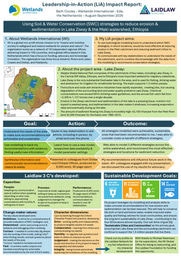
My LiA at Wetlands International in Ede, modelling how Soil and Water Conservation strategies could reduce erosion and sedimentation in Lake Ziway, Ethiopia, is where I put what I had learnt into practice. Lunchtimes in an office full of colleagues from around the world developed my understanding of global citizenship: rather than one person travelling somewhere to extract local knowledge and bring it home, the organisation brings cross-cultural knowledge to the table every day. I spent much of my first two weeks learning, from hydrologists at Acacia Water and colleagues in the WI Ethiopia Office, so that every strategy I modelled was one that people with local knowledge had recommended as achievable. This pushed me to work on my weakest dimensions: Humanity, in adapting my communication style to each person across different professional cultures, and Temperance, when calls dropped or meetings ran over. This developed the capacity area People more than anything else in my scholarship.
My results were somewhat negative: most strategies reduced erosion where they were used, but had little effect on the sediment reaching the lake. I learnt about how to frame this result to showcase the good that these strategies can do for the areas where they are used, while still explaining the limited impact on the lake clearly. This developed my integrity: meaningful, sustainable impact (the capacity area Performance) depends on being honest about what the evidence shows.
Over my Laidlaw scholarship, I have learnt a huge amount about listening to others, being honest about the limitations of research, and communicating effectively. However, the most impactful thing about the Laidlaw scholarship for me has been developing the ability to reflect regularly on my character and review both my work critically as I go, which I intend to take with me into a future of life-long learning and development.