The Laidlaw Scholarship has transformed the way I think about research and leadership. I began this programme with an interest in sustainability, biodiversity and the role that research could play in solving environmental problems. I leave it with a much broader understanding: that creating meaningful change requires not only knowledge, but strength of character, leadership, collaboration and an ability to see problems through a global lens.
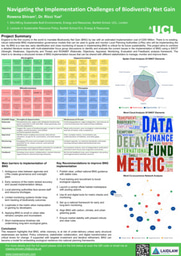
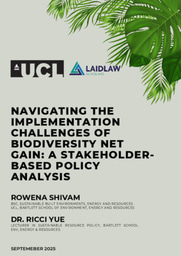
My first summer of research focused on Biodiversity Net Gain (BNG) legislation in the UK, exploring the experiences of different stakeholders involved in its implementation. Through focus groups and interviews, I began to understand the gap that can exist between well-intentioned environmental policy and its practical application. That research ultimately contributed to the creation of BNGsmart, my startup seeking to simplify and automate parts of the BNG process for different stakeholder groups.
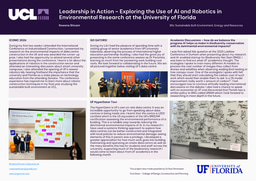
When presenting this work at the Laidlaw Annual Conference 2025 in Durham, I was asked an unexpected question: how could I justify using artificial intelligence to support biodiversity conservation when AI itself has significant environmental impacts? Rather than seeing this as a criticism to defend against, I began to see it as a dilemma worth researching.
This helped shape my Leadership in Action experience at the University of Florida where I spoke with academics using AI, drones and satellite imagery for applications ranging from monitoring trees planted for carbon credits to studying wading-bird reproduction in the Everglades and identifying tree-canopy species. I also helped organise and presented at the International Conference on Industrialised Construction, building on my research into the environmental impacts of data centres.
These experiences taught me that sustainability questions rarely have simple answers. Technologies can simultaneously create environmental pressures and provide tools for understanding and addressing environmental problems. Leadership therefore requires being willing to sit with complexity rather than searching immediately for a convenient answer.
The Scholarship's 3Cs framework of changemaker values, character and leadership capacities has helped me understand this more clearly. The Oxford Character Project, in particular, encouraged me to think about leadership not simply as the goals I achieve, but how I behave while trying to achieve those goals. Leading a startup has made qualities such as humility, courage, perseverance and openness to challenge feel much less abstract. I have learnt that being committed to an idea does not mean becoming defensive about it. Ethical leadership sometimes means allowing uncomfortable questions to change the direction of your thinking.
My Leadership in Action experience also challenged me to develop a more genuinely global mindset. The political context around sustainability in the United States was very different from what I had experienced in the UK. I encountered first-hand how politically sensitive environmental language can be, even being questioned at immigration about studying sustainability. At the university, I learnt about the difficulties researchers can encounter when accessing funding for work associated with terms such as bio ‘diversity’.
Yet this experience also challenged some of my own assumptions. By sensitively asking academics how they continued their work within this environment, I saw how much environmental action can still take place without the legislative frameworks I was familiar with. The UK may be pioneering in legally mandating Biodiversity Net Gain, but Florida, for example, has developed approaches to protecting its wetland habitats that operate through similar regulatory and policy mechanisms.
For me, developing a global mindset therefore means more than travelling internationally. It means recognising that no country has a monopoly on good ideas. Policies cannot simply be transplanted from one context into another, and effective leadership begins with listening and understanding before proposing solutions.
Climate change and biodiversity loss do not respect national borders. Neither should the exchange of ideas intended to address them. I therefore want to continue building international bridges between researchers, policymakers, businesses and communities, particularly around biodiversity legislation and sustainable infrastructure.
Most importantly, I want to carry forward an understanding of ethical leadership as a continual practice rather than a destination. As technologies such as AI become increasingly powerful, leaders will face difficult trade-offs between innovation, environmental impact and social benefit. I want to keep asking difficult questions, including of my own work, seek out perspectives different from my own and remain willing to change course when evidence demands it.
The Laidlaw Scholarship has taught me that being a global citizen and ethical leader is not simply about thinking globally or ethically. It is about acting with curiosity, responsibility and humility while recognising that the decisions we make can have consequences far beyond our own life and work.