Scholar Spotlight - Ishna Tripathi


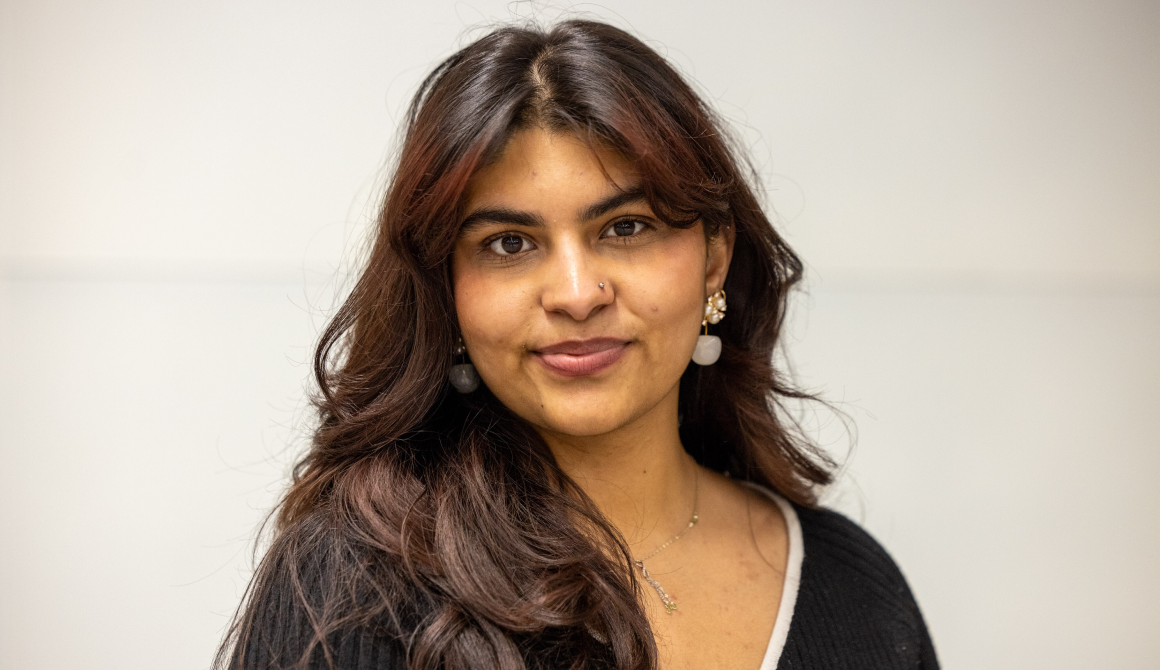
Ishna Tripathi, a Laidlaw Scholar at Trinity College Dublin, on using James Webb Space Telescope data to investigate whether a hidden moon is driving auroras on a distant brown dwarf.
Research title:
Cloudy with a Chance with exomoons: Hunting for transiting exomoons around a brown dwarf.
Please briefly outline what your research is about, and its potential real world impact
My project aims to investigate the mysteries of the cosmos – the aurorae of a free-floating brown dwarf. A brown dwarf is an object that is between a star and a planet. It can be from 13 to 75 times the mass of Jupiter but does have stable nuclear fusion. I will use new data from the James Webb Space Telescope (JWST) to search for moons orbiting giant extrasolar planets. I will observe 2MASS J10475385+2124234, which is a brown dwarf approximately 41 times the mass of Jupiter. It exhibits aurorae, the same as on Earth; however, the Earth’s aurora is caused by the sun and 2M1047 is a free-floating object (without a star). My project theorises that the aurora is caused by a satellite orbiting it. By analysing this data, I aim to detect if an exomoon is the driver of aurora. I will adapt machine learning techniques such as Gaussian processes, to search for faint signals of a transiting satellite.
Where did your passion for this research originate? How does your personal story feed into it?
My passion for the stars has been here since I was a little kid stargazing from my balcony with a makeshift telescope. I was always interested in discovering the mysteries of the cosmos – the Universe remains unseen and unexplained. In school, I was constantly drawn to questions about what lies beyond what we can directly observe, particularly in astrophysics, where indirect evidence and careful inference often lead to major discoveries. Exoplanets were once considered speculative; today they are abundant. Exomoons represent the next frontier in this progression, and the challenge of detecting them through subtle signatures strongly resonates with my scientific curiosity.This interest is deeply tied to my personal journey. As the first woman in my family to pursue higher education freely, I learned early on the value of perseverance and intellectual independence. Pursuing physics was not the expected path, but it became my way of exploring the Universe on my own terms. That determination now fuels my motivation to engage with complex, data-driven problems where progress requires patience, creativity, and resilience. “Cloudy with a Chance of Exomoons” aligns perfectly with how I approach research: combining rigorous analysis with openness to uncertainty. The project’s focus on atmospheric modelling, signal interpretation, and the search for hidden structures mirrors my broader interest in extracting physical meaning from noisy, incomplete data. For me, this research is not only about discovering new worlds, but also about contributing to a field that continuously redefines what is possible through careful, persistent inquiry.
What does it mean for you to be a Laidlaw Scholar and which particular leaders inspire you the most and why?
To me, being a Laidlaw Scholar means being a leader while also remaining an individual who is constantly learning, exploring life, and navigating new experiences. The Laidlaw programme provides me with the skills to better understand myself and to develop my leadership abilities in a meaningful way. Being a scholar also means giving back to the community, whether through Leadership Days or the Leadership in Action programme. It represents a commitment to service, growth, and responsibility. Additionally, being a Laidlaw Scholar gives me the opportunity to conduct research that may not have been possible otherwise, as the funding allows me to explore new ideas and contribute original knowledge.
I get a lot of inspirations from people such as Marie Curie who were not leaders but made significant changes within the realm of science. She was one of the first ladies to move boulders in science.
Briefly describe a scene from the future you are striving to create.
I imagine a world where people can understand and appreciate basic science.
Quick-fire Questions
📺 Currently Binging:


Apocalypse - CAS
🎧Current Podcast Obsession:

🌈 Something that made me feel joy recently:
Going out and socialising with people more because I have more free time this semester from lectures.
💫 Watch Ishna's TEDx Talk 💫
Ishna took her research to the TEDxTrinityCollegeDublin stage earlier this year. Watch her explain the mystery of brown dwarf auroras and what happens when the data doesn't give you the answer you expected:




Please sign in
If you are a registered user on Laidlaw Scholars Network, please sign in