Research Abstract
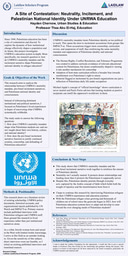
Education is a site of conflict for Palestinian refugees in UNRWA schools. In 1948, following the United Nations General Assembly’s Resolution 181, the state of Israel was established, expelling over 750,000 Palestinians from their homes in what became known as the Nakba, or catastrophe. To support the influx of refugees into Gaza, the West Bank, Lebanon, Syria, and Jordan, the UN established the United Nations Relief and Works Agency for Palestine Refugees in the Near East (UNRWA), which became the primary provider of education for Palestinian refugees in these areas. Drawing on peer-reviewed articles, policy documents, historical accounts, and organizational publications, this paper analyzes the various factors shaping the educational experiences of Palestinian refugees and their influence on national identity. UNRWA’s neutrality mandate is shaped by donor conditionality, international human rights frameworks, and external pressure, and has made Palestinian refugee education a deeply contested space that systematically suppresses Palestinian national identity and consciousness. This suppression has been largely obscured by a dominant narrative promoted by pro-Israel policy organizations that claim UNRWA incites and drives resistance and violence. As UNRWA continues to be under international scrutiny and faces increasing political pressure, this research aims to highlight Palestinian lived experiences and reframe the conversation that too often focuses on what Palestinian education allegedly promotes rather than what it systematically withholds.

Hi! My name is Hayden Chernow and I am from Boston, Massachusetts. I am a rising junior at Barnard College majoring in Urban Studies with a focus on the Middle East and Education.
My Laidlaw Scholars Research topic will examine how Jordan's growing refugee population impacts access to trauma-informed education.