Through the Laidlaw programme I have been given a wide-range of opportunities to challenge and develop new leadership skills as well as the opportunity to reflect deeply on what it means to be a leader. The research, training days and leadership in action required different environments to develop different parts of my leadership capabilities.
Through research
As part of my research, I lived with and interviewed members of intentional communities across the UK. Entering into spaces where I didn’t know anyone, to conduct research for the first time, was extremely daunting. However, it pushed the boundaries of my anxiety in ways that have been transformational and I feel pushed to continue to pursue similar experiences in the future. This has also provided a helpful backbone of confidence to the primary research I am now conducting for my dissertation.
In writing the research, I also reflected on the role of academia in relation to leadership. Research is a tool to represent people’s voices and with this opportunity to represent comes an element of power. Conducting and writing up primary research for the first time allowed me to explore the responsibility and integrity that comes with this.
Through leadership training
As part of the Laidlaw experience we participated in leadership training days which usually involved team tasks with different set conditions. The team projects were a useful space to better discover how I function in group dynamics. I discovered that I instinctively feel a need to contribute heavily and take a central role in group dynamics and that often, in projects where other people had more expertise and I was taking more of a backburner, I felt like I had failed in leadership. This was something I had felt in myself before, but the intentionally reflective process of the team tasks forced me to confront and therefore unpack these dynamics more directly. As well as this, we also went on a weekend away in Durham where we met other Laidlaw scholars and heard presentations on everyone's research. Learning about other people's research was really inspiring as it highlighted how people across such a wide-range of fields are using their different lenses to help solve similar problems.
Through leadership in action
My leadership in action allowed me to reflect on alternative forms of leadership. Within the ecological project I volunteered for, leadership took a variety of forms and leadership development (such as developing curiosity, adaptation and decision making) was co-curated as part of a community rather than individually. The ecological project’s community approach to personal development built on what I explored in my research project, which looked into non-hierarchical decision making in intentional communities. I had spoken in my initial interview about wanting to explore different ways of looking at leadership and so getting to pursue this exploration, in both the research and leadership in action, was really satisfying.
Developing the characteristic of courage
The Oxford Character programme offered scholars an extensive choice of characteristics to focus on improving across the course of the project. I decided that I wanted to focus on the character of courage. At all stages of the learning process I was presented with very new environments which allowed my courage to be stretched. Initially I approached these new experiences as one large act of bravery. However, through the process of both research and Leadership in action, I worked out methods to break down new experiences into smaller ‘acts of bravery’ that made the experience more manageable. In research, for example, the everyday act of bravery was approaching and chatting to someone new at lunch. By approaching the character of courage through this perspective, it makes developing and flexing this muscle more feasible, as I could break it down into more manageable parts. In order to continue my development as a leader, I intend to implement this approach, of breaking down large character changes into small chunks. This programme has also made me reflect on how focusing on one specific characteristic is perhaps too narrowminded. In reality, characteristics of leadership often blur and are challenging to distinctly define, especially as different characteristics (courage, integrity, patience) need to be performed in different situations.
Continuing the development of leadership
What this process has made me reflect on is that there are a variety of ways that you can develop leadership and not necessarily through conventional approaches. The values that are often assigned to leadership are not exclusive to individuals within a position of power, and often these values shine when co-created as part of a community. Therefore, in order to continue exploring leadership, I want to further pursue novel experiences in the community that will allow me to develop these skills. For example, I want to start working in soup kitchens again, as I found they were a place that tested leadership qualities within a cooperative environment. Whilst I initially signed up to the Laidlaw to gain experience conducting independent research, what I got out of the experience extended far beyond just this, which has served as an important reminder to continue to challenge myself by signing up to new and exciting experiences.
Finally, the most important thing that Laidlaw has taught me is the importance of reflection in developing a leadership quality. In both the research and the Leadership in action, it became essential that this reflection was done through writing, not just in my head. The act of analysis in writing forced me to articulate and express what I was experiencing, which solidified the leadership development. Going forward, I will continue to do similar, as I have learnt of the importance of writing as a tool of personal development.

Hey!
I am an undergraduate student at the University of Cambridge studying Geography.
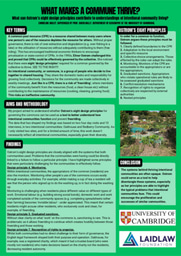
My project looks at agricultural systems that use cooperative practices (cooperatives, CSAs, intentional communities). I want to use Ostrom's eight design principles as a framework to understand similarities in their success stories. I want to understand how they operate alongside and within a capitalist economic system and how law and land policy shape their systems. Though I am realising this is perhaps way too much for one 6-week research project, the hope is that this can serve as a framework to upscale Commoning practices in Cambridgeshire. If you have any knowledge about land-use (policy + law), community economics, Commons and cooperation send it my way! Equally, if you have an LIA suggestion that can build on these interests that would be fab.
Whilst my project is very food and community focused, I am fascinated by all things geography, with a passion for social justice. My interests are definitely multidisciplinary and I am jealous of every project on here. 🦎