Reflection - Thematic Connections Between Late Medieval Gothic Armour and the Modern Gothic Sensibility
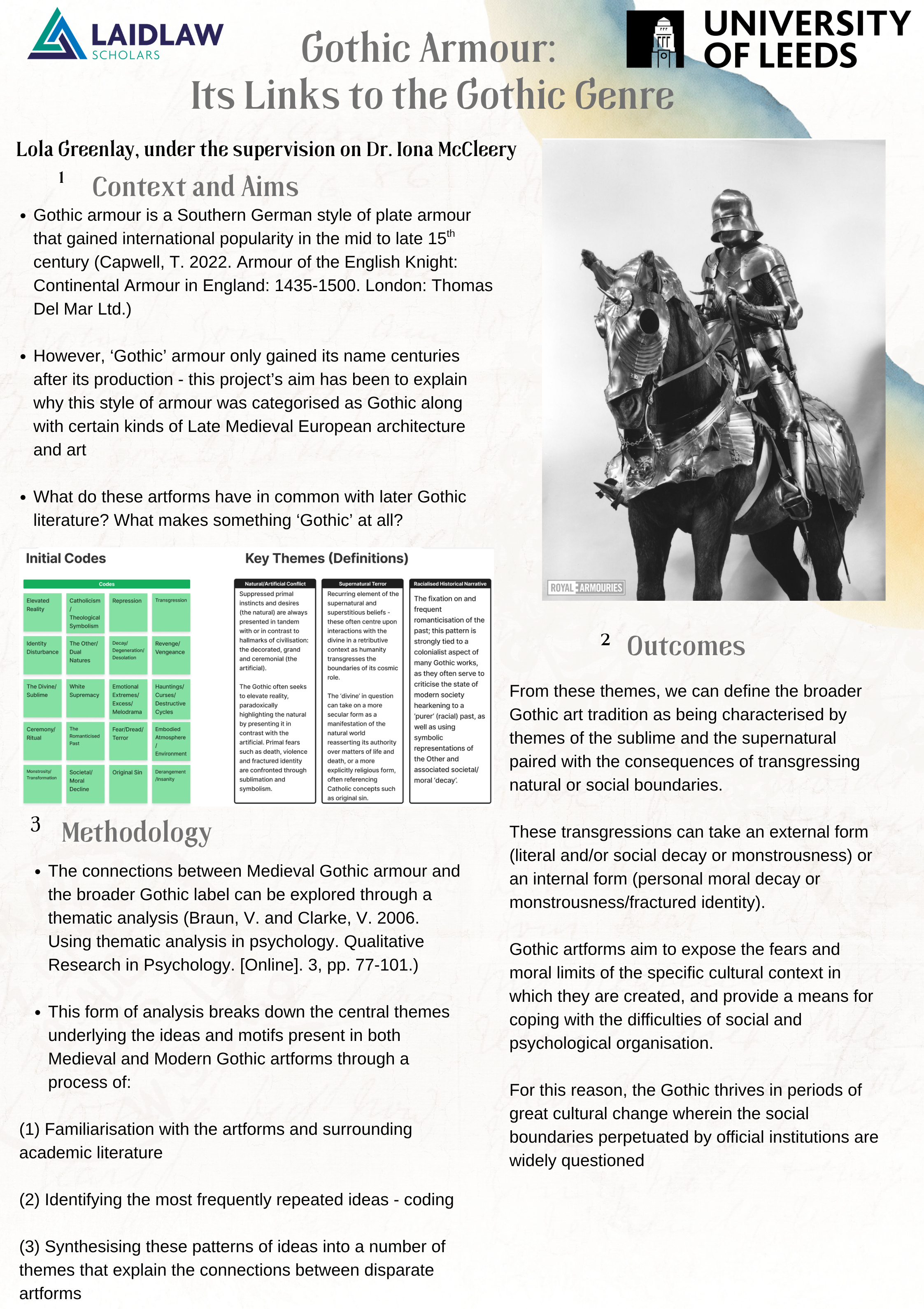

During the initial six weeks of my research project, I explored the thematic connections between Late Medieval Gothic armour and architecture and modern Gothic sensibilities, focusing on the early development of Gothic literature in the eighteenth century. After an extensive literature review which accounted for the majority of my research period, I have begun developing a framework for understanding these connections using the thematic analysis model developed by Braun and Clarke (2006) for their work in psychology.
What Impact Conducting Research Has Had On Me
This project’s focus has been on the Gothic aesthetic tradition, a subject that I have had a personal interest in for years now and was eager to explore further when I saw the Royal Armouries’ collection of Gothic plate armour. For me, this project was a way for me to expand upon previous research on the goth subculture as part of my voluntary participation in an exhibition on Leeds’ music history. As part of that exhibition, I had attempted to broadly explain the core characteristics of what makes a band ‘gothic’ (in the historical sense) but was limited in the amount of detail that would be appropriate. This sparked my interest in how seemingly disparate art forms across the span of centuries - music, fashion, painting, literature, architecture, armour - all came to inherit the ‘Gothic’ label, and this project was a great opportunity to delve into the amount of detail I desired.
I have been involved in goth subculture since I was a young teenager, and quickly became aware that the popular media’s conception of goth and the common reality is often vastly different. The term ‘goth’ has always been misinterpreted, used as a convenient catch-all, or has recently been applied increasingly arbitrarily. I think that this makes it reasonable to assume that the term has very little deeper meaning other than something (or someone) being ‘dark’ and having a penchant for the colour black. Something that I recognised when I first began seriously researching goth is that there is very little point in searching for a consistent tangible historical throughline from one gothic artform to the next. The label has mostly been applied retrospectively to styles that developed in separate eras and locations: their belonging to the goth umbrella has largely been a matter of convenience, the result of a little understood, often pejorative word being used to categorise a style, then adopted by successive generations of scholars until ‘gothic’ becomes the standard descriptor. What this means for thematic research into the Gothic is that many insights into how to most accurately describe what makes something ‘gothic’ are deductive. We approach gothic artforms with pre-existing assumptions of their necessary qualifiers (you know it when you see it). But I find that these pre-assumptions contribute to the general evasion of genuinely trying to discuss the throughlines of gothic artforms - we can dismiss these connections as trying to derive meaning out of a meaningless label. I disagree with this assessment. I think it is worth investigating the symbolic ties linking together gothic art from the twelfth century to the present works, regardless of the fact that the creators of this art largely did not intend for it to be labelled ‘gothic’.
To me, gothic art throughout the centuries shares a common identifiable sensibility and philosophy. While the thematic connections between eighteenth and nineteenth century gothic literature and modern goth subculture have been explored by academics extensively, I found a pattern of research on the Gothic glossing over the modern sensibility’s links to its symbolic roots in the High Medieval period. This seemed like a massive oversight as much of the earliest works of gothic literature (for example, Horace Walpole’s ‘The Castle of Otranto’) were written by antiquarians with a deep fascination for Medieval history and a desire to contrast their (albeit romanticised) understanding of the Medieval past with the societal issues of the Industrial Revolution they were living through.
With the project involving a deeper investigation into an aspect of the Royal Armouries’ extensive collection, I was presented with a unique opportunity to bring my ideas on the Gothic to a wider audience. Going into this project, I was aware that my approach to selecting and researching a topic of interest would be unconventional. Though I have a long-standing personal interest in Medieval history, particularly in the effect of religion on people’s everyday lives, I had not engaged in historical research in any official capacity since studying history at A level. My familiarity with sociological research has geared me towards a broader perspective on social trends and institutions rather than focusing on specific events and figures. This meant that my initial interest in Gothic armour geared more towards exploring its social and symbolic nature than the specifics of its design and manufacturing. The main challenge that this more cerebral approach presented was finding the right framework to give my ideas a defined structure and properly articulating the in-the-moment thematic connections I was making during my literature review. In the early stages of research, I have a tendency to cast my net too wide and spend most of my time hoarding any information that could possibly be relevant to my topic without putting it to much use. A significant part of my work during this project involved having to continually narrow down the scope of my research and parse out which sources were strictly relevant for the insights that I wished to gain. A particular challenge was identifying relevant primary sources to serve as evidence for my conclusions; considering that my analysis was largely limited to subjective interpretation, especially when it revolved around a term that did not exist at the time of the armour’s creation. Collecting more tangible examples of overarching Gothic themes being represented in primary sources is something that I would like to expand on as I go further with this project.
Leadership Skills
This project was largely independent and self-directed, which allowed me to utilise a lot more creativity with my choice of subject matter and how I approached the research process. I appreciated being given the freedom and flexibility to determine how I would contribute to the knowledge surrounding the Royal Armouries collection and further explore the subject of gothic history in relation to the collection. When I first began researching and considering how I would present my observations on Gothic armour, I was concerned about potentially failing to meet the project criteria or misinterpreting the assignment’s requirements due to its loose structure. But with the encouragement of my supervisor, and as I narrowed down my research question and began my literature review, I relaxed and was able to develop my self-management skills as I worked. In order to conduct a thorough and systematic analysis in the six weeks, I had to consistently organise my time so as to meet self-imposed deadlines as well as avoid losing motivation and frequently adapted my schedule and research focus as my ideas and subsequent aims changed. This involved re-prioritising the information I wanted to give my attention to, and being willing to accept that I could not be as comprehensive at this stage as I would ideally like. Instead, I chose to complete an initial review and summative analysis that could be elaborated on in more detail in the future. The project also marked the first time that I have used a specific mode of analysis beyond critical reflection to organise my observations, as my research was not going to be used for an essay or presentation, as I’m accustomed to with my degree.
The freedom to take this project wherever I wished for it to go has thus enabled me to improve my research and analytical skills, as I needed to determine how I was going to make my observations from my literature review accessible and consumable to a general audience. By extension, this work also improved my critical thinking and creative ideation skills; condensing a large amount of wide-spreading historical information into coherent notes required me to be selective in parsing out the primary perspectives surrounding Gothic art and its meaning, as well as including my own reflections on the pattern of colonialist assumptions underlying much of the work. Translating these observations into a creative project that adequately communicated quite an abstract chosen subject required me to evaluate and filter down various potential forms until I arrived at a tapestry with an accompanying explanatory piece that would make clear the connectedness of the concepts I am attempting to represent.
As I move forward with this project, I hope to be able to improve on my communication and collaboration skills, as I reflect more on how my research relates to ethical museum practice and how I can work alongside other researchers to bring my complete work to a wider audience in a way that is concrete and articulate. This will involve narrowing my focus of study and expanding on the tangible manifestations of Gothic themes in armour and artwork.
Dissemination of My Research
Though I have not had the opportunity to share my research at this stage, it is a definite possibility that I will be hosting a joint discussion with the other scholar on my project at next year’s International Medieval Congress, where I can share my analysis with an interested audience ahead of hopefully completing an academic article that will serve as the completion of my research and main point of presentation at the 2027 Laidlaw Conference. Though I am not well versed in the process of seeking publication for my article, it is something that I would be interested in pursuing if it is received well at next year’s conference.
What My Future Career, Educational or Continued Research Plans Are
While I’m satisfied with the current progress I have managed to make in translating an extensive literature review into a coherent analytic framework, the limitations I’ve faced regarding the construction of a fully-fledged argument for the recognisable Gothic qualities of Late Medieval armour have incited me to continue developing this project in order for my argument to focus on the thematic significance of specific forms of Gothic armour. I think that exploring the aesthetic history of Gothic tomb effigies and ceremonial armour is a viable avenue for developing my thematic analysis. Over the course of the upcoming academic year, leading up to the 2027 Laidlaw Conference, I believe that the most effective way to utilise my research would be to write an academic article applying thematic analysis to understand the place of Gothic tomb effigies in the wider Gothic art tradition.
Concerning how this project has impacted my future educational and career plans, I can’t claim that the specific subject matter is of direct significance to my intentions going forward as a sociologist. I have instead gained a personal satisfaction in having the opportunity to further explore and apply my research skills to a subject that I have a private interest in; though history is not something I plan to pursue as a career path at the moment, I have had a long-term personal investment in various historical subjects that I am always eager to share. However, on a more general level, this project has fortified and encouraged me to expand on my qualitative research abilities, which I hope to apply to a master’s degree in sociological research and a future career in research and advocacy. The prospect of investigating and coming to conclusions on complex topics with centuries of essential historical context can be overwhelming, but I have found it beneficial to consolidate the ability to approach these vast questions with a fortified process that helps me to understand the breadth of knowledge that already exists on a subject and how I can offer my own.

I am a Criminal Justice and Criminology undergraduate student at the University at Leeds, with an interest in bodily autonomy, transgender rights, and experiences of social marginalisation. I am passionate about social research, heritage, and dispelling pseudo-scientific misinformation. I intend to create a dissertation exploring how to combat the negative effects of discriminatory media campaigns on trans rights in the UK. I have recently participated in the Laidlaw Research Programme to bring a creative approach to the historical collections of the Royal Armouries, and am currently planning my LIA project.