Reflecting on what I have learnt throughout the Scholarship
When I first joined the Laidlaw Scholarship, I thought leadership was standing up and taking charge, but throughout my journey, my perspective on what leadership is has changed. Over the course of this scholarship, I have learnt that leadership is about adaptability, reflection, taking responsibility and most importantly, listening. There were many challenges along the way whether that was during my research project, funding and conducting my LiA, and even attending the lead days and conference. These obstacles and experiences have changed how I understand what it means to be a leader.
The 3Cs framework - Change Maker Values, Character and Capacities, has given me a useful way to understand that development. More importantly, I have learnt that these three elements cannot really exist independently. Having the capacity to lead is not enough without character, and having good intentions is not enough without the skills to turn those intentions into meaningful action.
One of the biggest changes for me has been in how I understand character. The Oxford Character Project encouraged me to think about qualities such as transcendence, integrity, courage, purpose and wisdom not as fixed personality traits, but as qualities that can be deliberately developed and practised. This became particularly relevant when I was trying to find a LiA project. Having organised my project 9 months in advance, I assumed that everything would run smoothly. However, at the last minute my LiA organisation backed out, leaving me in a vulnerable situation. Through my developed skills of courage, communication and networking skills I did something that I would not have done in a normal situation. I decided to conduct my LiA on the other side of the world in one month's notice.
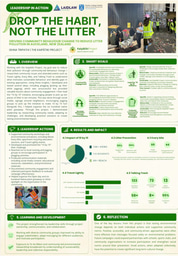
My Leadership in Action project with the Kaipātiki Project in Auckland, New Zealand taught me so many skills, qualities and I got to find myself. My goal was to contribute to reducing litter pollution through community-led behaviour change. I initially approached the project with several ideas about how I could encourage people to change their behaviour. One of those ideas was plogging - picking up litter while jogging. It very much did not work.
At first, this felt like a failure, my one great independent idea flopped harrrrd. However, it became one of the most valuable parts of the project. Rather than trying to force an idea simply because I had invested time in it, I had to step back and ask why it was not connecting with the community. I learnt that leadership requires the humility to recognise when an idea is not working and the courage to change direction.
This eventually led me to develop the “10 by 10” initiative, encouraging people to pick up ten pieces of litter in ten minutes. The idea was deliberately simple and accessible, and I promoted it through social media, signage and community networks. The campaign reached 10,000+ social media views, engaged more than 133 residents, and achieved a 55% conversion rate.
However, the numbers were not the most important lesson. The real lesson was the process behind them. I learnt that successful leadership is not necessarily about protecting your original idea. It is about being sufficiently curious and humble to listen to what people need and sufficiently determined to keep working towards the underlying goal. My understanding of character has therefore shifted from seeing leadership as confidence and decisiveness towards seeing it as responsibility, self-awareness and judgement.
I also gained confidence in travelling alone for over 35 hours to another country, navigating an 11-hour time difference, and immersing myself in Te Ao Māori culture. I made friends with people from a wide range of ages and backgrounds, which challenged me to become more open-minded, adaptable and comfortable outside my usual environment.
The second major area of development has been my leadership capacity. Throughout my academic research, I have developed technical skills in research, data analysis and problem-solving. My Laidlaw experience pushed me to apply those skills in situations where there was no obvious correct answer.
During my Leadership in Action project, I had to research community needs, evaluate engagement strategies, collect feedback, communicate with different audiences and develop practical recommendations. I also produced social media content, educational resources and outreach materials, while contributing to community events including the distribution of 600 native plants. This taught me that communication is not simply about explaining an idea clearly. It is about understanding who you are communicating with and what matters to them. Working with different community groups required me to adapt my messaging rather than assuming that one approach would work for everyone.
My experience across events such as Travel Lightly, Every Bite and Talking Trash helped me understand the importance of meeting people where they are. I also became much more comfortable with measuring impact. Instead of simply asking whether an activity had taken place, I began asking: What changed because of it? Who did we reach? What evidence do we have? What could we do differently next time? That mindset has carried back into my academic work. I now see research and leadership as much more closely connected: both require asking good questions, working with incomplete information, testing ideas and being willing to change your conclusions when the evidence tells you to.
Perhaps the most unexpected part of the Scholarship has been how much my understanding of a “global mindset” has changed. Before Laidlaw, I associated global experience primarily with working internationally or being exposed to different countries and cultures. My experience in Auckland showed me that global thinking is much more nuanced. Working with the Kaipātiki Project exposed me to Te Ao Māori and community-led approaches to environmental stewardship, which broadened my understanding of sustainability and collective responsibility. I began to recognise that environmental problems may be global, but solutions are deeply local.
Litter pollution is not simply a technical problem that can be solved by finding the “best” intervention and applying it everywhere. Behaviour is shaped by culture, community, infrastructure, social norms and individual circumstances. An approach that works in one community may not work in another.
This has changed how I think about global leadership. I no longer see it as bringing solutions from one place to another. Instead, I see it as being able to enter a different context with curiosity, listen before acting, understand different perspectives and then work collaboratively to develop an appropriate response.
That lesson extends far beyond sustainability. Whether I am working in scientific research, technology or another field in the future, the problems I want to work on will rarely exist within national or disciplinary boundaries.
If I had to identify one thread connecting my Laidlaw experience, it would be the importance of learning from things that did not go according to plan. The plogging initiative did not gain the participation I had hoped for. Not every engagement activity produced the same results. And I have sometimes found it difficult to balance wanting to take ownership with recognising that I do not always know what is best. But these experiences forced me to become more reflective.
The Leadership in Action project taught me that an unsuccessful idea is not necessarily an unsuccessful project. The important question is what you do next. In my case, failure prompted me to listen more carefully, adapt my approach and develop something more accessible. My final reflection from the project was that lasting environmental change depends not only on individual actions, but on supportive community norms and positive, accessible approaches. That is a lesson I expect to carry with me long after the Scholarship ends.
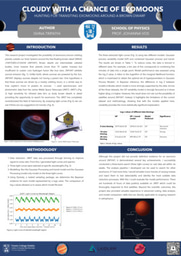
My project on finding exomoons around a brown dwarf further developed my curiosity about the universe and my ability to engage with complex scientific questions. Investigating these objects, which occupy the boundary between planets and stars, required me to understand how their formation, composition and physical properties challenge conventional classifications. I learnt that scientific progress often comes from questioning assumptions and examining evidence rather than accepting the most obvious explanation. This strengthened my analytical thinking and taught me to approach unfamiliar problems with patience, curiosity and a willingness to revise my understanding. More broadly, the project showed me that I find genuine satisfaction in exploring questions where the answers are not immediately clear, and it reinforced my desire to study a subject that combines rigorous reasoning with discovery.
When I first began my research project, I often felt that I did not fully understand what I was doing. As a second-year student, I was working with unfamiliar concepts, complex datasets and high-performance computing (HPC) systems, and I initially found it difficult to see how everything connected. However, as I continued to ask questions, work through the data and engage with the research, I gradually developed a much clearer understanding of both the science and the methods behind it.
One of the most valuable skills I gained was learning how to navigate complex datasets and use HPC to carry out research that I could not have approached confidently at the beginning. I also became more comfortable discussing scientific ideas with researchers and explaining my own findings. This was a significant change from initially feeling like a second-year student who did not know enough to contribute. Presenting my work through a TED Talk and having it published in F1000Research Taylor & Francis were particularly meaningful milestones, as they showed me that I could take something I initially found overwhelming and develop it into work that could be communicated to a wider audience.
The experience taught me that confidence in science does not come from knowing everything at the outset. It comes from being willing to learn, persist through uncertainty and gradually build the understanding needed to contribute meaningfully.
I entered Laidlaw wanting to become a better researcher and leader. I am leaving with a broader understanding of what leadership actually means. I have developed practical capacities in communication, research, project management, collaboration and impact evaluation. I have developed a greater awareness of the character required to use those capacities responsibly. And I have developed a more nuanced understanding of what it means to work across cultures and communities. But I also recognise that this development is unfinished.
I want to continue developing my ability to listen before acting, particularly when working in unfamiliar environments. I want to become better at balancing confidence with humility, and ambition with patience. Most importantly, I want to maintain the habit of reflection rather than assuming that experience automatically produces growth.
The greatest thing Laidlaw has given me is therefore not a particular leadership technique. It is a different way of approaching problems. Be curious enough to ask questions. Be brave enough to try. Be humble enough to change course. And be determined enough to keep going. For me, that is what it means to become a global change-maker.