Learning to lead in the archives
When I began my Laidlaw journey, I understood leadership mainly as intellectual command: identify the problem, assemble the evidence, and make the strongest argument. Two years later, I still value rigour, but I no longer think a good argument is enough. My journey moved from solitary archival research, to explaining that research in public, to producing evidence for a community partner in Shanghai. At each stage, the audience became more immediate and the consequences of imprecision became more serious.
What changed was not my commitment to research. It was my understanding of what research asks of a leader. I learned that leadership also means listening, translating between different kinds of knowledge, exercising judgment about what can responsibly be claimed, and remaining accountable for the limits of one’s work.
Reading power through incomplete records
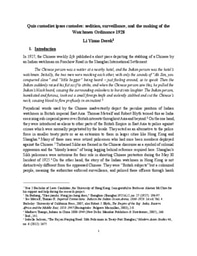
From 14 July to 31 August 2025, I worked under Professor Alastair McClure on “Regulating South Asians in Colonial Hong Kong: the Making of Watchmen Ordinance, 1928.” I researched and drafted an approximately 9,000-word final essay, “Quis custodiet ipsos custodes: sedition, surveillance, and the making of the Watchmen Ordinance 1928.” Professor McClure’s assessment highlighted my independent research ability and my eye for argument and analysis. That encouragement mattered, but the project’s deeper leadership lesson came from the difficulty of the evidence itself.
The Watchmen Ordinance appeared on its face to regulate private security work. My argument was that it also operated as racialised anti-sedition surveillance over Indian watchmen in colonial Hong Kong. These men occupied an unstable position. They exercised authority within a colonial system, often over Chinese communities, while remaining colonised subjects whom the British authorities monitored and sought to control. I described them as “coerced intermediaries”: empowered for imperial purposes, constrained when they appeared politically dangerous.
It was tempting to present this thesis as a clean uncovering of hidden intent. The archives did not permit that confidence. Official correspondence preserved the concerns and prejudices of colonial administrators in great detail, while the watchmen themselves appeared much less often in their own words. The imbalance was not simply a gap to mention in a footnote. It shaped what kind of history I could write.
The most important counterweight was a petition submitted by representatives of about 300 Indian watchmen. They challenged the proposed restrictions as discriminatory and intrusive, objecting to limits on contract, employment, movement, and punishment without proper trial. Their petition helped secure amendments, including a distinction between police-supplied and privately employed watchmen and protection for some existing practices. This complicated any account in which colonial officials acted and racialised subjects merely received the consequences. The watchmen organised, argued and changed the legislation, even within a profoundly unequal system.
That petition changed how I thought about leadership. It showed that listening is not passive. It can alter the structure of an argument by restoring agency to people whom the dominant archive has pushed to the margins. It also required restraint. Where the evidence did not establish a causal link, I had to say so. The later stagnation in the number of Indian watchmen may be consistent with the Ordinance’s restrictive effects, but consistency is not proof of causation. Acknowledging uncertainty did not weaken the project. It made the argument more trustworthy.
From 9,000 words to three minutes
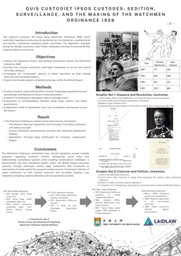
The next stage required a different kind of discipline. At the Laidlaw Scholars Conference at Durham University from 17 to 19 October 2025, I presented a research poster and gave a three-minute presentation. Compressing approximately 9,000 words into three minutes was not merely an exercise in speaking faster or deleting detail. I had to decide what another person truly needed in order to understand why the research mattered.
I centred the tension between regulation and surveillance, and the position of Indian watchmen as coerced intermediaries. But I also needed to preserve the petition and the uncertainty of the sources. If compression removed all qualifications, the presentation would become clearer but less honest. I began to see communication as an ethical form of selection: every explanation foregrounds some facts and leaves others out, so a leader must choose without distorting.
Durham also moved the project beyond the relationship between one researcher and one supervisor. By attending talks, workshops and masterclasses, and by meeting scholars from other countries and universities, I encountered different disciplinary assumptions and ways of defining public value. The exchange made my historical problem feel both more specific and more connected. Racial classification, migration, surveillance and the use of apparently neutral rules to exercise power were not only questions within Hong Kong legal history. They could be examined through many fields and compared across societies.
My participation in Oxford Character Project ethical-leadership training added another layer. It encouraged me to connect choices about evidence and communication with character and responsibility. The question was no longer only whether I could defend a conclusion. It was whether I had treated the people, institutions and uncertainties within the project responsibly.
Initiating a partnership in Shanghai
In Year 2, I moved from analysing a historical institution to supporting decisions in a living one. I initiated and scoped a Leadership-in-Action project, “Improving rehabilitation and education of offenders in Shanghai,” with the Shanghai Social Assistance and Education Volunteers Association. The organisation supports people in prisons and community correction, as well as people returning to society after punishment.
Initiating the partnership required a different kind of leadership from independent archival work. I had to identify a contribution that matched the organisation’s needs and that I could realistically deliver. The original application was broad: it contemplated interviews, questionnaires and outreach to employers. By 31 August 2026, I had not conducted those activities. I therefore do not present them as completed work, nor do I claim effects on beneficiaries. The responsible scope became two desk-research reports that I personally researched, drafted, delivered and discussed with the partner.
The first compared legislation and institutional arrangements across jurisdictions. It examined how legal systems define volunteer roles, select and train volunteers, divide responsibility between professionals and volunteers, protect confidentiality, support reintegration, and evaluate programmes. The second examined the available methodologies and evidence behind rehabilitation and volunteer support. Together, they moved from the question “What do other places do?” to the harder question “What does the evidence actually allow us to conclude?”
This distinction mattered because rehabilitation work attracts strong but often untested claims. A programme may be humane, well established or widely praised without having been shown to reduce reoffending. Participants may differ from non-participants before any intervention begins. Administrative data may measure attendance or completion more reliably than long-term outcomes. A rule written in legislation may operate differently in practice. I had to resist turning comparative examples into proof.
Instead, I translated the most consistent findings into practical choices. Across several jurisdictions and international standards, the evidence repeatedly supported structured volunteer screening and training. It also supported clearer boundaries: volunteers can provide continuity, relationships and community connection, but professional judgment and responsibility should not be displaced onto unpaid participants. Finally, the research pointed toward more independent evaluation, designed before conclusions are announced rather than added afterwards.
The partner agreed to pursue and test these three directions: structured screening and training, clearer professional-volunteer boundaries, and more independent evaluation. This was a modest outcome, but a real one. The reports did not transform services or establish beneficiary impact. They created a basis for organisational choices that can now be tested. Leadership here meant making evidence usable without pretending it was stronger than it was.
What I now mean by leadership
Looking back, the journey has changed the verbs I associate with leadership. I began with arguing. I now add listening, translating, judging, limiting and accounting.
The archive taught me to listen for voices that institutional records preserve unevenly. The petition taught me that people subject to regulation are not simply objects of policy. Durham taught me to translate a complex argument for a public audience without sacrificing its integrity. Global and interdisciplinary exchange taught me to test my assumptions against perspectives formed elsewhere. The Shanghai project taught me to turn comparison into choices while drawing a firm line between evidence, inference and aspiration.
Most importantly, I have learned that limits are not the opposite of leadership. Stating what I did not do, what the data cannot prove, and what remains to be evaluated is part of being accountable. Confidence is useful when it helps a group act; it is dangerous when it hides uncertainty.
My next step is concrete. I want to support the Shanghai partner as it turns the three agreed directions into testable procedures: written screening criteria, staged training, an explicit division of responsibilities, and an evaluation plan with defined process measures and independent input. I also want future research to include the perspectives absent from desk research, especially volunteers and the people receiving support, with appropriate ethical safeguards. The goal is not to replace uncertainty with a louder claim. It is to build decisions that are more careful, more transparent, and more answerable to the people they affect