Reflections on Character, Leadership and Global Mindset through the Laidlaw 3Cs
Across my two-year Laidlaw Scholarship, I moved between legal history, international exchange, ethical-leadership training and a self-initiated Leadership-in-Action project. These experiences were different in subject and setting, but they repeatedly raised the same question: how should I act responsibly when evidence is incomplete, power is uneven and good intentions are insufficient?
The Laidlaw 3Cs—Change Maker Values, Character and Capacities—help me answer that question. I have come to see leadership less as certainty or visibility than as a disciplined way of making decisions: remaining curious, exercising judgment, communicating limits and accepting scrutiny. My global mindset has developed in the same way. It does not mean travelling widely or copying a policy because it works elsewhere. It means comparing contexts carefully, tracing connections across borders and asking what must change before an idea can be responsibly adapted.
Change Maker Values: Curiosity, Bravery and Determination
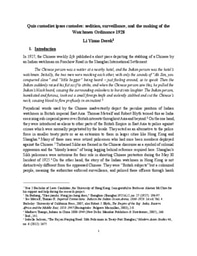
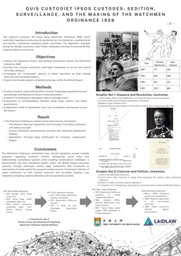
Curiosity shaped my Year 1 research from 14 July to 31 August 2025. Supervised by Professor Alastair McClure, I studied the making of Hong Kong’s Watchmen Ordinance 1928. What initially appeared to be occupational regulation became a history of race, surveillance and imperial power. Indian watchmen occupied an uneasy position: they performed security functions within British-controlled Hong Kong and China, yet were themselves colonial subjects exposed to discriminatory regulation.
Following that history required looking beyond Hong Kong. Indian migration, anticolonial movements and imperial intelligence connected Hong Kong with India and Chinese treaty ports. This Hong Kong–India–imperial network taught me that global thinking begins by questioning the boundaries of the subject itself. A law enacted in one jurisdiction may have been shaped by people, information and political anxieties moving through many others.
Curiosity, however, needed bravery. For me, bravery did not mean making the strongest possible claim. It meant resisting a neat conclusion when the archives could not support one. Official records were incomplete and reflected the priorities and prejudices of colonial administrators. Around 300 Indian watchmen petitioned against the proposed legislation, and their action helped secure amendments. Their intervention mattered, but I still had to exercise causal restraint: the available record did not justify attributing every change exclusively to their petition. Saying “the evidence does not establish this” can require more courage than presenting a confident narrative.
Determination also changed meaning for me. It was not stubbornly preserving an original argument. It was continuing to search, revise and narrow the claim when the evidence demanded it. I carried this lesson into my second year: persistence should deepen responsibility, not harden assumptions.
Character: Justice, Humanity, Humility and Judgment
The Character dimension of the 3Cs became most concrete when I considered whose perspective was present in my sources and whose was missing. Justice required me to examine a formally neutral ordinance as part of a racialised system. Humanity required me not to reduce Indian watchmen to objects of regulation or symbols within an imperial theory. They were workers pursuing livelihoods, members of diasporic communities and political actors capable of challenging the terms imposed upon them.
Yet humanity without humility can become projection. I could not recover every watchman’s motives or experience from administrative records. Integrity therefore meant distinguishing evidence from interpretation and acknowledging silence rather than filling it with an invented voice. Judgment lay in holding two truths together: the archive could reveal structures of discrimination, while still being insufficient to establish every individual experience or causal relationship.
The Oxford Character Project’s ethical-leadership training helped me understand that these are leadership questions, not merely research techniques. Leaders often act through categories, metrics and institutional procedures. Those tools may be necessary, but they can obscure the people affected by a decision. Ethical leadership requires asking who defined the problem, who bears the risk of error and who can challenge the resulting account.
This became especially important in my Year 2 project with the Shanghai Social Assistance and Education Volunteers Association. Work involving people in prison, community correction or post-release reintegration concerns dignity, privacy and unequal institutional power. A commitment to justice cannot justify expanding volunteer authority without safeguards. Nor should humanity become paternalism. Support must preserve agency, and volunteers must not replace the professional or public responsibilities that properly belong to qualified practitioners and state institutions.
Capacities: Turning Comparison into Responsible Action
My strongest growth in Capacities has been in research and analysis, critical reflection, project management, communication and collaboration. In Year 1, I learned to reconstruct a legislative history from fragmented sources. In Year 2, I applied comparative research to a present-day organisational question: how could volunteer involvement in rehabilitation and reintegration be structured more responsibly?
I examined 28 jurisdictions alongside United Nations and Council of Europe standards. The point was not to identify a foreign “best practice” and import it into Shanghai. Legal status, professional structures, community relationships and access to data differ substantially. Japan’s volunteer probation officers, European rules on public responsibility and volunteer safeguards, and American approaches to independent evaluation each answered problems arising from particular institutions. A global mindset therefore required disciplined contextual comparison: identifying the function of a safeguard, the conditions supporting it and the risks of transplantation.
This approach produced two desk-research reports, both delivered to and discussed with the Association by 31 August 2026. The partner agreed to pursue or test more structured volunteer screening and training, clearer boundaries between professional and volunteer roles, and more independent evaluation. These are practical outcomes, but I must state their limits. I did not conduct interviews, questionnaires or employer outreach, and I cannot claim effects on beneficiaries. The reports generated proposals for organisational learning; they did not prove that rehabilitation outcomes improved.
That distinction transformed my understanding of impact measurement. An activity completed is not automatically an outcome achieved, and an outcome observed is not automatically caused by the project. Evaluation should begin before implementation by defining intended outcomes, comparison points, timeframes and data protections. Independent scrutiny is particularly important when the organisation delivering a service also judges its success.
Commitments for Ethical and Global Leadership
These two years leave me with concrete commitments. I will seek affected people’s perspectives rather than treating institutional records as complete. I will state uncertainty and distinguish findings, interpretations and aspirations. I will separate public and professional responsibilities from appropriate volunteer roles. I will protect dignity and personal data, especially when working with people facing stigma or state supervision.
Before evaluating a project, I will define its intended outcomes and the limits of what its evidence can show. I will invite independent scrutiny rather than treating criticism as an obstacle. I will also revisit decisions when new evidence or affected voices reveal that an earlier judgment was incomplete.
For me, acting as a global citizen means remaining answerable across contexts: learning from elsewhere without assuming equivalence, recognising how histories connect places, and adapting ideas without erasing local institutions or human experience. Ethical leadership is not a final identity achieved through the Scholarship. It is the continuing practice of comparing carefully, acting proportionately and remaining willing to be corrected.