Reading a City Through Its Pipes: Wastewater Surveillance in Boston

Field: Environmental Health
Project Title:
Name: Mirari Ubani
Faculty Advisor/PI: Hannah Greenwals Healy
Host Institution/Department: Harvard T.H Chan School of Public Health
Concentration/Major: Anthropology
College: Harvard College
House: Currier House
Graduation Year: 2029
I distinctly remember the first time I was face-to-face with nine liters of fresh sewage water. It was my first field sampling day and I started my morning staring down a 20-foot-deep manhole, trying and failing not to gag at the foul odor rising up from below. All I could think about was how far this scene was from the white coats and sleek, climate-controlled labs I assumed “summer research” would look like. Nevertheless, this “gross” substance is, in fact, one of the most honest sources of public health data there is. Wastewater does not lie, does not get embarrassed, or avoid the clinic out of shame. Instead, it reflects exactly what a community is carrying.
A City Undercounted
That honesty is important because Sexually Transmitted Infections (STIs) remain a significant public health burden in Boston, with infection rates exceeding both state and national averages. Notably, infection rates were reported at 891.3 per 100,000 in Boston, compared to 322.2 in Massachusetts, and 445.7 nationally—meaning Boston’s rates are nearly triple the state average and almost double the national average . Despite this, STIs continue to be substantially underreported in official statistics. This is due to barriers to testing such as asymptomatic infections that go undetected until complications arise, stigma that discourages people from receiving care, and unequal access to clinical testing, leaving large populations completely underrepresented in the data. These gaps create an incomprehensive population health data landscape for STI infections, making infection monitoring, resource allocation and overall public health response difficult. This is precisely what drew me to this research in the first place. I am curious about what socially-induced barriers to healthcare exist within my community, the ways stigma or lack of access can make a person fall below the radar of the systems that are meant to serve them, and what role I might play in closing this gap.
Sewage as a Second Opinion
The solution my research group turned to was wastewater-based epidemiology (WBE), which offers population-level surveillance entirely independent of individual testing behavior. In practice, it involves analyzing wastewater for the causative agents (the actual bacteria, viruses, or their genetic fragments) of various infectious diseases to better understand the disease burden within a neighborhood. This is a substantial improvement from existing methods because state and municipal-level statistics often blur neighborhood-scale inequalities, grouping together areas with very different needs into larger, less useful clusters. Wastewater-based epidemiology helps mitigate this by allowing researchers to zoom in on sewer catchments that only flow from a specific neighborhood, revealing patterns that would remain otherwise hidden in city-wide figures. WBE has been validated as an effective method for monitoring a range of infectious diseases such as SARS-CoV-2, influenza, norovirus, and other enteric and respiratory pathogens, most notably during the COVI-19 pandemic. More recently and more relevant to my project, it has also been used to detect and monitor HIV, syphilis, chlamydia, and HPV, proving real potential for the surveillance of STIs in particular.
From Sample to Signal
My summer project involved building on these previously established methods of wastewater surveillance, and refining them to specifically detect the causative agents of gonorrhea, syphilis, and chlamydia. In collaboration with the Boston Public Health Commission, our team collected a total of 1,454 wastewater samples from 11 different neighborhoods in the Greater Boston Area from August 2024 to June 2025. This was then narrowed down to 189 samples that were strategically chosen for analysis based on the time and geographic location of collection, in order to provide the most informative and representative data possible. For each sample, we first extracted the nucleic material using a manual, solution-based extraction system designed to separate genetic material from the rest of the wastewater matrix . These extracts then underwent ddPCR (Digital Droplet Polymerase Chain Reaction)—a highly sensitive technology used to detect and quantify species-specific bacterial DNA targets unique to the three pathogens we were studying. It involves partitioning each extracted sample into thousands of tiny individual droplets and testing each droplet separately for a positive or negative read for the target pathogen’s DNA, allowing for more precise detection than other PCR methods. After testing for the three primary pathogens, the samples were also tested for Carjivirus, a bacteriophage naturally found and consistently present in the human gut microbiome, which served as a normalization factor to account for differences in wastewater composition and fecal content across samples. On a particularly rainy day, for instance, stormwater runoff can heavily dilute the wastewater flowing through the sewer system, falsely suppressing the positive ddPCR readings for the target pathogens, even if infection rates remain unchanged. Testing for Carjivirus helps account for this since its concentration should remain relatively stable across samples from the same population. This fact then allows us to mathematically adjust the raw concentrations of the gonorrhea, chlamydia, and syphilis biomarkers accordingly and arrive at figures that accurately reflect the true underlying disease burden.
Not every part of the research process went by smoothly and with minimal setback. About half way through the summer, our team hit a wall that I continue to think about. All of the samples we had analyzed thus far had chlamydia results that came back exactly zero. Given that chlamydia is the most commonly reported STI in Boston, and that we had been detecting gonorrhea and syphilis biomarkers in the samples, this was extremely alarming. I was very confused because surely there should be chlamydia in the wastewater. Was our method ineffective for chlamydia? Was chlamydia genuinely absent from those samples, and if so, why? My mentor began asking these important questions, which sent me back through every step of the protocol, looking for why, if at all, the process might have failed. I initially suspected that perhaps the time elapsed between extraction and ddPCR gave room for sample degradation, which was why we were experiencing no chlamydia detection. However, if this was the case we would not have detected carjivirus, gonorrhea, or syphilis at all. Eventually, we landed on a more likely culprit: shedding patterns. In similar studies done prior, gonorrhea was consistently detected in larger concentrations than the clinical testing data would suggest. From this we could conclude two things: either gonorrhea is significantly underreported, or the shedding rates for individuals with gonorrhea are much higher in comparison to other STIs. In these same studies, chlamydia on the other hand, would consistently present much lower concentrations than the clinical testing numbers show, raising the possibility that chlamydia is simply shed at lower rates compared to the gonorrhea and syphilis. This was the working theory that we settled on as an explanation for the lack of positive reads for chlamydia despite its known prevalence in Boston. It is plausible, although it is not easily proven because it is extremely difficult to accurately quantify the amount of genetic material associated with a disease that is consistently present in the fecal matter of the infected individual. In all honesty, this was not a satisfying moment; Instead of a “eureka” moment, I instead got a hypothesis, a list of variables to keep in mind going forward, and a genuine appreciation for how much of research is troubleshooting rather than discovery.
What We Found and What It’s Worth
So what exactly did we find? Our method successfully detected biomarkers for gonorrhea and syphilis across our Boston wastewater samples, with positivity rates of 23.5% and 7.4% respectively. This is meaningful evidence that these pathogens are circulating and detectable through sewage, independent of anyone ever showing up to a clinic. Chlamydia has yet to turn up in our current dataset, and we believe this reflects differences in shedding rates rather than a true absence of the pathogen in the community. The main takeaway is that the method itself works and we can reliably pull disease signals for STIs out of a substance most people would rather not think about at all. The gaps in our chlamydia data are giving us a clear, specific target for improvement, rather than simply being a dead end. More broadly, our work extends a young and promising method of population health monitoring into a new pathogen territory in a new city. Our dataset adds to a small but growing body of evidence that Wastewater-based epidemiology generalizes beyond the handful of settings where it was first proven.
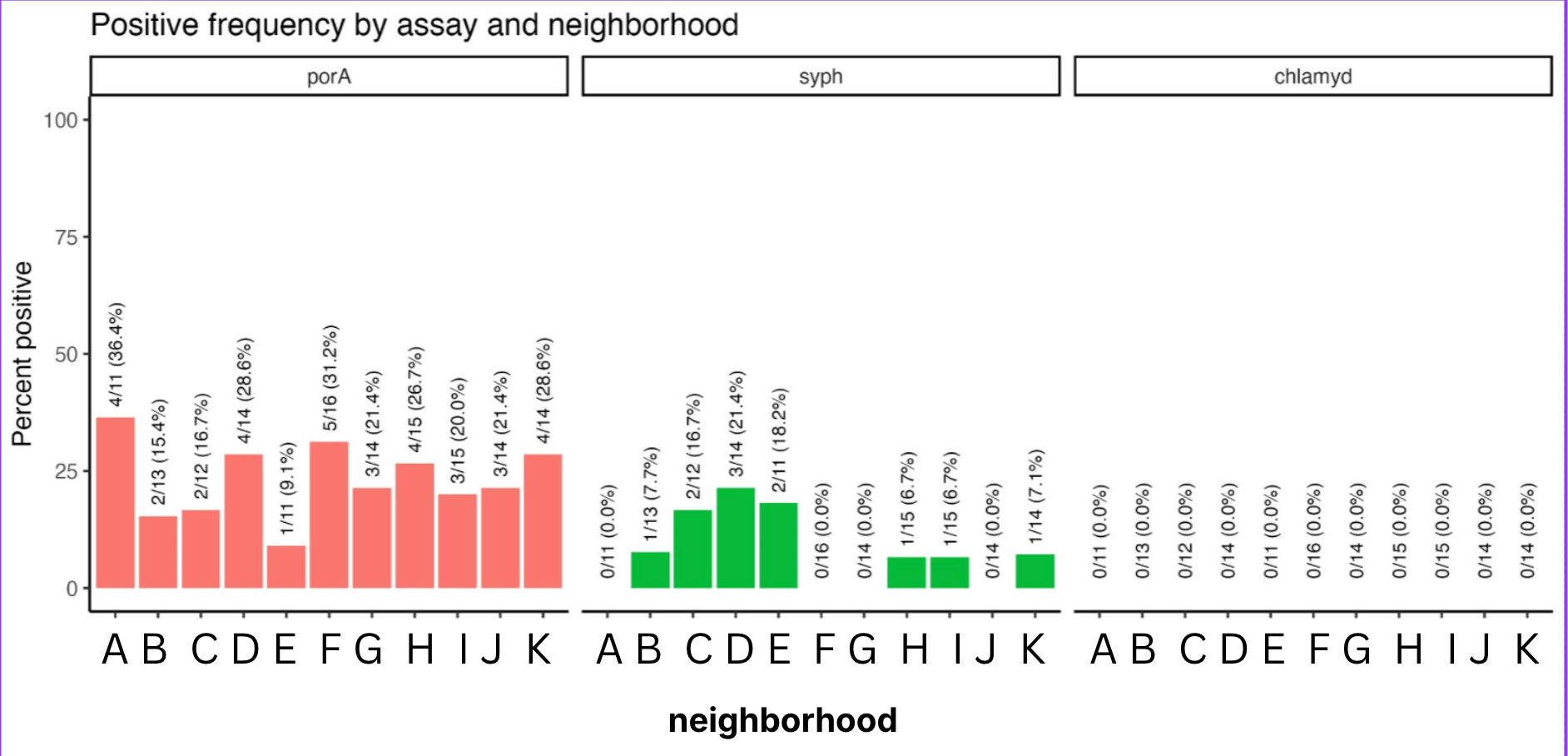
Figure 1: Positive frequency by assay and neighborhood
Note: neighborhoods have been anonymized
We reported our findings to the Boston Public Health Commission (BPHC), who will use the information to shape health education and other resource allocation delivered to specific communities in accordance with their specific needs. Presenting my findings to the BPHC felt particularly rewarding because I was able to witness very clearly in real time how my lab work was being translated to actual action that supported some of the most vulnerable populations within my community. Oftentimes, research can seem very distant from real world impact outside of the pursuit of knowledge. However, within the span of a few months, I was able to see the results of my research play out in real time and it was without a doubt the highlight of my summer.
Reconsidering My Future Goals
Zooming out, I keep coming back to how this summer fits into my long term academic and career goals. Coming into this project, I had an introductory background in biology and chemistry coursework and a general, growing interest in public health, global health, and social medicine. It was the kind of interest built more from statistics I'd read, rather than from anything I'd actually done. This summer taught me how much I like being able to see my research directly and positively impacting lives, deepening my personal interest in public health research. I have long-term goals of becoming a physician who makes an effort to understand health beyond a purely medicinal perspective. I hope to be someone who treats a patient not as an isolated case but as a person shaped by their neighborhood, access to care, and the barriers that kept them from walking through the clinic door in the first place. This research provided me with the opportunity to practice that mindset before even starting any form of medical training. Looking at a positive read on my computer was looking at a proxy for real social barriers to healthcare. Wastewater surveillance allowed me to engage with those barriers structurally, on a large scale, rather than on an individual level—which was a novel and fulfilling experience.
Before this summer, I did not realize how important it is that research and clinical work coexist and inform each other, rather than being on two separate tracks. This was my first research experience and I now know that this intersection is something that I want to continue to pursue both academically and in the future, professionally. I hope to pursue an MD-PhD after I complete my undergraduate studies.
I also came away from this research experience with a clearer sense of my own limits and how much learning I still have ahead of me. I’m far more comfortable with lab techniques than I was in June, but the parts of this project that I found the most challenging and energizing were the aspects that required me to think more like an epidemiologist, and not a bench scientist. I am now motivated to seek coursework in epidemiology and biostatistics during my college career and perhaps beyond. I left this summer with my interests not only confirmed, but pointed in a slightly more specific direction than before.
Currently, I am still concerned less with pathogens and more with people: how do we build health systems, clinical or otherwise, that extend the same honesty to the patients they are meant to serve? How can these systems be designed to see people regardless of whether or not they show up asking to be seen? Although I am still unsure about the answers to these questions, this summer gave me a working example of what it could look like, and I would love to continue exploring similar solutions hopefully through my Leadership in Action project and beyond.

Hi! I'm Mirari and I’m currently pursuing a double major in Anthropology and Chemistry. I’m particularly drawn to global health and social medicine, especially how structural barriers and stigma shape healthcare outcomes. I’m curious about how we can design more equitable systems of care that better serve marginalized communities.