Project Outline: The Impact of Socioeconomic and Demographic Factors on Healthcare-Seeking Behavior and Symptom Severity in Acute Rhinosinusitis
Abstract
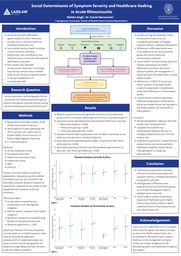
Acute rhinosinusitis (ARS) affects approximately 20 million people annually in the United States and typically resolves without medical intervention. However, a subset of patients progress to more severe disease, and prior research suggests that socioeconomic disadvantage, including low income, lack of private insurance, lower educational attainment, unemployment, and racial or ethnic minority status, is associated with delayed access to care and worse outcomes across many conditions, including ARS. Prior work has shown that publicly insured and uninsured patients are far more likely to seek emergency care for uncomplicated ARS, and that Black patients present to emergency departments for ARS at substantially higher rates than White patients, raising the question of whether these disparities are driven by delayed entry into care and the greater symptom severity at presentation.
This project is a retrospective secondary analysis of data from the NOSES (Nasal Steroids, Irrigation, Oral Antibiotics and Subgroup Targeting for Effective Management of Sinusitis) trial, a multi-site randomized clinical trial of ARS treatment strategies in primary care settings. Using demographic and socioeconomic data collected at enrollment, this study examines whether household income, insurance type, educational attainment, employment status, race, and ethnicity are associated with symptom severity at presentation, measured using the modified Sino-Nasal Outcome Test-16 (mSNOT-16), which serves as the primary outcome of this analysis. Two secondary outcomes are also examined: the number of days between symptom onset and presentation for care, and progression to Phase 2 randomization within the NOSES trial, a marker of unresolved illness. By identifying which socioeconomic factors are most strongly associated with delayed care-seeking and greater symptom burden, this project aims to inform targeted interventions that could shorten the gap between symptom onset and care for disadvantaged populations.
Research Objectives & Questions
Primary Objective: To determine whether socioeconomic status (SES) indicators are associated with delayed healthcare-seeking behavior and increased symptom severity among adults presenting with acute rhinosinusitis.
Primary Research Question: Are household income, insurance status, educational attainment, employment status, race, and ethnicity associated with (a) the number of days between symptom onset and presentation for care, and (b) mSNOT-16 symptom severity scores at presentation?
Secondary Objectives:
- To assess whether SES indicators predict progression to Phase 2 randomization within the NOSES trial, as a marker of illness persistence.
- To assess whether SES indicators are associated with the number of days between symptom onset and presentation for care
Background
Acute rhinosinusitis is one of the most common upper respiratory conditions in clinical practice, accounting for roughly three billion dollars in healthcare costs annually. Although most cases resolve without pharmacologic treatment, some progress to acute bacterial rhinosinusitis, which can lead to orbital or intracranial complications. Since most ARS improves with conservative management, timely evaluation matters, however access to that evaluation is not equally distributed. A growing body of literature has connected social determinants of health (income, education, insurance coverage, employment, and race/ethnicity) to disparities in ARS care.
Patients with public insurance or no insurance are more likely to rely on emergency departments for uncomplicated ARS than privately insured patients, a pattern attributed not to differences in disease presentation but to difficulty securing timely primary care appointments. Uninsured patients tend to present with higher pain levels, consistent with delayed intervention allowing symptoms to worsen. Patients from lower-income and less-educated communities are similarly less likely to access specialty rhinology care and face added barriers such as transportation limitations and lower health literacy. Pediatric data showed that Medicaid-insured or uninsured children are more likely to present with severe intracranial complications of sinusitis. Race and ethnicity add another dimension as Black patients present to emergency departments for ARS at substantially higher rates than White patients, and symptom reporting itself differs across groups, with Hispanic patients more often reporting facial pain and headache rather than classic sinonasal symptoms, and Black patients reporting sinonasal symptoms less often overall.
This literature suggests that socioeconomic and demographic factors may influence not just where ARS patients seek care, but when they enter the healthcare system and how severe their symptoms are once they do. This project builds on that foundation by testing these relationships within a controlled trial dataset (NOSES).
Methodology
This project is a retrospective secondary analysis of data already collected through the NOSES trial, a randomized clinical trial evaluating ARS treatment strategies for adults across six Practice-Based Research Networks (Georgetown University, Penn State College of Medicine, UCLA, University of Washington, University of Wisconsin–Madison, and Virginia Commonwealth University). As the data already exists in the trial's REDCap database, this project does not involve new patient recruitment, rather extracting, organizing, and statistically analyzing demographic, socioeconomic, and clinical variables already gathered at enrollment.
Population: Adults aged 18-75 presenting to primary care, urgent care, or student health settings with ARS symptoms lasting 1-21 days (or meeting "double sickening" criteria). The analysis includes all enrolled participants who completed the Demographics and General Health form and had at least one symptom-severity measure recorded.
Socioeconomic Variables: Four self-reported indicators drawn from the enrollment form: household income, educational attainment, insurance status/type, and employment status, along with race and ethnicity. Participants who answered "prefer not to answer" or "don't know" are treated as missing for that variable.
Outcome Variables:
- Primary outcome: mSNOT-16 score at Day 0, a validated, continuous patient-reported measure of symptom burden and quality of life, where higher scores indicate greater severity.
- Secondary outcomes: Days elapsed between symptom onset and enrollment (a continuous proxy for care-seeking delay), and progression to Phase 2 randomization (a binary marker of unresolved illness, since Phase 2 enrollment occurs only among patients without adequate improvement after roughly 9 days).
Analytic Approach: Each SES/demographic variable will be examined in relation to each outcome. Continuous outcomes (mSNOT-16 score, days to presentation) will be compared across SES categories; the binary outcome (Phase 2 progression) will be compared as proportions across the same groups. My statistical analysis plan has not been decided yet.
Potential Impact
Health disparities continue to affect when patients seek medical care and the outcomes they experience. By identifying socioeconomic and demographic factors associated with delayed presentation and greater symptom burden in acute rhinosinusitis, this research may help clinicians recognize populations at increased risk for poor outcomes and inform interventions that improve equitable access to care. More broadly, the project contributes to the growing body of literature examining the impact of social determinants of health on common outpatient conditions and may support future efforts to reduce healthcare disparities through targeted public health and clinical strategies.

Hi! My name is Rishika Singh and I'm a rising sophomore at Georgetown University majoring in Human Science. As a Laidlaw Scholar, I am investigating how socioeconomic and demographic factors, including income, insurance status, educational attainment, employment, race, and ethnicity, influence healthcare seeking behavior and symptom severity among patients with acute rhinosinusitis. Beyond research, I love being active and spending time with my friends. I also love food and my favorite cuisine is Thai food. Feel free to reach out here or at rs2298@georgetown.edu!