Project Outline: Security or Sovereignty—An Analysis of US Military Bases in Japan
Background
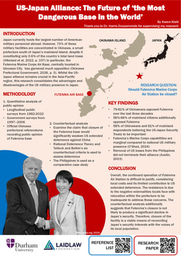
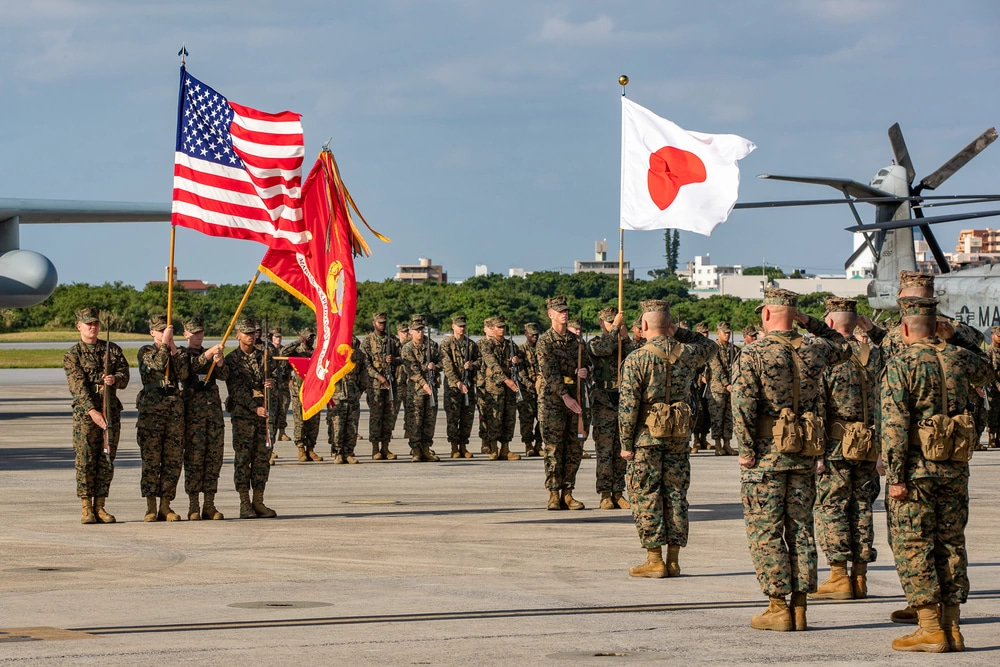
The United States Forces Japan (USFJ) currently deploys approximately 60,000 military personnel across 15 major bases in Japan. However, 70% of these military facilities are stationed in Okinawa, a small prefecture south of Japan’s mainland island, despite it constituting only 0.6% of the country’s total land mass. Over the years, the local population has repeatedly demonstrated discontent towards the military presence, as most notably seen in 2010, following the Prime Minister's failure to relocate the Futenma military base, criticised due to its urban location, out of Okinawa Prefecture as previously promised. Despite longstanding opposition, their presence continues to be supported due to its effective deterrence; Okinawa’s proximity to Tokyo, Taiwan, China, and both North and South Korea helps assert American dominance against nuclear-armed rivals. For Japan, they have acted as the country’s only military defence since 1945. With relocation of the base being prolonged and government meetings ending in stalemate, the future of the alliance is unclear.
Since the postwar era, the US-Japan relationship has proved crucial in maintaining Indo-Pacific relations. Recently, this alliance has been undergoing a transformation, moving away from its long-established dynamic where Japan focused on defence strategies and the US provided offensive military power. Under the five-year defence plan set out just last year, Japan’s cabinet approved a record defence budget that is on track to reach 2% of the country's GDP by March, marking a significant shift away from their previously self-imposed cap of 1% of the GDP, established in their 1976 constitution as a commitment to pacifist values. This clear shift is significant as it brings into question the future of the San Francisco System and implicates the wider Asia-Pacific region. It is important to reexamine the stability of this bilateral relationship and future implications in an era of interconnectedness and rising global tensions.
Objectives
My goal is for my research to encompass the varying advantages and disadvantages of the US military presence in Japan through thoroughly investigating all stakeholders in the matter. With Japan hosting the largest number of American military personnel abroad, these military bases remain crucial to international security. However, it is the Japanese citizens who feel their immediate consequences. Many studies on this matter take a Eurocentric stance and overlook the dangers these military bases pose to their immediate surroundings, especially those located in urban areas such as the Futenma base. On the other hand, this military presence undeniably bolsters the Japanese economy, especially in Okinawa, where income is heavily reliant on tourism. As its economy continues to decline, complete removal could have huge ramifications. Hence, there is much debate even domestically on whether these bases are worth the dangerous risks, which is another question I hope to address in my research. Close evaluation of whether the costs outweigh the benefits or vice versa will be needed, and I hope to propose a solution where the negative international externalities are kept to a minimum, whilst not overlooking the Japanese locals’ voices.
Methodology
I will be approaching my research in two steps. Firstly, I hope to carry out a quantitative analysis of general public survey results starting from the 1950s, documenting changing opinions on the US military presence. This data will be collected through primary sources that have conducted public surveys, such as the NHK (the Japanese Broadcasting Company), and official results of government referendums will be reviewed. Secondly, through a thorough literature review, I will be able to gauge confidence in Japan’s ability to defend itself and apply frameworks such as the Rational Deterrence Theory to evaluate the necessity of US bases. Their effectiveness as a deterrent and any potential security threats following their complete removal will be examined with a counterfactual analysis, using primary sources which publish reports on deterrence impacts, such as the RAND Corporation. Ultimately, I aim to evaluate if the US military presence in Japan should be removed or reduced.
Supervised by Dr Harris Dousemetzis, Durham University School of Government and International Affairs

Hi, my name is Karen and I am a first-year Philosophy, Politics and Economics student at Durham University. My research project aims to examine the American and Japanese bilateral relationship through analysing the impacts of US military bases in Okinawa. I am excited to be part of the 2026 Laidlaw cohort!