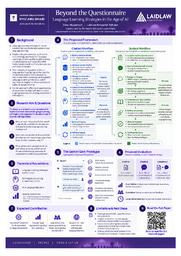
Project Outline: Rethinking Language Learning Strategy Assessment in the Age of AI


Language learners are often encouraged to use specific learning strategies to improve their progress, such as planning their study sessions, practicing vocabulary in particular ways, monitoring their understanding, or managing anxiety when speaking. To help learners identify which strategies suit them best, researchers have developed questionnaires that ask students about their learning habits, challenges, and experiences. Based on their responses, learners are often matched with strategies and activities designed to support their development.
However, most of these instruments rely on static self-report questionnaires. They assume that learners can accurately describe their own behaviors, recognize the strategies they use, and reflect on their learning process. Existing research suggests that this may not always be the case. Learners are not always aware of how they learn, may struggle to identify the source of their difficulties, and often complete these questionnaires at only a single point in time despite learning being a dynamic process.
This summer, my research will explore whether conversational AI can improve the way language learning strategies are identified and recommended. Rather than focusing on AI as a tool for teaching languages directly, I am interested in whether AI can help learners better understand how they learn. Specifically, I will investigate whether a guided AI chatbot could provide a more personalized and reflective alternative to traditional questionnaires by asking follow-up questions, adapting to learner responses, and helping learners uncover strategies they may not realize they are already using.
Motivation
What initially drew me to this project was my growing interest in the educational applications of artificial intelligence. During a recent J-Term course exploring the impact of AI on the fashion industry, I became interested in the broader question of how AI might reshape established systems and practices. This led me to wonder whether AI could improve existing approaches to educational support rather than simply automate them.
I was particularly drawn to this project because it sits at the intersection of technology, education, psychology, and human behavior. As an Economics student, it also gives me the opportunity to explore a field I would not normally encounter through my coursework while developing research skills in an emerging and rapidly evolving area.
Impact
As AI becomes increasingly integrated into education, understanding how it can support learning effectively and responsibly is becoming more important. If conversational AI can improve upon traditional strategy assessment methods, it may help learners receive more personalized guidance and become more aware of their own learning processes.
Beyond language learning, this research contributes to broader conversations about how AI can support self-regulated learning, reflection, and skill development. Ultimately, I hope this project will provide insights into how AI can be used not simply to deliver information, but to help learners better understand themselves and make more informed decisions about their learning.
I am excited to begin this research and to connect with other scholars exploring the intersections of education, technology, and human development. If your work touches on AI, learning, lang