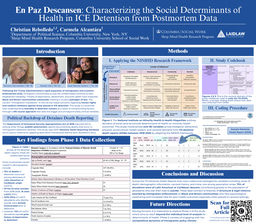
Project Outline: Characterizing Social Determinants of Health in ICE Detention from Postmortem Data
Characterizing Social Determinants of Health in ICE Detention from Postmortem Data
Supervisor: Dr. Carmela Alcántara, Sleep, Mind, and Health Research Program Director, School of Social Work, Columbia University
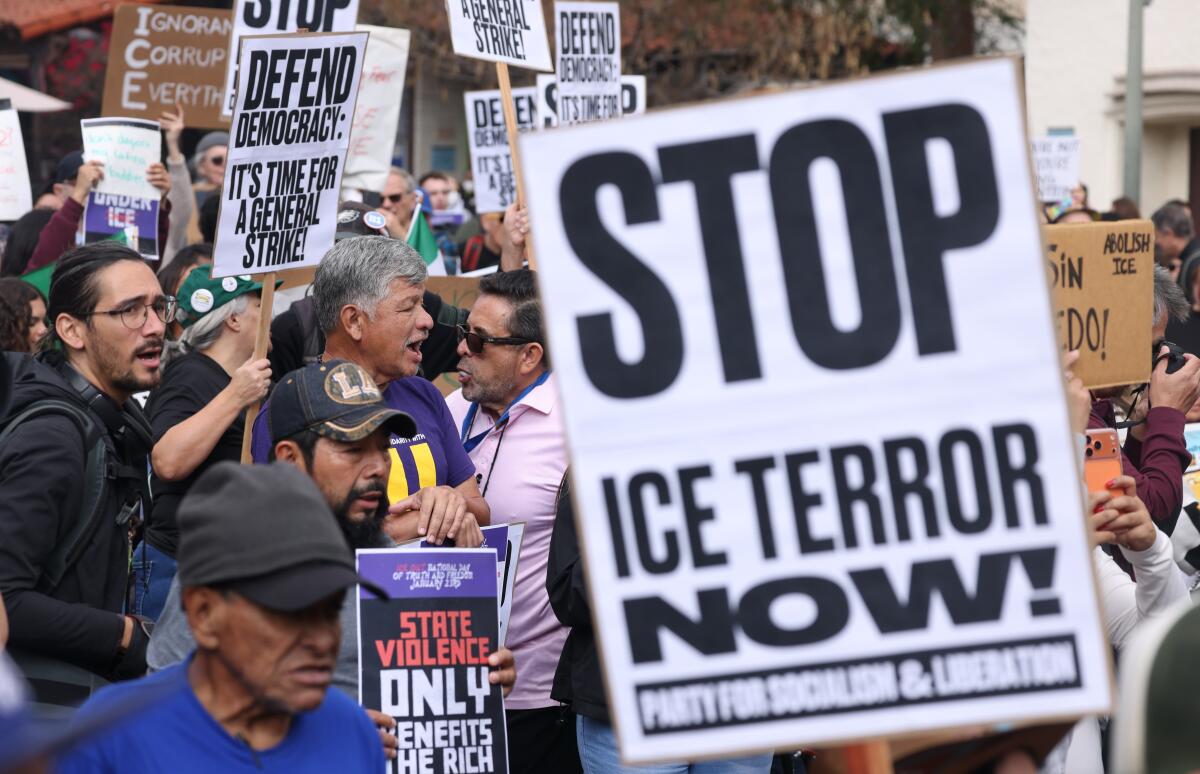
As immigration enforcement expands through executive actions such as Protecting the American People Against Invasion, undocumented communities across the United States face heightened instability shaped by detention, racial profiling, deportation, and institutional violence. Reports of deaths in Immigration and Customs Enforcement (ICE) custody—many linked to suicide, untreated illness, and alleged medical neglect—have increasingly drawn public attention. Yet statistics alone cannot fully explain the broader structural conditions that shape these outcomes. By examining deaths in ICE detention through a public health lens, my research seeks to contextualize these cases within larger systems of healthcare access, incarceration, and social vulnerability.
This project will characterize and analyze qualitative post-mortem reports from ICE’s Detainee Death Reporting Database (IDDRD) using variables tied to the social determinants of health. Through this work, I hope to better understand how detention conditions intersect with chronic illness, medical treatment, and structural inequities throughout the life course of detained individuals. More broadly, this research aims to contribute to conversations surrounding immigration governance and human rights by advancing the principle that healthcare and dignity should not depend on immigration status or political ideology.
Project Background
The expansion of ICE detention has coincided with growing concern over transparency and accountability within detention facilities. While mainstream media coverage has documented deaths occurring in custody, there remains limited systematic research examining the broader socioeconomic and medical patterns underlying these cases. Understanding mortality in detention requires more than counting deaths; it requires examining the structural vulnerabilities detainees carry with them into incarceration and the institutional conditions they encounter while detained.
Recent transparency mandates, including provisions in the DHS Appropriations Bill of 2018 requiring ICE to publish post-mortem reports within 90 days of an in-custody death, have created new opportunities for archival and policy-oriented research. These reports provide qualitative insight into detainees’ medical histories, detention experiences, and causes of death, allowing researchers to identify potential trends that may otherwise remain obscured.
My project approaches these reports through the framework of public health and the socioecological model. By characterizing factors such as demographics, chronic illness, prior medical conditions, treatment access, carceral history, and institutional responses, I aim to assess whether deaths in detention represent isolated incidents or reflect broader patterns of structural vulnerability and neglect. This topic sits at the intersection of immigration policy, governance, and health equity—fields I hope to pursue professionally through a future JD/MPH pathway.
As a Mexican American, this work is also deeply personal. Stories from Hispanic community members who were detained and never returned have reinforced my commitment to using research as a tool for advocacy, transparency, and justice. Through this project, I hope to contribute evidence that informs policy discussions surrounding detention practices and the treatment of immigrant communities in the United States.
Methodology
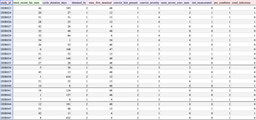
During Summer 1, I will develop a Processing Plan worksheet to systematically analyze qualitative reports from the IDDRD. This worksheet will organize demographic information such as country of origin, fiscal year of death, age, race, and sex for each decedent. I will then characterize additional variables connected to the socioecological model, including medical history, carceral history, media coverage, treatment in detention, and reported causes of death.
To structure this analysis, I will create binary coding questions for each feature of interest, categorizing variables using “yes” or “no” responses to facilitate tabulation and comparison across reports. Because the reports are qualitative and often extensive, I anticipate conducting multiple rounds of review and close reading to identify recurring themes and relevant information. After constructing these datasets, I will use the statistical programming language R to generate regressions, tabulations, and graphical representations of the data in order to identify patterns among compounding factors. This analysis may reveal relationships between chronic illness, institutional treatment, detention conditions, and mortality outcomes that warrant deeper investigation.
Given the large volume of reports—more than 100 files—Dr. Alcantara and I are also exploring the possibility of integrating Artificial Intelligence tools to accelerate the initial processing and categorization of documents. While this process is still under consideration, the primary emphasis of the project remains careful archival review and qualitative characterization conducted by hand to ensure accuracy and contextual understanding.
Objectives
Ultimately, I hope this research will contribute to a more comprehensive understanding of how immigration detention affects health outcomes and human dignity. By identifying structural patterns within ICE detention deaths, I aim to provide evidence that can inform future policy discussions surrounding detention standards, healthcare access, and institutional accountability.
This project also represents my broader commitment to combining research, public health, and legal advocacy in service of immigrant communities. Through careful analysis and transparent reporting, I hope to use scholarship not only to document systemic inequities, but also to support conversations about justice, health equity, and the protection of human rights for vulnerable populations. I am beyond excited to embark on this research journey.