Of Mosques, Mango Juice and Mapping
I have re-typed my introduction a million times, and still I sit with the perfectionist aspiration I have tried to overcome. Oxford's monotonous essay structure has extinguished my yearning for a more op-ed style of writing. Perhaps it is in the six Laidlaw reflection blogs that I begin to reclaim it, or perhaps this too will be in vain. These new experiences not only mark this new chapter, but also reflect my first week here in Historic Cairo, Egypt.
I landed in Cairo, a place strikingly similar to my home city of Karachi. Arriving from an intense period of fieldwork between Oman and Pakistan, as well as a wedding season in London, I was glad to create a (temporary) base in a city that rewards spontaneity and movement, whilst offering tranquillity through the Nile.
Yet my day today, the beginning of my second week here, is nothing like the promises of the Nile. I woke up with an allergic reaction and sore throat, realised I had forgotten to exchange cash (needed for medication), then had a very unsuccessful trip to the bank after realising I had left my passport at home. I was then left stranded when my Uber driver cancelled on me. I was therefore late to work, attempting to speak my little Arabic in a taxi I found on the roadside. Nevertheless, I am here, in this beautifully reclaimed office, typing this blog.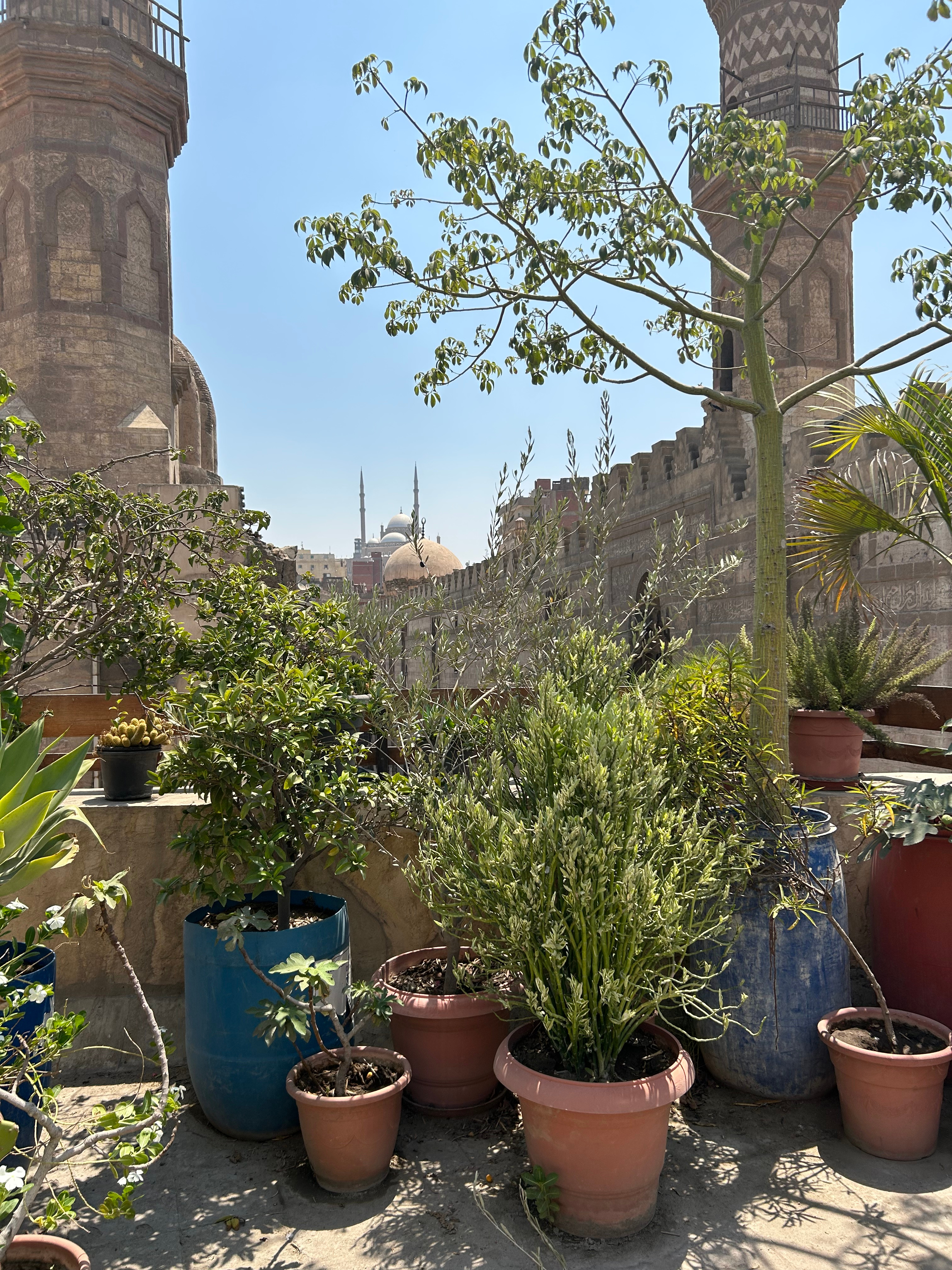
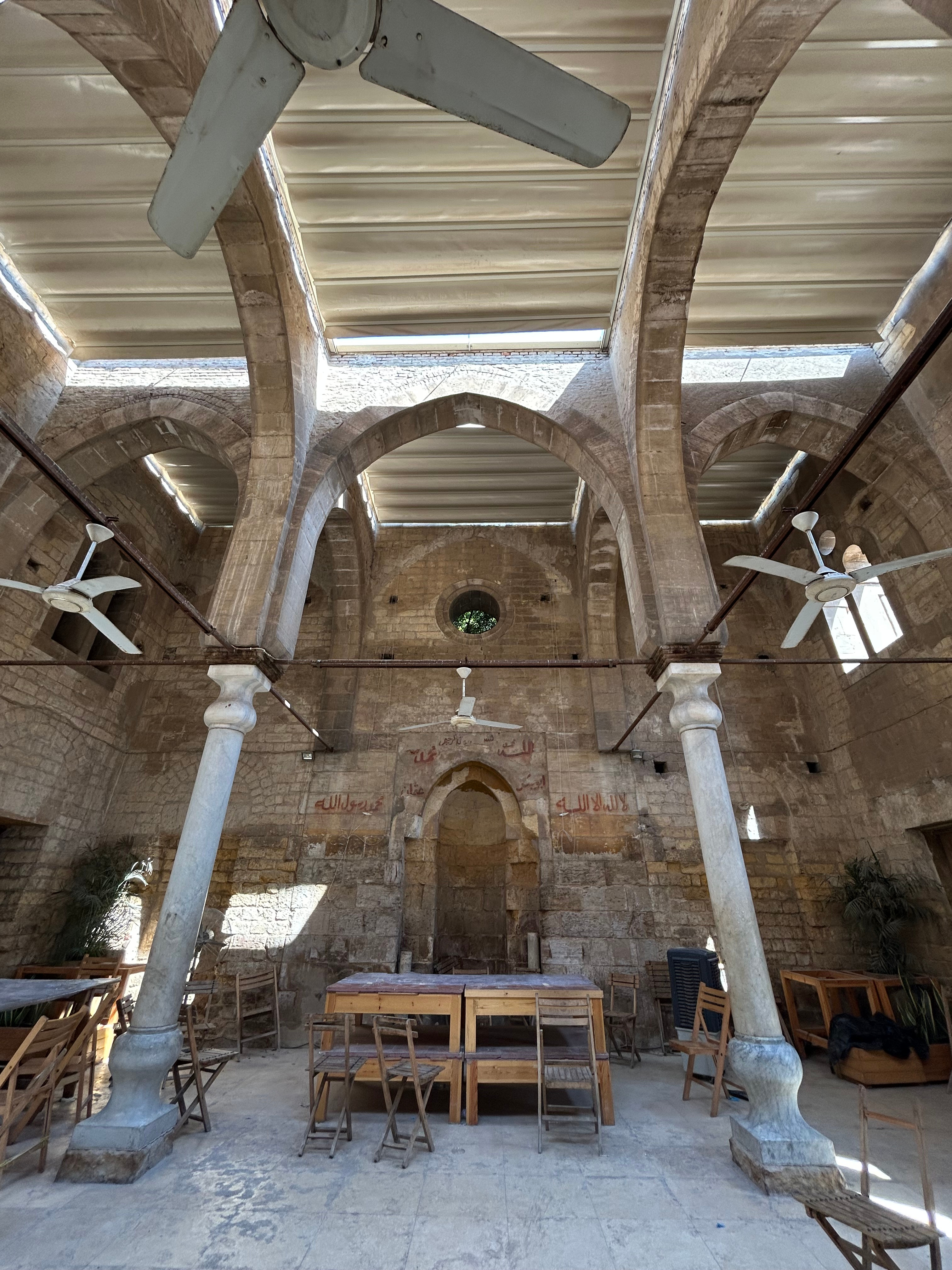
(Left): The roof garden on my office created by Megawra's Urban Greening Team. (Right): The interior of the Megawra community centre
Nestled around some of the earliest mosques built in North Africa, prominent Islamic shrines, sites of Sufi practice and palimpsests of palaces, the two offices blend well into the local architectural orthodoxy. Yet, with this romanticism comes hardship. As was made visible through the window of my air-conditioned taxi on the journey here, the area is one of Cairo's poorest. As the community battles inflation, many residential buildings are to be demolished to create roads- lanes that some of the poorest here cannot even afford to drive a vehicle on. I think a lot about bulldozer politics, and how, despite borders, violence is inflicted upon the urban poor spatially.
In my attempt to diverge from my degree's purely theoretical framing of issues (which I do find comfort), I yearned for something material. And nothing is more material than working at an architectural, built-environment office focused on heritage conservation, urban regeneration and (ground)water management. Yet, what drew me to Megawra was not just the issues it worked on, but how it approached them. As someone who has worked with many stakeholders in the UK climate space- young people, policymakers, engineers, politicians and researchers- I specifically sought an LIA oriented towards on-the-ground work, for, and by the community, as this is what I yearn for the most.
As I had an impending academic deadline last week, the Megawra team kindly arranged for me to work from home so I could firstly recover from weeks of jet lag and exhaustion, but also reflect on what I want out of this fellowship. As is the case with many organisations working radically, securing funding for permanent projects proves difficult. At the same time, it is these longer-term projects that facilitate ongoing community dialogue.
Nevertheless, after arriving at the office, I was given tours of the different projects and sites in the neighbourhood, from the Ibn Tulun Mosque to the local mango juice seller, as well as residential urban gardens providing communities with medicinal native herbs. This way of working is rooted in face-to-face interaction: the "assalam o alaikum"s, the laughter of the local children currently being hosted at Megawra's summer camp, and the 'happy birthday' (sana helwa ya gameel) song they sang for their teacher. Although this meant that team building and community engagement were prioritised for the first few days, I was desperate to be 'productive'. It was then that I had to rethink my LIA not as a 9-5 internship, but an experience rooted in relationships, observation and presence.
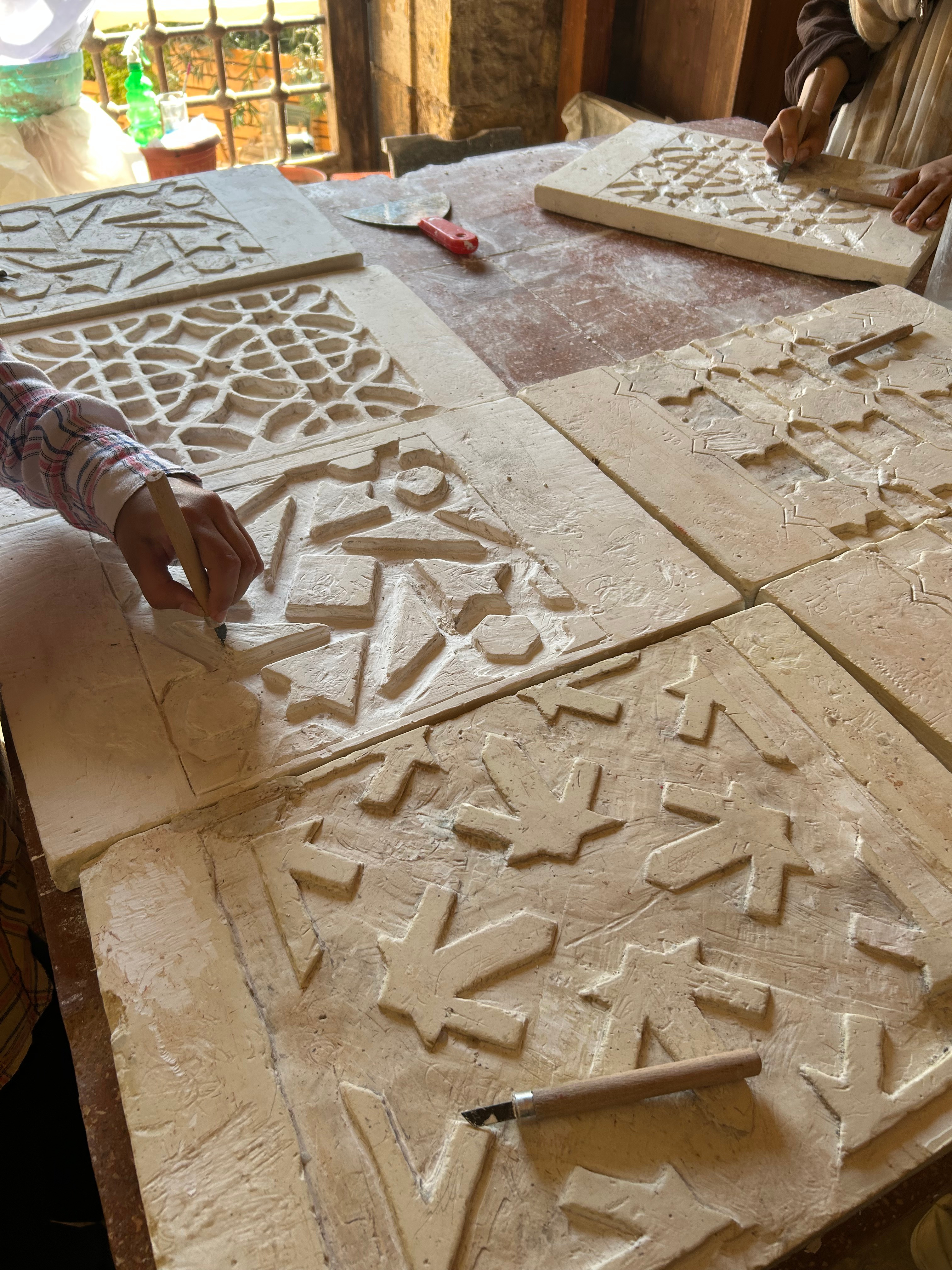
Stone carving workshop
After being invited to a carving workshop designed for the students of the summer camp, I was able to meet a (much older) volunteer group comprised of university students like myself, studying geography (like me!!), architecture, and even media studies. Whilst carving, a commentary on art translated into a conversation about belonging, which then folded into a critique of consumption. I'm glad that even in the oldest part of one of the oldest civilisations, there exist pockets of alternative pedagogical thinking.
Despite writing almost eight hundred words, I've realised that I still haven't described my main tasks and title for the LIA period. Although I am working predominantly on their Geographic Information System (GIS) in order to map out all their project interventions, community relationships and stakeholders, I am also working with architects and conservationists in the field, surveying historic sites and, at times, working on the summer camp. Since I am also to write my undergraduate thesis at the same time, I'm glad the LIA involves more tangible ways of working.
At present, I'm retouching my GIS skills and learning about the technicalities of surveying. Tonight, I'll visit some old bazaars to buy souvenirs before retreating to a bench by the Nile to read my newly purchased literary fiction books set in Cairo. Yet, the thesis awaits my attention…

Hey :)
I'm Mahnoor, a student at the University of Oxford specialising in human and environmental geography. My interest lies primarily in climate justice, and I have been working in the UK climate-change sector since 2021 on intersectional youth inclusion, just transition, green jobs, the energy sector, climate and environmental policy, and community-led action and co-creation. Through this work, I’ve collaborated with a wide range of organisations like the UN, the UK Government, think tanks, NGOs, philanthropic organisations, and youth-led charities. Currently, I am a trustee at the OVO Foundation, where I help deliver climate-justice grants. I also freelance as a workshop facilitator, consultant, and speaker on the topics above.
My first-year project explored the demand- and supply-side restrictions to extracurricular provisions in Oxford, and is now published in Taylor and Francis.
I am in Cairo, Egypt, for my LIA at the moment where I'm working with Megawra, an architectural and built environment collective specialising in urban regeneration, heritage conservation and community co-production in Historic Cairo.
Please never hesitate to reach out for a chat :)
In community,
Mahnoor