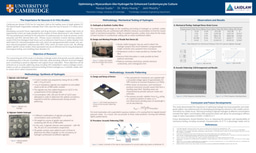
My LiA involved two parts: a technical project building an electrode system and medium to sustain and electrically stimulate cardiomyocytes, and an outreach programme meant to connect that work to patients and the wider community. Due to the intensity and long hours demanded by laboratory work, I had to be pragmatic about how I would divide these six weeks over my objectives. I worked with the Protein Synthesis Group on SDS-PAGE verification of antibody constructs, and with Eric Dubuis on the cardiomyocyte isolation, culture medium, electrical stimulation set-up and patch-clamp recordings. The outreach side involved informal, semi-structured conversations, which I would hope to expand to workshops, patient listening sessions and clinician interviews when exploring this field further
I found that the most useful lessons from my time at the lab weren’t the successful setups, but rather the parts of the mechanism that didn’t work. The stimulated cardiomyocyte culture outlasted the unstimulated control at 24 hours, but by 48 hours both had died. My supervisor Eric and I decided to value it as a real finding to improve current medium formulation. Writing it up as a limitation rather than discarding the finding felt like a more significant piece of judgment than anything about the electrode wiring.
I also learned how much unglamorous groundwork sits underneath a result that looks simple under a microscope. I had to undergo four days of training on safety protocols and risk assessments before I could handle lab equipment. Running SDS-PAGE gels involved many monotonous hours of repeating the same procedure over and over again. The cardiomyocyte stimulation protocol that needed several iterations before it produced data worth interpreting. These routine procedures were a significant portion of my time at Maxion, but are instrumental for producing valuable results.
The interviews I conducted were useful because they helped me ask the question of who this intensive biotechnology research is targeted towards, and how effective the allocation of these costly resources to research are in terms of output. Talking to people outside the lab about what's confusing or inaccessible about arrhythmia and its treatment changed how I think about the technical work. I discovered that a validated, low-cost electrode protocol could be more useful to an under-resourced lab than a proprietary one, and that earlier or cheaper diagnostics are the need of the hour for Cambridgeshire communities.
The leadership aspect of this placement involved managing resources within a structure I didn't control. I was working across two supervisors with different priorities, in an industry environment rather than a university lab, and I had to repeatedly decide what to prioritise when the technical work and the outreach work competed for the same limited time.
Moving from a university lab into an industry biotech setting was also a real adjustment, separate from the science itself. I had to acclimatize to a different pace, different expectations about documentation and safety, less flexibility to let an experiment run long because it was interesting. As an international student, this was also my first time working inside a commercial UK environment rather than an academic one, which added a layer of unfamiliarity on top of the technical learning curve.