LiA Report: Exploring Cardiovascular Bioengineering and Protein-based Antibodies for the Treatment of Heart Rhythm Disorders in Cambridgeshire Communities

This summer, I pursued my Leadership in Action Project via a 6-week placement at Maxion Therapeutics, a clinical-stage biotechnology company based in Sawston, UK. Maxion is revolutionizing treatment for ion-channel and GPCR-driven diseases (chronic pain, autoimmune conditions and cardiovascular diseases) through their novel antibody technology. One of the founders of Maxion, John McCafferty, was the co-inventor of antibody phage display – the technology which won the 2018 Nobel Prize in Chemistry.
The project I undertook with Maxion had a two-pronged approach. The first aspect was to ask how bioengineering can build a bridge between molecular ion-channel therapeutics and the electrically active human tissue they are designed to treat. The second part of this project investigated how the insights from that bridge can, in turn, be made meaningful to the communities most affected by heart rhythm disorders, including communities who currently have the least access to specialist cardiac care.
My LiA served as a direct extension of my Summer One Research Project, in which I worked on optimising a myocardium-like hydrogel for enhanced cardiomyocyte culture. The lab-based side of my LiA project involved working with the Protein Synthesis Group (led by Principal Scientist Gurdeep Singh Minhas) and also with the Tissue Culture Group (under Principal Scientist Eric Dubuis) on protein verification, cardiomyocyte isolation and electrical stimulation. This gave me the scientific grounding I needed to understand the target demographic for this biotechnology, and how it improves the quality of life for patients of heart rhythm disorders.
The Aim and Objectives of the Project
Maxion's cardiovascular programme sits at an early, molecular stage of drug discovery. At that stage of its development, it is natural for their projects to be focused on the scientific robustness of their antibodies and products — whether a current trace accurately mimics the natural action potential of a heart cell, whether a gel band runs at the right molecular weight. However, the intensive lab work and discovery engineering is strongly underpinned with the objective benefitting those most in need of these ion-channel treatments. Arrhythmia diagnosis and treatment are not evenly accessible. They depend on proximity to specialist cardiology services, on health literacy, and on the cost of both diagnostics and long-term therapeutics. The aim of my LiA is to examine the interplay between the technical and patient outreach aspect of biotechnology research.
Methodology
I. Protein Engineering: Supporting Antibody Engineering with the Protein Synthesis Group
Working alongside the Protein Synthesis Group, I learned about the verification of expressed and purified protein constructs using SDS-PAGE. Samples were run alongside Precision Plus Protein™ Dual Colour molecular weight standards, allowing me to annotate the resulting gels against known reference bands and assess the purity and expected molecular weight of each construct. Running and annotating gels for multiple samples side by side (Sample 1 and Sample 2) gave me a direct, hands-on introduction to this important quality-control step. I learned that before a candidate can be tested against a channel or a cell, its identity and purity have to be confirmed.
This work was a useful counterpoint to the cardiomyocyte-facing side of the project. It grounded me in the reality that the 'molecular' end of Maxion's work: an antibody or KnotBody® candidate has to be verified with the same rigour as the 'tissue' end.
II. Designing an Electrically Stimulating Medium for Primary Cardiomyocytes
With Eric, I worked on designing a culture medium and stimulation set-up capable of delivering consistent electrical stimulation to primary cardiomyocytes over extended periods. We found via secondary research that this is a prerequisite for any pacing or stress-induction protocol, since the cells first have to remain healthy and electrically responsive under sustained stimulation before they can be used to model fibrillation-like stress. We imaged cardiomyocyte cultures after 24 hours, and then 48 hours of continuous electrical stimulation to assess morphology, adherence and general culture health, comparing stimulated wells against unstimulated controls.
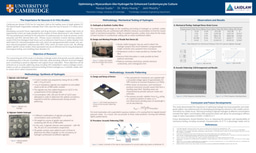
This built directly on my Summer One research, in which I optimised a myocardium-like hydrogel substrate for cardiomyocyte culture. While my previous project focused on the scaffold the cells grow on, this one asked what happens once you start driving those same cells electrically — a natural progression from static culture optimisation into applied cardiac electrophysiology.
III. Electrophysiological Considerations: Action Potentials and Ion Channel Currents
A central part of my technical work involved characterising the electrical behaviour of cardiomyocytes at the single-cell level. We collected action potential (mV) traces alongside the underlying sodium and potassium ion channel currents that shape cardiac depolarisation and repolarisation — the same currents whose dysfunction underlies arrhythmias such as atrial fibrillation, and the same channel families that Maxion's KnotBody® candidates are designed to modulate.
I also gained experience helping Eric run rheobase experiments. We injected increasing current steps into the cells to determine the minimum current threshold required to trigger an action potential, and plotting peak action potential amplitude against current step. This threshold is an important descriptor of cell excitation, and it gave me a reference point against which any future change in excitability due to fibrillation-like stress could eventually be measured.
Alongside this, we also ran the voltage side of the analysis - applying a sequence of voltage steps to isolate inward and outward (positive and negative) membrane currents and to estimate the cell's equilibrium potential.
To ground this in something more concrete than assumption, I conducted a small number of semi-structured interviews with people from Cambridgeshire neighbourhoods (Sawston and Greater Shelford) to try to understand what is confusing, worrying, or simply inaccessible about heart rhythm conditions and their treatment. These were informal conversations which were valuable in surfacing perspectives I would not otherwise have had direct access to as a bench scientist. Recurring themes included a sense that the electrical nature of an arrhythmia is rarely explained in plain terms, and specialist cardiac investigation and follow-up care can feel remote or slow to reach for people outside major urban centres. Additionally, I observed that cost and distance, more than a lack of interest, are often what stand between someone and earlier diagnosis or better-managed treatment.
How This Project Could Benefit Cambridgeshire Communities
These conversations sharpened the link between Maxion’s antibody Discovery Engineering and its impact on local communities:
- Arrhythmias such as atrial fibrillation are more prevalent with delayed diagnoses, in populations with less regular access to primary and specialist care. This means that earlier, cheaper, or more widely deployable diagnostic and treatment tools disproportionately benefit underprivileged communities rather than simply adding convenience for those close to city centres and medical facilities.
- Maxion's KnotBody® antibody platform is designed to be more stable and more precisely targeted than many existing biologics. This translates into simpler dosing, longer shelf life, and potentially lower manufacturing cost at scale, making future ion-channel therapeutics more deployable in lower-resource healthcare settings than current alternatives.
- The electrode-based stimulation system built during this placement uses comparatively low-cost, commercially available components (a bath chamber, platinum electrodes, a standard pulse generator) rather than specialist proprietary hardware. A validated, well-documented protocol built on accessible equipment is easier for under-resourced academic or clinical research groups to replicate than a black-box commercial system. This approach serves sd the first step to potentially lowering the barrier to this kind of cardiac electrophysiology research outside well-funded labs.
- A clearer, channel-level understanding of what drives arrhythmia as a health condition is also something that could, in time, feed into more accessible patient-facing explanations of diagnosis.
Talking to people outside the lab changed how I think about the purpose of the technical work described in the companion report, and gave me a more honest sense of the distance between a working current-clamp protocol and a treatment that actually reaches the people who need it most.
Conclusion
My LiA has left me with a documented electrophysiological baseline, an equivalent-circuit model to guide electrode design, and a verified set of protein samples. Each of these serves as a component of the bridge between ion-channel biology and living cardiac tissue that this project set out to build. Looking ahead, I hope to stay in contact with Maxion and take my invaluable learnings from this internship into biotech industry that I hope to enter.