LIA Weeks 2/3
Costa Rica is renowned for being one of the most stable democracies in not only Latin America, but globally. Costa Rica abolished its army and invested the funds it would've spent otherwise in healthcare and education. Costa Rica was the first Central American country to recognise and perform same-sex marriages. As of the 2026 elections, Costa Rica has more women diputados in its national assembly than men. Yet the Latin American culture of 'machismo' is still evident. It has been fascinating to watch how gender stereotypes are reinforced from the littlest children I worked with (as young as 18 months) to my lovely abuelita that I live with in San José (who is nearly 80, but still cooks, cares and cleans for her family from 5am every day, as she has done she was married at 19). One of her children turned 50 last week, the other is 48; both still live with her.
Of course, this also demonstrates a very striking element of Costa Rica - the emphasis on family, culture and being tico. People are very proud to be from Costa Rica. I had the privilege to experience this firsthand as I am living here during the 'month of independence', watching the parades of Independence Day (15/09) and seeing the faroles the night before. But their pride for their country is evident, through the little flags that adorn every Uber, to the traditional dress of the children, to the constant celebration of identity. Part of being tico is this pride in country, culture and family.
It has been very interesting to compare Ireland and Costa Rica as I spend time here. On the surface, they are so different. The language is one thing, but the wildlife, the food (incessant amounts of rice and beans), the weather all seem to be an abrupt change from what I am used to. Yet, I find that this is not entirely the case. Yes, the food in Ireland I eat is somewhat more diverse than rice and beans for every meal. Yes, Ireland lacks any dangerous wildlife (there are a lot of things here that could feasibly kill me, not least crocodiles). Yes, in Ireland we speak a different language.
But the culture feels weirdly familiar. It is in a different language, but retains the familiarity of an old lady stopping you on the street. One may be saying, "awk how are you wee pet?" and the other saying "con gusto mi amor!", but the sentiment remains the same. Also, despite Ireland lacking dangerous wildlife (which suits me better), Ireland is so GREEN! And so is Costa Rica! Where I think Ireland could improve is in terms of its appreciation of what we have. Any time I speak to people here, they are constantly proud to boast of their country's beautiful rainforests, luscious beaches and incredible wildlife. Irish people tend to be glass-half-empty kind of people. We have beautiful forests, unspoiled coasts and immense history, yet if you talk to an Uber driver in Ireland, they are much more likely to ask you why on earth you would come to Ireland on a holiday! Costa Ricans are outraged by the destruction of their beautiful country and care deeply about the environment that they have been blessed to live in. I do not find that same passion at home. I intend to bring it back, hopefully! We are so lucky.
I spent week two volunteering with the children of Fundación La Cabaña Feliz. It isn't what I came here to do - as I came to San José with the intention of working with and for women here. Yet I learnt so much from spending the first two weeks with the children, that I have no regrets (they are also very cute). I watched how gender stereotypes form from the earliest ages. I loved parading with the children in their traditional dress for the Independence Day. I learnt from the women who cared for these children with limited resources but with so much care. The children are provided with a free breakfast and lunch every day. It is not seen as a privilege, but rather a right. All children in Costa Rica are entitled to a free breakfast and lunch, regardless of their family's socio-economic background. Oddly, I find myself coming back to food a lot while I've been here (classic). It is such an important part of the Costa Rican culture, with breakfast being considered the most important meal of the day. They take immense pride in all of the food being fresh, using local ingredients and many fruits and vegetables that I have never even heard of before coming here. They do not believe in leftovers.
In between week two and week three, I travelled to Tortuguero, a remote island only accessible by boat (which felt really quite dodgy in the crocodile-infested waters). Tortuguero is a community of around 1000 people. There were no cars. The only mode of transport is by bike or scooter. With little else to do here, the main attraction is seeing the turtles nest in the beach or kayaking through the amazing canals. For the turtle-watching, we had to wear dark clothes, phones were banned (because white light disturbs the turtles, and the tourist authority don't wish to turn the turtles' essential processes into an influencer event), and set off in the pitch black to the beach. As we promenaded through the jungle to the beach, we spotted sloths, poisonous spiders and stray dogs (which seem to be everywhere in Costa Rica). As we waited for the turtles to begin nesting, we watched as the most immense lightning struck the sea with shades of electrifying violet. It was so mesmerising. I felt myself wishing to be able to photograph it. But what would it have been for? An aesthetic instagram story so I could get another few likes and impress people with my very exciting travels? I realised that I wasn't focused on the amazing natural processes I was witnessing, but rather thinking of social media. Not being allowed on my phone was a great idea. Instead of watching the turtles squeeze out eggs via the artificial light of my phone, I was immersed in the process, knelt down in the sand with only a touch of red light to see. It was very special.
I moved projects in week three to Fundación Mujer, which works to increase employment opportunities and encourage entrepreneurship amongst the Costa Rican people, but particularly women. This made a significant change from the giggling, crying, screaming children of La Cabaña Feliz. Now I have an office filled with women, hugging me and greeting me as I come in each day. They showed me the best place to get lunch, and I have gone there every day since. Of course, it is more rice and beans, and a different glass of freshly-squeezed juice every day (including cas, passion fruit and pineapple). It is fun to sit in this little soda in the middle of a suburb of San José. The women who work in the soda are pillars of the community, serving the nearby police station, trusting me when I forgot cash to pay them (twice), and always calling me 'mi amor'. I always get stared at here, as a very obvious 'gringa'. People will (unprompted) feel and admire my curly light hair. Coming back to the 'machismo' point, I have experienced more men catcalling me in Costa Rica than my whole life in the UK and Ireland! It is a different culture, but takes some getting used to. Most of the staring comes from a place of interest - there simply are not many people here who look like me (which is hardly unexpected)!
During week three, I worked on searching for funds that Fundación Mujer could apply to. I used their mission and goals to search for similar funding opportunities, and created a master document which outlined all the key information (deadline, themes, etc). Now, I am working on a master document that they can use to apply to as many of these funds as possible. It will contain all the key information about Fundación Mujer, that they can repurpose for many applications (avoiding duplication of resources). I created these in Spanish and English, as none of the ladies who work there can speak English to a sufficient level that they could submit a competitive funding application. My Spanish is being constantly tested and assessed, but it is a challenge that is improving my skills day by day (even if I am still certainly not anywhere near perfect).
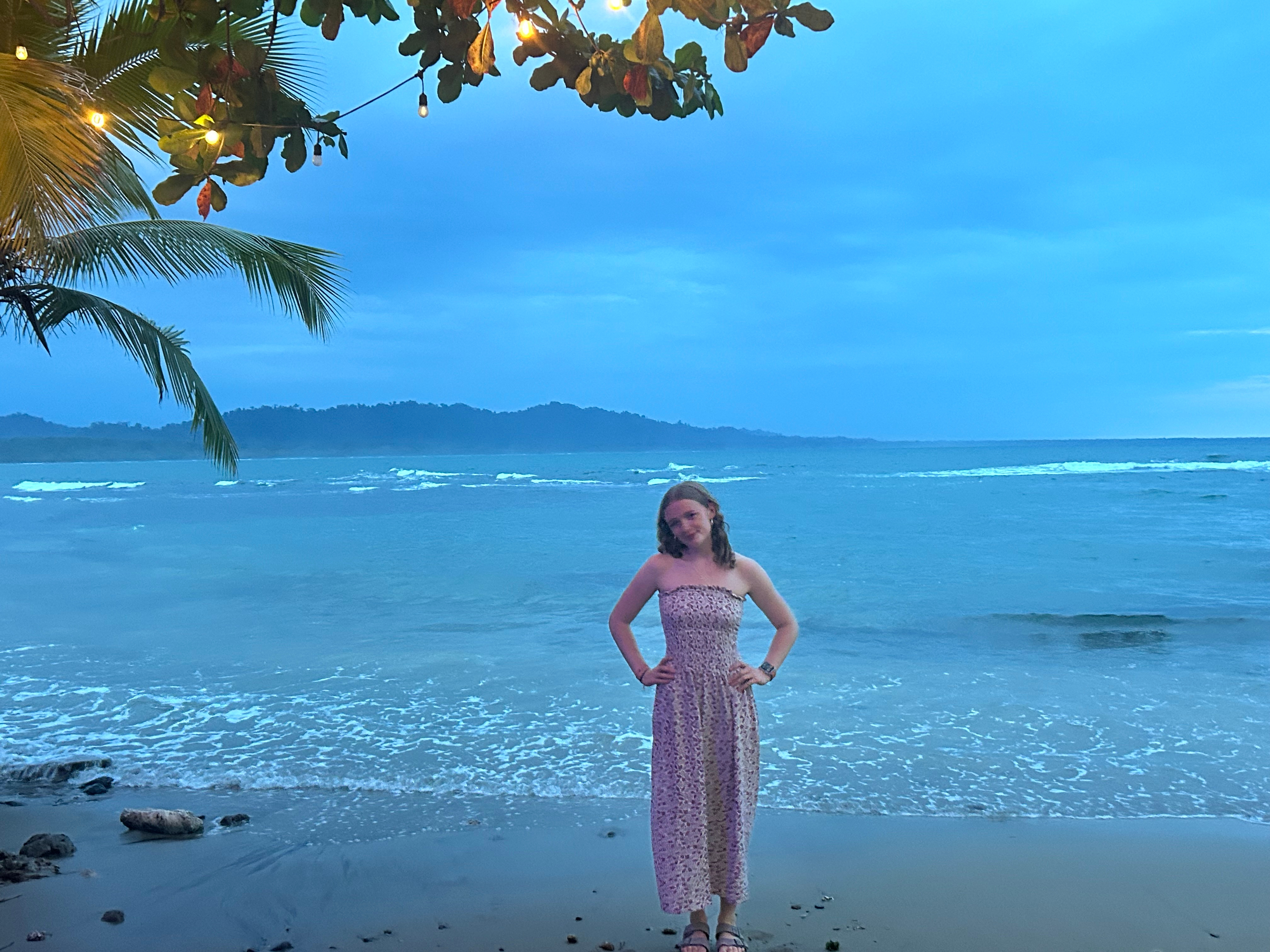
In between week three and week four, I visited the idyllic Caribbean town of Puerto Viejo. It is definitely my favourite place that I have visited so far - the beaches are stunning, the sea is gorgeous, the culture is amazing. We spotted monkeys in the National Park, a sign for an armadillo crossing, and many lizards! I also tried my hand at surfing, which I was terrible at. As we watched the sun set on the beautiful sea, with a few Imperials to accompany us, I couldn't have been more grateful for this amazing experience.
I am looking forward to seeing what my final two weeks have in store!