LiA Week 2

Like

Share this post

Choose a social network to share with, or copy the URL to share elsewhere

This is a representation of how your post may appear on social media. The actual post will vary between social networks

This week was spent refining my research design. I've tried to visit as many University of Toronto libraries as possible to do my work and its been nice – they are wonderfully air-conned and most importantly, empty!

I've also been drafting my interview questions and getting feedback from my supervisor and the other interns. It's hard to balance the pressure of knowing that once I have the questions locked, I can't change them. Part of me is scared that they won't be optimal and the damage will be irreversible. However, I know that I just have to commit and that I will have to learn from my mistakes if they don't yield the results that I want them to.

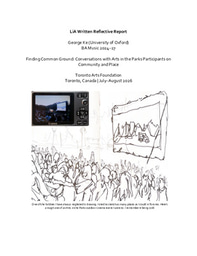
This Sunday, I also attended my first AITP event - Samba in the Park! It was a lovely experience. I was there trying to recruit interviewees but I found myself talking to lots of people about the community and their lives. It was also the furthest I've been away from the core of downtown and it's nice to see a new side of Toronto that isn't just big glass skyscrapers. I was extremely intimidated trying to get people to sign up. But, I was able to refine what I said with each new approach based on what had been received positively before, and adapt to the things that would hold the most attention. 

Outside of work, I went to the Royal Ontario Museum. A lot of dead dinosaurs.
Please sign in

If you are a registered user on Laidlaw Scholars Network, please sign in

Go to the profile of Benjamin Margetts
25 days ago

George,

This captures very well the transition from designing research in principle to conducting it with real people. Approaching strangers can feel extremely intimidating, so successfully recruiting participants — and becoming more confident with each conversation — is meaningful progress. Your ability to notice what was and was not connecting with people and adapt your explanation accordingly is a good example of learning through action.

I would gently challenge the idea that, once 'locked', interview questions can never change. You should retain consistency around the core topics and follow the agreed ethical process, but semi-structured interviewing usually allows questions to be clarified, reordered and supplemented with responsive probes. If early interviews reveal that a question is confusing or failing to address the research question, discuss this with your supervisor rather than feeling obliged to reproduce a flaw throughout the study.

Similarly, the objective is not quite to produce the results you want, but to ask questions that enable participants to express their experiences — including findings that challenge your expectations or the organisation’s assumptions. An unexpected answer is not necessarily evidence that the question failed; it may be where the most valuable learning begins.

It is encouraging that recruitment quickly became conversation about people’s lives and communities. As you move beyond downtown Toronto, these encounters should enrich your understanding of what place and belonging mean in different parts of the city. Just remain clear about when you are having an informal conversation and when someone has consented to contribute research data.

A thoughtful and honest Week 2 reflection. Research rarely involves finding the perfect question in advance; it requires careful preparation, ethical consistency and enough humility to learn when reality answers a different question from the one we expected.

P.S. A concise but apparently accurate review of the Royal Ontario Museum. 🦖