Seoul is beautiful this time of year–alternating between the persistent factory smog blowing in from the west (coming down in the form of brown rain) and the occasional sunny, cherry blossom-filled mornings. After wrapping up my most recent clerkship at a law office in San Francisco, I landed in Seoul at 4:39 a.m. on Monday.
The next day, I began my journey at the War and Women’s Human Rights Museum by going through the tour myself, a self-guided tour that lasts around 45 minutes to an hour depending on how long you take to read. The museum is divided into three segments, summarized on the website as following: Chapter 1. In the Past, Those Heavy Times, Chapter 2: Where the Past Meets the Present, and Chapter 3. Empowering the present, advancing toward the future. The introduction is a gravel path filled with the sounds of marching military boots, making tangible the terror that the kidnapped girls felt. I remember being most impacted by the second floor, where primary documents show the incredibly organized and meticulous trafficking and sexual slavery system. Soldiers paid different “prices” by their ranking, and women were routinely subjected to invasive medical examinations to check for sexually transmitted diseases–not to protect them, but to protect the abhorrent soldiers assaulting them.
My first week was an incredibly busy week at the museum, filled with several tabling events, the beginning of the mural exhibition (which will become my main task), and a special Wednesday Demonstration. I met the activists and workers at the museum, proposed a self-started task to begin translating the reviews of English-speaking education sessions for the website, and translated where necessary. The bulk of our project starts next week, when the mural project begins in earnest.
The Museum, as a branch of the Korean Council for Justice and Remembrance for the Issues of Military Sexual Slavery by Japan, participates in organizing the weekly Wednesday Demonstrations, which have been ongoing in front of the former location of the Japanese embassy since 1992. Coincidentally, my second day on the job was the day where the barricade around the Statue of Peace (소녀상, or “sonyeosang”) was removed for the first time in six years. Threats from history denialist groups and several instances of vandalism had caused the barricade to be erected. As volunteers, we cleaned the statue, removing years of dirt and vegetation in her respect. I didn’t expect the volume of journalists that would be present, however, and I inadvertently ended up photographed on the front page of several newspapers that day.
There are no words to describe how meaningful the action of cleaning the Statue was to me. I never thought I would even get to see her unbarricaded, let alone be a part of the team to clean her. Despite the mass of reporters surrounding us, my head was blank, only filled with deep emotion about this one action. The grime, packed in for so many years, was difficult to remove.
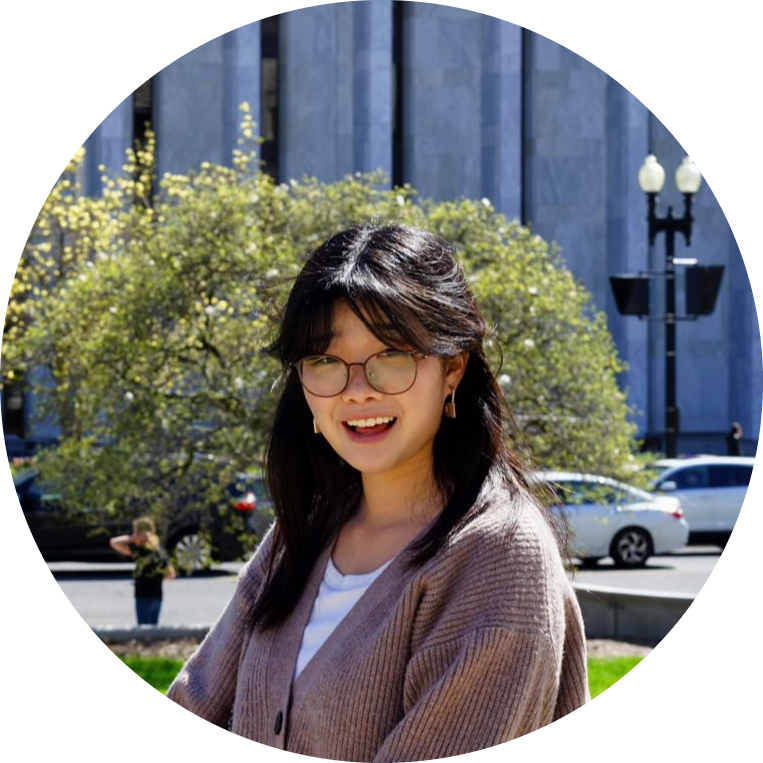
Hi! My name is Annabelle Kim and I'm a rising senior at Georgetown University. I am majoring in Public Policy and Economics. I'm from the San Francisco Bay Area–Pleasanton, CA to be specific. Throughout my studies and my career, I hope to contribute to improving educational equity in the U.S. K-12 system, with a special focus on marginalized students within high-performing districts.
I am currently completing my LiA project at the War and Women's Human Rights Museum in Seoul, Korea.
In summer 2024, I researched within-district disparities between continuation high schools and comprehensive high schools in California. Continuation schools (alternative high schools for students at risk of not graduating) have higher per-pupil funding than their traditional brick-and-mortar counterparts. Despite this, facilities and services provided to these students often fall far behind--I hope to clarify why that might be. My research builds on my experience researching school funding decisions nationwide with a faculty member of Georgetown's McCourt School of Public Policy.
A fun fact about me is that I've technically flown a plane before I got my driver's license...and that even now I'd far prefer flying a plane to driving on a California freeway.
Please sign in
If you are a registered user on Laidlaw Scholars Network, please sign in