Week 5 Reflection – Leadership-in-Action
1. What Went Well?
This week was one of the most meaningful stages of my project so far, as I had the opportunity to engage directly with the Family Insight Group (FIG)—a small group of parents who have graduated from Family Group and continue to support The School & Family Works through reflection and feedback.
We met in Kew Gardens, London’s Royal Botanic Garden, beginning in a lesser-known community space within the gardens where individuals dealing with addiction, trauma, or depression are able to garden freely as part of a therapeutic initiative. The setting itself was striking: a quiet, restorative environment that contrasted with the intensity of the experiences being discussed. After gathering there, we walked through the gardens—past cherry blossoms and tulip fields—while continuing our conversation. This format created a space that felt open, reflective, and grounded, which shaped the tone of the discussion in a very positive way.
My goal for the session was to test elements of the long-term impact framework with participants themselves. I explained the intentions of the project—particularly the aim of understanding the lasting effects of Family Group in a way that is both ethical and meaningful—and asked a series of questions around:
- what they perceived as the most important long-term impacts of Family Group
- whether and how they would engage with a future follow-up study
- how the proposed research design felt from their perspective
- and how any future work might connect to the data collected during their time in the programme
The discussion was extremely valuable in grounding the framework in lived experience.
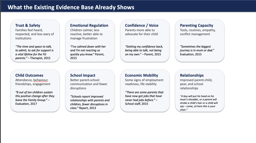
A consistent theme that emerged was that the most lasting impact of Family Group was not simply on children’s behaviour, but on parents’ capacity and confidence in their role. Many parents described how the programme gave them a language, as well as practical tools and strategies, to better understand and support their children. This was particularly important for families facing complex challenges—whether raising children with disabilities, navigating single parenthood, or dealing with social isolation.
Several parents reflected on how, prior to Family Group, their children had been withdrawn, isolated, or physically reactive, and how the programme helped them respond in ways that were more constructive and relational. Importantly, they contrasted this experience with other parenting programmes they had encountered, which they described as overly prescriptive and disconnected from their lived realities. In contrast, Family Group was seen as personalized, empowering, and grounded in real-life interaction, rather than abstract instruction.
Another key theme was the importance of community. Parents spoke about the value of being in a group with others who understood their circumstances, without requiring constant explanation or justification. This shared space created a network of support that extended beyond the formal sessions, and contributed to a sense of belonging that many felt had been lacking previously.
In addition to these insights on impact, the group provided highly practical feedback on the design of a potential longitudinal study.
One of the most interesting points raised was the role of anonymity. Several parents noted that while in-person or phone-based conversations might produce more detailed responses, they could also create a subtle pressure to present positive outcomes. An anonymous survey, by contrast, might allow for greater honesty, even if responses are less personalised. This highlighted an important trade-off between depth and candour.
As a result, they suggested that participants should be given multiple options for how to engage, including:
- in-person conversations
- phone interviews
- and anonymous online surveys
They also proposed a hybrid approach—for example, allowing participants who engage in conversation to later add additional reflections anonymously online. This kind of flexibility could make participation feel more comfortable and accessible.
Another important insight was that who initiates contact matters significantly. While there was agreement that it should not come directly from a therapist, parents emphasised that hearing from someone within SFW—someone they recognise or trust—would make them far more likely to respond. This reinforced the importance of balancing professional boundaries with relational continuity.
What I am most proud of this week is that I was able to move beyond designing the framework in abstraction and instead test it directly with the people it is ultimately meant to serve. Their input has already begun to shape the framework in meaningful ways, particularly in terms of participation design, question framing, and ethical considerations.
2. What Could Have Been Done Differently?
This week also highlighted areas where I could improve my approach.
While the discussion with FIG was highly productive, I realised that I could have been more structured in how I captured and organised their feedback in real time. Given the richness of the conversation, it was sometimes difficult to fully document specific phrasing or distinguish between individual perspectives and broader themes. In future, I would prepare a more systematic way of recording responses, particularly for sessions where participant input is central to the project.
I also recognised that I could have done more to explicitly test specific elements of the framework, rather than focusing primarily on open-ended discussion. While the open format encouraged valuable insights, incorporating a more structured comparison—for example, presenting alternative question formats or participation models—might have yielded even more targeted feedback.
Finally, I became aware of the importance of managing the balance between listening and guiding the conversation. While it was important to allow parents to speak freely, there were moments where more deliberate facilitation could have helped ensure that all key aspects of the framework were fully explored.
3. Leadership Reflection (3Cs Model)
Values
This week, the values of Curiosity and Good were particularly evident in my approach. Curiosity guided my engagement with parents’ experiences, while the value of Good shaped my focus on ensuring that the framework is genuinely beneficial and respectful to participants.
There was also a growing emphasis on Respect, particularly in recognising the expertise that participants bring through lived experience. Treating their input as central to the project—not supplementary—was an important shift.
Character
This week required attentiveness and humility. Engaging with participants who have navigated complex personal challenges required sensitivity, as well as an awareness of my own role within the conversation.
Judgment was important in deciding when to probe further and when to allow space, ensuring that the discussion remained comfortable and participant-led.
Capacities
The key capacity I developed this week was facilitation—creating an environment where participants felt comfortable sharing their perspectives, while also guiding the conversation toward relevant insights.
I also strengthened my ability to translate participant feedback into design implications, connecting what was said in the moment to how the framework should evolve.
4. Ethical Engagement
This week reinforced the importance of co-design in ethical engagement.
Rather than making assumptions about what participants would be comfortable with, the session with FIG allowed those decisions to be informed directly by their perspectives. The discussion around anonymity, for example, highlighted that ethical design is not just about minimising risk, but about creating conditions for honest and meaningful participation.
I also became more aware of the importance of trust. While formal safeguards such as consent processes are essential, trust is ultimately relational. The feedback that participants would be more likely to respond if contacted by someone familiar within SFW underscored this point.
Finally, this week highlighted that ethical engagement involves recognising participants not only as subjects of research, but as partners in shaping it.
5. Adjustment & Development for Next Week
Next week, I will focus on integrating the insights from FIG into the longitudinal framework.
Specifically, I plan to:
- incorporate flexible participation options into the design
- refine question formats based on participant feedback
- and further develop the balance between anonymity and relational engagement
In terms of personal development, I want to continue improving my ability to translate qualitative insights into structured design decisions.
A concrete action I will take is to update the framework document with a dedicated section on participant-informed design, drawing directly on the feedback from FIG.

Hello! I’m Jiyon, a third-year student at Georgetown University from New York City. I am studying at the University of Oxford for the 2025-26 school year. I’m majoring in Economics and minoring in Mathematics, with my academic interests lying in public economics, governance, climate policy, and labor economics. In my first summer as a Laidlaw Scholar, I assisted a research project in Georgetown’s McCourt School of Public Policy on identifying causes of heterogeneity in U.S. state tax systems and associating variations in tax progressivity with different infant health outcomes. Separately, I have looked at how different types of public spending across U.S. states can improve social capital for the elderly. I am passionate about finding public policy solutions that improve quality of life, promote effective governance, and create durable socioeconomic institutions. In my second year of the scholarship, I am completing my Leadership-in-Action placement with The School and Family Works in London, where I am seeing firsthand the effect that multi-family therapy sessions in schools can have on student engagement, parental relations, and future outcomes.